The supplicants trickled in slowly, gradually filling the rows of the dimly lit auditorium in Foggy Bottom. It was 13 days before the midterm elections, and this group had come to hear from Washington’s favorite political oracle.
Onstage at the front of the room sat their high priest, Amy Walter, flanked by her team of deputies from the Cook Political Report. The experts had come with the goods: new polls, color-coded charts, fresh analyses of Democrats’ likely gains in the House (big) and Republicans’ chances of holding the Senate (dicey). The audience, made up of the report’s loyal subscribers and a handful of journalists, eagerly absorbed the pronouncements, scribbling notes in their Cook-branded notebooks.
For 42 years, the report has been serving up insights to anxious political obsessives and information-starved politicos in the months before voters head to the polls. The company offers a range of election-related analyses, but its marquee product remains its proprietary race ratings, a seven-point system for ranking upcoming elections based on their likely outcome.
Come late October, Cook’s ratings — which sort races into “Solid,” “Likely,” “Lean” or “Toss Up” categories — assume a mystical, even quasi-prophetic status in Washington. “When I worked in an outside organization, I thought that the people at the Cook Political Report would ascend the mountain and get the tablets from on high,” said Carrie Dann, the report’s managing editor, who joined in 2025 after 18 years covering politics for NBC News. Even minor changes to the ratings — a shift in a competitive Senate race from “Likely Republican” to “Lean Republican,” for instance — are treated as major political events, prompting cable news segments and flurries of social media posts and headlines in major media outlets (yes, including The Washington Post).
That buzz is a reflection of Cook’s unusual role in the political mediasphere: The report is one of the last bastions of nonpartisan election wonkery that nearly everybody in Washington trusts.
“It’s a testament to the fact that when we make a change,” said Dann, “we don’t do it lightly.”
The report was founded in 1984 by then-30-year-old Charlie Cook, an aspiring analyst who caught the political bug while working odd jobs on campaigns and at polling firms. In its early days, the report was primarily geared toward lobbyists and PACs, which paid $150 a year to get their hands on a hard-copy booklet packed with black-and-white charts and tables. Its publication schedule was more of an art than a science, a quirk that inadvertently burnished its oracular reputation. “Deadlines were fairly alien to me,” said Cook, 72, who still writes a weekly column published by the report.
By the early 2000s, the report had begun to migrate online, where it found a broader audience among journalists and political enthusiasts. In 2021 Cook sold the report to Walter — who had come aboard as House editor in 1997 and returned in 2013 after stints at National Journal and ABC News — and her wife, Kathryn Hamm, who is now its chief operating officer.
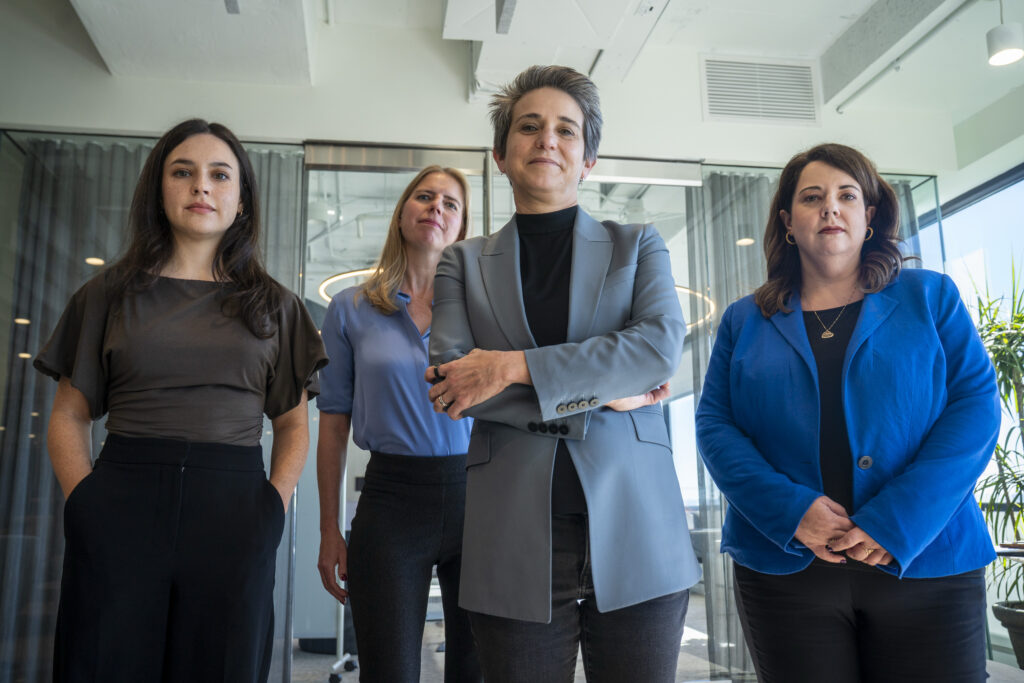
Today, Walter, a fast-talking 57-year-old with a gravity-defying cowlick of salt-and-pepper hair, runs the report from the ninth floor of a concrete office building in Arlington, Virginia. Old editions of the Almanac of American Politics serve as decor. The report’s team is deceptively small — only nine full-time employees — and, with the exception of elections analyst and redistricting guru Dave Wasserman, all female. For many of its members, working at Cook is the professional equivalent of making it to the major leagues. “When I turned 13, I asked my parents for a subscription to the Cook Political Report,” Wasserman said. To his disappointment, they came back with a less-expensive subscription to Roll Call.
Walter, who just marked her 35th year in Washington, remains an unapologetic insider. On top of her work at the report, she serves as a contributor to “PBS News Hour” and is a ubiquitous talking head on CNN and NBC; when she’s not on TV, she travels around the country preaching the gospel of Cook’s analyses to audiences at businesses and universities. The thicket of sources and relationships she’s cultivated along the way, she says, is part of what gives the report its enduring authority.
“We are hanging out with — and being seen as credible by — the different generations of political operatives and campaign staff and people in the states,” Walter said from the green room of the auditorium after the briefing. “Even as politics has become more vitriolic, they’re like, ‘But yeah, I can trust you, because I’ve been talking to you for 15 years.’”
In nonelection years, Walter’s team devotes some of its time to building out its suite of data tools, including the Cook Partisan Voting Index, which measures how each state and district leans at the presidential level compared with the nation as a whole. Around election season, though, the team’s focus shifts almost exclusively to maintaining the race ratings, which are published for free in a bare-bones chart on the report’s website. (Hardcore junkies can fork over $350 per year or $35 a month for access to a slew of weekly newsletters, briefings and paywalled data; like many D.C. publications, The Post pays for subscriptions and relies on that data for reporting.)
Servicing the race ratings is decidedly unsexy work. The rankings are informed by a constantly changing torrent of data gathered from Cook’s nationwide network of sources, which means the editors spend most of their days glued to their phones and laptops trying to dig up new information — fundraising figures, outside spending numbers, internal and external polling, relevant bits of campaign gossip, and pertinent intel. At this point in the cycle, Erin Covey, who oversees the House ratings, spends approximately 30 minutes every day watching new campaign ads.
Once an editor thinks they have sufficient evidence to support a change to a rating, they bring their case to the rest of the team to discuss. A race may move several times throughout a single cycle, but the goal is to make a move only when the team is absolutely confident that there’s been a shift in the underlying political dynamics.
“If we were changing them more often, or changing them back and forth, they wouldn’t have the gravitas they have when you do make the moves,” said Dann.
The process is slow and deliberate, much slower than the minute-by-minute updates provided by election models or prediction markets. The relatively leisurely pace of Cook’s race ratings has of late become the subject of some intra-analyst controversy. In September, election modeler Nate Silver took a shot at Cook in a blog post, accusing the forecasters of waiting too long to shift competitive races in Democrats’ direction.
Wasserman, who used to write for Silver’s FiveThirtyEight site, waved off Silver’s criticism, chalking it up to the difference between the modelers’ data-heavy approach and the forecasters’ more qualitative touch. “I don’t think one approach is more right or wrong than the other,” Wasserman said. “So I don’t really see a need to debate him.”
The headline-making power of a rating change creates other occupational hazards for the Cook team. When a campaign catches wind of an imminent shift, the editors gird themselves for a flurry of anxious phone calls. “They make their feelings known very vehemently,” said Dann. On cue, Jessica Taylor, the editor overseeing Senate and gubernatorial ratings, stepped into another room to make a call informing a campaign operative of a pending downgrade in their candidate’s rating.
How’d it go?
“It is what it is,” she said, shrugging. “They have a job to do, and we have a job to do.”
Campaigns’ grievances aren’t always intuitive. Sometimes, Covey said, a candidate in a competitive district is angrier about an upgrade to their race rating than about a downgrade, since a high-profile boost to their chances risks choking off much-needed fundraising cash and media attention. Covey said she’s even had campaigns try to hide positive poll numbers from her to forestall a rating upgrade. “They all want to be a ‘Toss Up’ at the end of the day,” she said.
The report’s process is proudly old-fashioned, but it has proved surprisingly nimble at adapting to a shifting competitive and technological landscape. In response to the rise of data-heavy election modeling in the late 2000s and early 2010s, the editors incorporated more hard data into their analyses, largely under the guidance of Wasserman, the report’s in-house quant.
With the advent of social media, the team discovered that it could inject its rating changes directly into the political bloodstream without waiting on traditional media outlets to do it for them. The embrace of social media was also led by Wasserman, who had built his own loyal following online by live-tweeting race calls on election night with his signature tagline “I’ve seen enough.” (Wasserman has since retired the tagline after trading up on his social media clout to become a consultant on NBC News’s Decision Desk.)
Now with the rise of online prediction and betting markets, Wasserman said, Cook is riding a “spike in interest from prediction market bros” who use the ratings to get a competitive edge on their bets. Which isn’t to say that the Cook team holds those markets in particularly high intellectual esteem. “I don’t care about some 19-year-old guy sitting in his parents’ basement in his boxer shorts betting 10 bucks on Kalshi,” said Cook. “I want expertise.”
Nor does the Cook team seem particularly worried about the arrival of artificial intelligence, which is already bringing its supposedly godlike omniscience to bear on predicting election outcomes. “Even in the Moneyball era, they didn’t get rid of scouts,” Walter said. “Our market is people who really want to have a deeper understanding about what our politics is.”
The ultimate reason that Washington keeps coming to pray at the altar of Cook may be that, more often than not, its forecasts turn out to be right. An internal review of the 10,374 races that the report ranked between 1984 and 2024 found that 97 percent of its “Likely” ratings and 94 percent of its “Lean” ratings were ultimately correct, while its “Solid” ratings were on the money nearly 100 percent of the time. As would be expected, “Toss up” ratings were more or less evenly split between parties, with a slight edge for Republicans.
Still, every member of the team could name a flubbed race rating that keeps them up at night. “I put South Carolina Senate as a ‘Toss up’ [in 2020], and it ended up being a 10-point race,” said Taylor, with a haunted look in her eye. “I still get that one thrown back in my face.”
At the very least, Wasserman said, the occasional mistakes serve to heighten the drama. “If we were always right,” he said, “then none of this would be interesting.”
The post What is the Cook Political Report, and why is Washington so obsessed with it? appeared first on Washington Post.