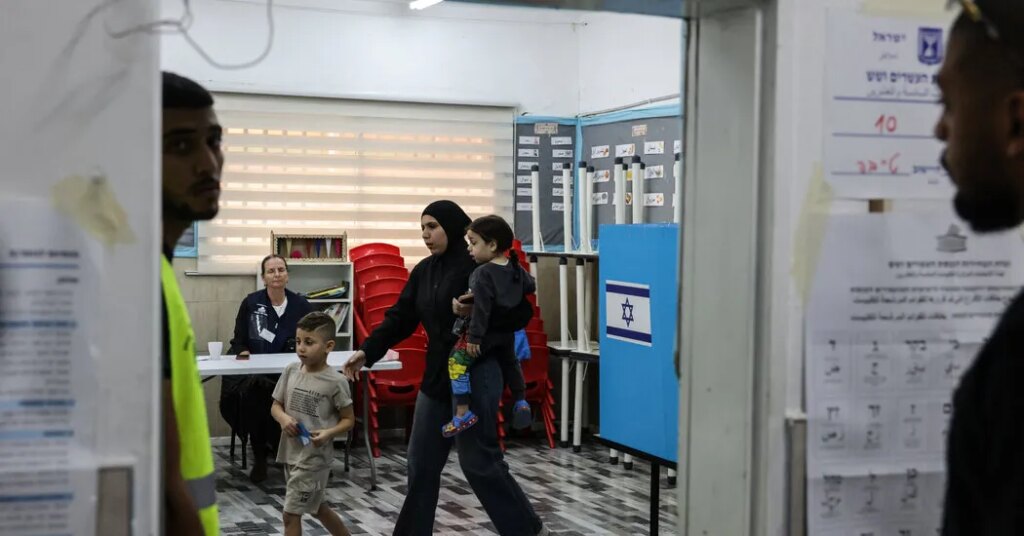
For decades, Israel’s Arab parties have been relegated to the margins of Israeli political life, often sitting on the sidelines while Jewish parties assembled a governing coalition in Parliament and picked a prime minister.
Heading into Israel’s pivotal election on Tuesday, Prime Minister Benjamin Netanyahu warned his supporters that the Arabs were “trying to steal the election,” though electoral officials said there were no reports of widespread irregularities. He repeatedly invoked the specter of Arab voters to galvanize his right-wing base, vowing to keep them out of power.
Mr. Netanyahu’s leading rival, Gadi Eisenkot, largely declined to answer whether he would partner with Arab parties if necessary to topple the Netanyahu government, though he said none met his conditions as potential allies.
But record turnout on Tuesday by supporters of the Arab parties looks to deliver them their largest vote totals in generations, possibly since Israel’s establishment 78 years ago.
Now, the Arab minority represents a political reality that cannot be ignored.
Turnout in the Arab community, which represents about 20 percent of Israeli citizens, appears to have translated into a stunning windfall of parliamentary seats — potentially as many as 19 combined between the two leading parties, Raam and the Joint List alliance. The Arab parties have 10 seats in the outgoing Parliament.
Israel’s future could turn in part on whether Mr. Eisenkot decides to take the political risks of partnering with them. Without their support, Mr. Eisenkot and his alliance will almost certainly fall short of the 61-seat majority required in the 120-seat Parliament to form a new government and end Mr. Netanyahu’s hold on power. Mr. Netanyahu’s alliance also looks to fall short of 61 seats.
Many Israeli Jews have long objected to building a governing coalition that relies on Arab party backing for a majority. Some say a Jewish state should be ruled exclusively by Jews. Some cite national security reasons, questioning whether Arab leaders who see themselves as part of the wider Palestinian people can be entrusted with crucial matters of state.
Those objections became even more acute after the Hamas-led Oct. 7, 2023, attacks on Israel and the subsequent rightward shift in Israeli politics. Both Raam and some members of the Joint List condemned the assault, although they have also been highly critical of how Israel has conducted its war against Hamas in Gaza.
The Arab parties for many years were themselves reluctant to join governments that oversaw the Israeli occupation of the West Bank and Gaza. And turnout among Arab Israelis has traditionally been lower than Jewish turnout, reflecting doubts about their ability to influence national decision-making.
Raam, a socially conservative party with roots in Islamist politics, has achieved some acceptance in Israel’s mainstream. But the Joint List, an alliance of three smaller parties, contains a mix of leftists and Palestinian nationalists and is seen as more antagonistic toward Zionism. Initial election results show that the Joint List will be the significantly larger of the two in Parliament.
“Netanyahu knows that without the Arab parties, there’s no majority to unseat him. That’s why he incites against us,” said Yousef Jabareen, the leader of the Joint List alliance in an interview. “The opposition should reject that incitement.”
He added: “The ball is now in Eisenkot’s court. Whoever wants to remove Netanyahu and change his policies — we are ready to cooperate to topple his government.”
Political analysts say the Joint List would be more likely to support Eisenkot from outside the governing coalition, for instance by agreeing to block any no-confidence votes. There is some precedent for this: In the 1990s, then Prime Minister Yitzhak Rabin relied on Arab lawmakers to prevent the collapse of his own minority government.
Arab citizens, some of whom view themselves as both Israeli and Palestinian, experience a tension that can cut to the heart of daily life. Unlike Palestinians in the West Bank — who live under Israeli military rule — Arab Israelis can vote, and some have held high office, including on the country’s Supreme Court.
But they largely live in separate cities and towns from Jewish Israelis and retain tight familial and historical bonds with Palestinians in the West Bank and Gaza. Many view themselves as second-class citizens in the Jewish state, saying they face discrimination in housing as well as neglect in receiving public services.
Before this year, the largest electoral success recorded by Arab parties was in 2020, when they secured 15 seats. And the first — and so far, only — time an independent Arab party joined the Israeli governing coalition was in 2021, when Mansour Abbas, the leader of Raam, joined Mr. Netanyahu’s rivals to unseat him in favor of a short-lived government.
Mr. Abbas has since worked to make his party more acceptable to Israeli Jews. He has recognized Israel’s Jewish character as a fact of life and publicly considered integrating Arabs into the country’s mandatory national service, in particular community service.
In a bold move during the election campaign, he named Jewish lawmaker Yoav Segalovitz — a former senior police officer and centrist Zionist — as the number two on the Raam candidate list.
But if exit polls and initial results are correct, Raam’s support would not be enough to give Mr. Eisenkot’s bloc a parliamentary majority. He would also have to rely on the Joint List to topple Mr. Netanyahu. While political analysts say that Mr. Eisenkot might be willing to bring Raam onboard, he would struggle to keep his bloc with him if he made common cause with the Joint List, even if he wanted to, because this could provoke too much political blowback from many Jewish voters.
“There’s a shift in Arab politics, an attempt to get closer to the Jewish Zionist mainstream. It’s just that the other side is not willing to do so,” said Thair Abu Rass, an expert on Israel’s Arab politics. “There’s no partner on the Jewish side to create an alternative reality.”
The post Surprise Showing by Arab Parties in Israeli Vote Puts Them in Spotlight appeared first on New York Times.