In the north of Italy, students carried posters with slogans like “fewer profits, more salaries.” In the south, truckers blockaded freeway exits and strung banners across their cabs, proclaiming, “You’re blockading my future! I’ll block your present.”
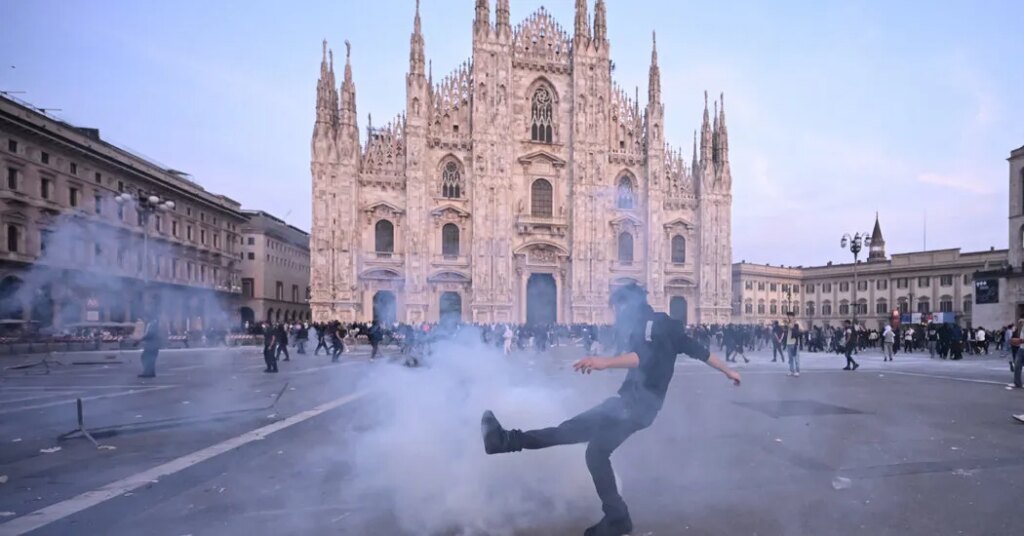
As unrest in France has at times led to arson, looting and other violence, demonstrators across neighboring Italy have also taken to the streets in recent weeks — mostly peacefully — to protest the rising cost of food, rent and fuel.
The demonstrations in France have partly inspired those in Italy, both protesters and political analysts said. But the public outcry in Italy also reflects a buildup over months and years of frustration about cost-of-living increases, lack of well-paid job opportunities and a widespread sense of stagnation. The tumult has the potential to influence national government elections scheduled for next year, in which Prime Minister Giorgia Meloni will seek a second term.
For the truck drivers, the protests encompass anger about recent increases in the cost of fuel, partly driven by the war in Iran. According to government data, the price of diesel rose 32 percent between February and October.
“No one has serenity,” said Angelo Derenzo, 43, owner of a Calabrian trucking company, who parked his vehicle to block an exit off one of the region’s busiest highways for days this month. In addition to the price of fuel, he said, “we’re all worried about our grocery bills. We’re in a world of tension.”
In the north, where protests briefly devolved this month into rioting, looting, and a police response with water cannons, tear gas and a smattering of arrests, students last weekend gathered mostly peacefully to vent their fears about their ability to thrive.
“You can see it very clearly with gas prices, with rents, with life that costs more in general,” said Giovanni Iacoponi, 21, a university student who marched with about 10,000 others in Milan on Saturday. “So it’s a moment in which it’s even easier to understand that we have to protest and we have to obtain something, a better future.”
Although many of the marchers in Milan chanted profanity-laced slogans expressing their anger at Ms. Meloni and other members of her government, they had a more difficult time articulating any policies they wanted implemented to alleviate their dissatisfaction.
“The protests in northern Italy seem much more of the kind of general unhappiness and frustration,” said Giovanni Orsina, the head of the political science department at Luiss Guido Carli University in Rome. Demonstrators there, he said, are “protesting against the current political order, against globalization, against a right-wing government. They do not seem to have any specific objective.”
By comparison, the truck drivers and farmers in the south had a clearer goal, he said: “to try and extract privileges or money or resources from the government.”
Earlier this month, Ms. Meloni announced an aid package worth about $195 million in tax credits for farmers, fishers and truckers affected by high fuel prices. Italian media commentators noticed, however, that she has not yet visited the south to meet with those leading the blockades. “While the roads in the South were paralyzed by trucks, Meloni praised herself for her four years in office,” wrote Marco Damilano in an editorial in Domani, a daily newspaper in Rome. Ms. Meloni has not responded directly to criticism about her absence from meetings with protesters.
Opposition leaders Elly Schlein, the leader of the Democratic Party, and Giuseppe Conte, a former prime minister and the leader of the Five Star Movement, another opposition party, have both visited the south to talk with striking truckers and farmers.
Ms. Meloni has instead leaned into security. Over the weekend, her government deployed 500 soldiers to Milan as a preventive measure against possible violence, which by and large did not materialize. On Sunday, she posted a photo of a soldier on social media, writing, “After the Army’s presence in our cities was stepped up, some on the left cried out about ‘militarization.’ It’s curious that people are concerned about the soldiers who contribute to citizens’ safety, rather than the violent individuals who seek to turn our public squares into battlegrounds.”
Such appeals to public fears can help mobilize conservative voters, said Jean-Pierre Darnis, a professor of Italian politics and contemporary history at the Université Côte d’Azur in France. Deploying soldiers to the streets of Milan was “operationally not very useful,” but communicated to Ms. Meloni’s conservative base that she would quell chaos.
Some of the protesters in Milan sensed the generational divide of such political appeals. Judith Nemzou Njamin, 30, a master’s degree student from Sesto San Giovanni, a working-class suburb of Milan, said she felt called to protest “a state of old people that doesn’t respect young people, doesn’t allow us a future.”
As in France, some of the student protesters had specific complaints about the dilapidated state of their school buildings. Dalia Tomassoni, 17, a high school student in Milan, said “the buildings are literally crumbling on our heads.” At her school, she said, “one of my classmates found rubble on her desk.”
Protesters also expressed frustration with the government’s continued support for aid to Ukraine, a commitment that has endured even as members of Ms. Meloni’s own governing coalition have debated it.
“Money, money, money invested in wars, while they cut welfare, cut public health care, they cut public education,” said Alice Cossa, a 22-year-old university student in Venice.
Truckers and others from the south, too, are angry about what they see as foreign spending at the expense of the needs of people at home.
Outside the Chamber of Deputies parliamentary building in Rome this week, a banner with the words “No more weapons and money to Zelensky … think about Italians!” was draped over a railing. Ms. Meloni is “thinking about war, she’s thinking about other people, everyone but us,” said Vincenzo Liso, owner of a dirt-moving company in Puglia.
Aside from questions about funding for Ukraine, the broader frustrations of the protesters could pose a challenge for Ms. Meloni as she prepares for elections next year. Her government may partly be a scapegoat for forces beyond her control that are wreaking havoc on Italy’s economy, but voters still hold her responsible.
Experts said that other than offering Band-Aid measures like short-term tax breaks or subsidies, the government is not making the kind of long-term strategic changes or investments that could help the country escape its overall malaise.
“This has to do with a long story of people feeling stuck in their situation, and having no hope of social mobility,” said Gianfranco Viesti, an economist at the University of Bari in Puglia, in Italy’s south. “It’s something coming not from the present but from a story of problems summing up and summing up and summing up.”
The post Italians Protesting High Prices Fear a Listless Future, Too appeared first on New York Times.