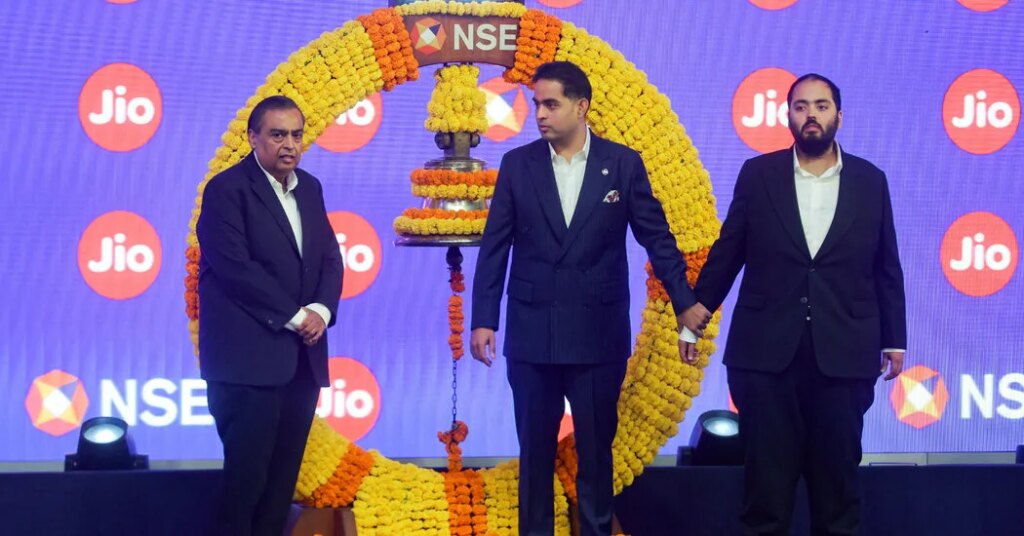
India’s richest family brought one of its crown jewels to market on Wednesday, turning Mumbai, the country’s financial capital, into something like a national festival ground. Bells clanged and drums thundered outside the stock exchange for hours before trading began.
Jio Platforms, the telecom and data arm of the Ambani family’s empire, had raised $3.1 billion in the largest initial public offering in the country’s history. After a jump in its share price on the first day of trading, it became India’s second-most valuable public company, behind only its parent conglomerate — Reliance Industries Limited.
Yet Jio’s triumphant debut comes at a dreary time for Indian stocks. The main indexes have gone nowhere in two years, frustrating investors. I.P.O.s remain a draw, especially for mutual funds hunting for fresh winners. Of the more than 300 companies that have listed this year, most quickly fell below their offering prices.
Jio’s debut offered a welcome contrast. The stock rose 27 percent from its offering price on Wednesday, making the company worth nearly $140 billion — roughly as valuable as AT&T.
The market’s “enormous response” demonstrated that “for high-quality companies, backed by large reputed conglomerates, demand is not a challenge,” said Atul Mehra, chief executive of Axis Capital, one of the 19 banks that managed the listing.
For all the hoopla, the listing also marks the end of an era. When Mukesh Ambani, India’s richest man, launched Jio’s services in 2016, he propelled the country into a new age of mass digital consumption. A decade later, India is awash in data.
The average user consumes more than 35 gigabytes a month, more than anywhere else, with most of it beamed from cellular towers to smartphones. The days of explosive growth are over.
The next challenge is extracting more money from Jio’s existing customers. Google and Meta, which held 8 and 10 percent stakes in Jio, respectively, now stand to reap greater rewards from India’s digital transformation, alongside the company’s other minority shareholders. Jio and its main rival, Bharti Airtel, together control 78 percent of India’s market.
Jio’s success was built on ruthlessly low prices. Data was initially free and Mr. Ambani helped put cheap smartphones into the hands of millions of Indian consumers. When Jio launched, barely a quarter of Indians owned smartphones and most mobile connections ran on 2G networks. Jio signed up its first 100 million customers in six months. Today, it has 524 million users, most of them on 5G.
The company eagerly claims credit for transforming how Indians live online. As Jio expanded, transactions on India’s national payments system increased tenfold, helping make the country the world’s largest market for real-time payments. Video streaming, much of it on homegrown platforms including Jio’s, grew twentyfold, “turning what was once a novelty into one of the most common ways Indians spend their evenings,” the company wrote in a news release.
The I.P.O. was timed to coincide with the festive season between Dussehra and Diwali, when gift-giving, celebration and conspicuous consumption fill India’s streets. Mumbai’s spectacular Sea Link bridge was illuminated with a light show celebrating the listing, just as it had been in April for a young Ambani heir’s birthday.
Reliance ran full-page newspaper ads celebrating Jio’s debut, thanking India for making the country’s “largest I.P.O. possible.” Mr. Ambani has divided responsibility for his empire among his three children, with his elder son, Akash, taking charge of Jio Platforms in April. Akash appeared alongside his brother and sister in the advertisement, a public display of the family’s generational passing of the torch.
In a live broadcast from the stock exchange, Mukesh Ambani’s younger son delivered a speech praising Jio that left his father visibly teary-eyed with pride and joy.
Mukesh Ambani inherited Reliance from his father, Dhirubhai, after a bitter power struggle with his own brother. Dhirubhai, who founded Reliance, had turned a trading business in yarn and spices into an industrial giant built on textiles, oil refining and manufacturing. Mukesh, now 69, pushed into new territories: telecommunications, retail, satellites and green energy.
His children are stepping into the limelight as India itself assumes a more prominent place in the world economy: It has a $5 trillion stock market and an economy that ranks as the world’s fifth or sixth biggest. But international competition is getting more intense. Akash Ambani defended the family business in a recent war of words with Elon Musk, who complained that his Starlink satellite internet service was being shut out of India.
Since the early days under its founder, Dhirubhai, Reliance has had a gift for turning stock market appearances into spectacles. Now, with billions in fresh capital and a new generation in charge, the Ambanis have the funds for their next round of battles.
The post For India’s Richest Family, a Record I.P.O. and a Moment of Pride appeared first on New York Times.