Democratic campaigns have dominated small-dollar fundraising this election cycle, raising four times as much as Republicans from small-dollar donors ahead of next week’s midterm elections, according to a Washington Post review of federal fundraising data.
Democratic House and Senate campaigns reported about $574 million from people who cumulatively gave less than $200, according to the fundraising data, compared with $143 million reported by similar Republican committees. Republicans, however, have dominated unlimited giving to outside groups.
Small-dollar contributions account for 31 percent of money sent to Democratic campaigns, compared with 16 percent for Republicans.
The disparity underscores how Democrats rely on small contributions to power their campaigns, while Republicans depend on outside groups that can receive much larger gifts and wealthy donors.
Small-dollar donors have powered Democratic campaigns for years, driven by anger at Donald Trump and Republicans in Washington. But even after Trump left office in 2021, Democratic small-dollar donors kept giving, showing a consistency the party’s more fickle major donors have lacked. Big-money donors slowed their giving to Democrats after the party’s loss to Trump in 2024.
“Digital fundraisers are in the windmill-making business; they are not in the wind-making business,” said Rob Flaherty, a longtime Democratic operative focused on digital communications. “And so part of this is a measure of enthusiasm and a sign that Democratic grassroots supporters are crawling over broken glass to have Democrat wins and Republican grassroots supporters aren’t motivated.”
The Democratic advantage with small-dollar donors this cycle is significant. The Post analysis includes money raised for primaries and some candidates who are not running for office but still raised money this cycle.
About 6.65 million people gave through ActBlue, the Democratic Party’s preferred online fundraising platform, during this midterm cycle — compared with 1.44 million who gave through the Republican platform WinRed, according to a Post analysis of Federal Election Commission filings. The gap shows Democrats’ continued strength in mobilizing a broad online donor base and Republicans’ struggles to do the same.
Still, Republicans have retained a financial edge over Democrats because a small number of wealthy donors give to outside groups, with contributions dwarfing the small donations fueling the Democrats. Federal rules cap contributions to individual candidates, but there are no caps on giving to outside groups that run ads supporting candidates.
Three of the four individual donors who have given more than $100 million this midterm cycle mainly back Republican candidates. For example, Elon Musk has contributed $446 million to Republican-aligned PACs, making him the largest individual political donor in modern American history. Overall, the 50 biggest donors have contributed $1.7 billion to back Republicans compared with $832 million to support Democrats.
The fourth-biggest donor this cycle is billionaire George Soros, a prolific Democratic donor who has given $102 million to Democracy PAC, a liberal super PAC.
Democrats nationwide have sworn off money tied to corporate political operations and criticized the role billionaires play in Republican campaigns. But many outside groups and party committees helping Democrats this cycle, such as the Democratic Congressional Campaign Committee and the Democratic Senatorial Campaign Committee, accept corporate PAC money, and some Democratic operatives privately acknowledge that the party needs more regular donations from moneyed interests to keep up with Republicans.
Flaherty acknowledged that Democrats have struggled with top-dollar donors, putting more pressure on the grass roots. But he argued that Republican reliance on wealthy donors has become a “huge political liability” at a time when anger at the uber-wealthy and concerns about corruption are high.
“The more Republican advantages of billionaires go up, the more grassroots donors feel like they are compelled to give,” he said. “It is a bit of an arms race between Elon Musk and your aunt who is watching Rachel Maddow.”
Some billionaires do give to Democratic candidates. That has caused awkward moments for candidates such as Troy Jackson, the Democratic Senate nominee in Maine, who claimed in a debate that “there are no billionaires funding me.”
But some of these deep-pocketed donors had contributed to his campaign, a fact Jackson later acknowledged during a debate with Republican Sen. Susan Collins.
“As far as billionaires I might have on my campaign, that is accurate,” Jackson said. “If they want to give them money during this campaign, I guess that is up to them. But they know I don’t owe them a thing like Senator Collins.”
Despite Democratic success with small-dollar donors, Republicans have used their wealthy-donor advantage to flood the airwaves nationwide. Republican campaigns and aligned efforts have spent $2.6 billion on ads this cycle, according to a Post analysis of data from AdImpact, a group that tracks political ad spending, more than Democrats’ $2.3 billion. But that disparity is more dramatic at the state level — in Texas, for example, Republicans have spent $479 million to Democrats’ $234 million, and in Ohio, Republicans have spent $318 million to Democrats $240 million — leading some Democrats to question whether the party can afford to alienate wealthy donors.
“Anyone who said there is no tension there would be full of it,” said Greg Krieg, a Democratic operative who argued the party has two options: either try to get back into the good graces of the wealthy, or press its advantage with a populist message that calls out the wealth disparity that has been benefiting many of those donors. “Neither one is perfect, but I think it has become clear to everybody that whatever the downside is to alienating billionaires, it is surpassed by the support you get from the grass roots.”
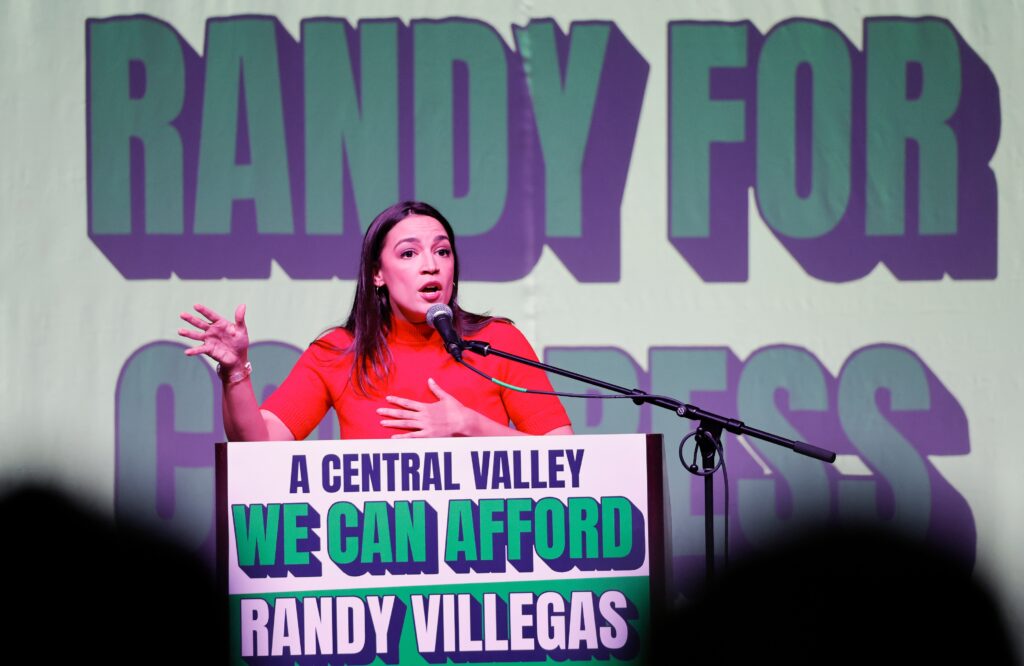
Seven of the 10 House candidates who have raised the most from small-dollar donors are Democrats. Rep. Alexandria Ocasio-Cortez (D-New York), a favorite of progressives, raised the most of any candidate, bringing in over $24 million. Among Republicans, only House Speaker Mike Johnson (Louisiana), Rep. Eli Crane (Arizona) and Rep. Brandon Gill (Texas) crack the top-10 list, at eight, nine and 10, respectively.
Democrats running against polarizing, high-profile Republicans often receive the most small donations.
Eileen Laubacher, the Democrat challenging Rep. Lauren Boebert, has raised $13.7 million in her race against the Colorado Republican, who is known for her bombast and efforts to troll Democrats. Over $9 million of that haul — or 68 percent — came from small-dollar donors, compared with Boebert, who has raised $1.1 million this cycle, 39 percent of it from small-dollar donors. The money has put this race in play, with the nonpartisan Cook Political Report now rating it only “Lean Republican.”
The same is true in northwestern Georgia, where Democrat Shawn Harris is running against Clay Fuller, the Republican who replaced Rep. Marjorie Taylor Greene, a Republican firebrand who routinely angered Democrats. Over 75 percent of the $8.4 million Harris has raised this cycle came from small-dollar donors, compared with just 12 percent of the $1.6 million Fuller has raised. The race is considered a reach for Democrats and rated “solid Republican” by Cook.
“It is an issue of feeling powerless. It feels like there is nothing people can do about the level of corruption and the level of insanity they are seeing,” said Jessalyn Reid Mahoney, a Democratic operative who runs a firm focused on online fundraising. “The opportunity to actually be a part of fighting back against that in a meaningful way is attractive to people.”
Tom Bonier, a Democratic political strategist, said that despite that disparity, Democrats are in a “great position” to win back the House next week because of the political environment. But money issues “will always be a concern” for Democrats, and they could come into sharper focus next year, when more states are expected to redraw their maps and the national environment may not be as anti-Republican as it is right now.
“Even though Democrats have done an incredible job this year with grassroots fundraising, [they] will be outspent in a lot of key races because of just the massive resources that a relatively small number of very wealthy people are pouring into the Republican Party,” Bonier said.
Mariana Alfaro contributed to this report.
The post Breaking down the cash fueling Democrats and Republicans in the midterms appeared first on Washington Post.