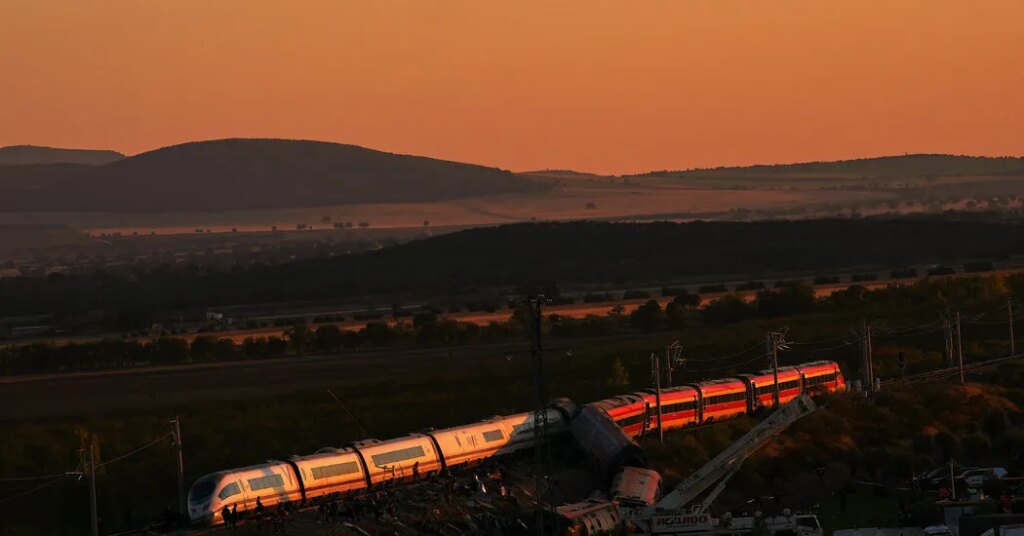
Traveling home on a high-speed train from Madrid to Seville in Spain, Fernando Seco was annoyed when congestion caused the train to stop about a half-hour after its 8 a.m. departure Wednesday. Not long after, it restarted, picked up speed and slammed into another train stopped on the tracks.
Mr. Seco, 62, and other panicked passengers climbed out of their carriage at the back of the train and into a field in central Spain. They saw the derailed carriages of the train they had barreled into in an embankment farther ahead. A rail beam, he said, had “pierced right through a carriage from bottom to top, like carving meat.”
He and others rushed to those carriages and found the dead and injured, those “trapped in a twisted tangle of metal and wreckage.”
The scene was eerily quiet because people were either dead or so hurt they couldn’t speak. He said survivors used parts of the destroyed train as makeshift stretchers to extract the injured from the wreckage. That’s when the screaming started. Doctors among the passengers treated people in what became a field hospital among almond groves.
At least 68 people died in the crash. More than 50 others were injured, some critically.
Spain is living through a recurring nightmare. For the second time in less than a year, a high-speed crash between the same two train operators on the same busy line from Madrid to Seville threw the country into official days of mourning, shook its confidence in the security of it once-vaunted rail system and undercut its international image as a modernizing tourist mecca helping to thrust Europe forward.
In January, a collision between two high-speed trains near Adamuz, farther south, left 46 dead in what had been the country’s worst rail disaster since 2013. The crash on Wednesday, a month before national elections in an already bitter campaign, surpassed that toll and became one of the deadliest train crashes in Spanish history.
“It’s not possible for a country like Spain to suffer two high-speed train accidents in one year,” Prime Minister Pedro Sánchez told reporters at the scene of the crash. Even though the two episodes seemed unrelated, they showed that Spanish rail’s security systems needed to be reinforced, he said.
As he joined Spain’s king, international leaders, his election opponent and local officials in expressing condolences to the families of the victims, he said the country would turn its focus to why the crash had occurred.
His government had already given an explanation. Óscar Puente, Spain’s transportation minister, told reporters that the horrific crash appeared to have resulted from an “inexplicable” decision by train traffic control operators in Madrid.
After watching a reconstruction of the crash and listening to relevant audio recordings of communications between the control center and the trains involved, Mr. Puente recounted the unfolding of a national disaster.
About 8:30 a.m., half an hour after the latter train — run by the national operator, Renfe — departed, the aging safety system along that section of the railway went down. Its failure forced the six trains traveling in that area to stop.
Following protocol, Mr. Puente said, a train traffic control center in Madrid took over. It allowed the Renfe train to resume its journey. “Was that the correct decision?” Mr. Puente asked. He clearly did not think it was.
He said one conductor of a train not involved in the crash had even corrected the operator at the control center, saying that the trains were not supposed to resume normal operation and had to proceed at low speeds of about 40 kilometers an hour (about 25 miles an hour) that would allow their drivers to stop within the visible distance ahead. Mr. Puente recounted that the Madrid operator, who was not identified, replied, “Oh, yes.”
According to Mr. Puente, the railway control operator told the Renfe train conductor to resume regular travel “despite there being another train ahead of it.” The minister called the instruction “incorrect.” The Renfe train traveled 15 miles, or about 25 kilometers, before rear-ending the other train, which had remained stopped on the tracks.
Mr. Puente said the stopped train, which was run by the private company Iryo, had apparently received instructions to move on, as well. But the radio station Cadena Ser reported late Wednesday that Iryo said its train conductor was awaiting confirmation from Madrid to move on when the crash occurred.
At the moment of impact, Antonio de la Corte, 77, was napping in the third carriage in the back of the Renfe train. “Bam!” he said, recalling that he was immediately awaken, lurched forward and banged his knees while his brother, with whom he was traveling, hit his head. A rail shot through the inside of his train car like a skewer, killing people seated to his right, he said.
As he and his brother climbed down to the field, farmhands cut the fences around the embankment so passengers could take shelter in the fields of alfalfa and almond trees. Word of the disaster quickly spread, and Yahadi Mohamed Maulud, 41, a resident in the nearby town of Yébenes, loaded his car with water bottles and rushed to help.
“We found a massacre,” he said, describing torn limbs and one woman, drenched in blood, searching for her brother. He said he was one of the first people on the scene and helped move the injured passengers on makeshift stretchers.
Soon, a long procession of ambulances, police cars and fire trucks arrived under the whir of rescue helicopters flying low overhead. Dozens of Civil Guard officers, many wearing the white protective suits and masks used by forensic investigators, inspected the scene and gathered evidence.
Broken cables and fallen utility poles were scattered around. The derailed carriages looked pulverized, a heap of charred wheels, smoldering metal and crushed luggage. Some workers hovered over still bodies covered in Mylar blankets as firefighters used cranes to lift the wreckage in search of survivors and more dead.
As family members and friends rushed to sports pavilions to which survivors, including Mr. Seco, had been evacuated in Urda, a group of Roman Catholic priests approached the crash site.
“We came to pray for the dead,” said the Rev. Luis Lucendo, 63, a parish priest in the nearby town of Villacañas. “One man told us that his wife had died, and I was able to make the sign of the cross over her,” he said.
Mr. Maulud, who had brought water and other supplies, was also in Urda, watching the scenes of both thankful reconciliation and grief behind his cigarette smoke. He frequently took the train himself for business in Madrid, he noted.
Then he added, “I’m never getting on that train again.”
The post ‘A Twisted Tangle of Metal and Wreckage’: Spain Train Crash Kills at Least 68 appeared first on New York Times.