Abby ShalekBriski and Ryan Loy are agricultural economists. ShalekBriski writes the Substack “Field Notes on Progress.”
Ranching in Oklahoma can be full of surprises, such as droughts, tornadoes, price shocks and out-of-the-blue notices from state officials asking whether selling shares of your herd violated state securities law.
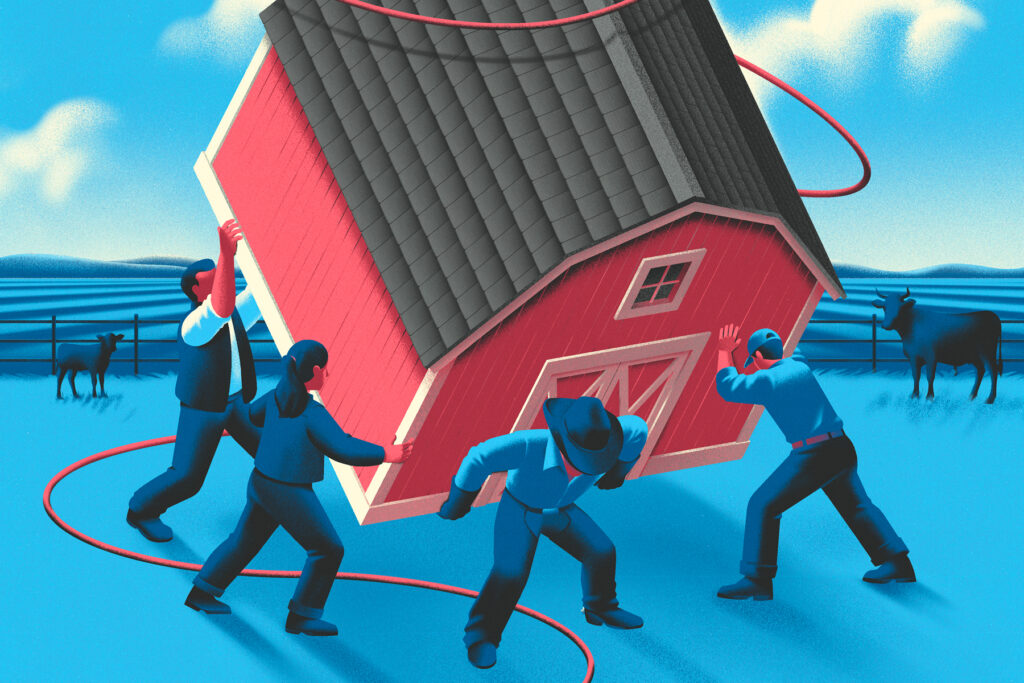
Mayes County rancher Joel Hollingsworth told us he got this last jolt earlier this year via a subpoena from the Oklahoma Department of Securities demanding sales materials, financial records, cattle inventory and the identities of everyone who purchased shares in his herd. Hollingsworth manages about 425 cows, and building that herd was not easy. There are substantial barriers to entry for a first-generation rancher like him: land scarcity, high production costs and rising equipment prices.
So to make the math work, Hollingsworth borrowed from an age-old agricultural arrangement: the crop share. In a traditional crop share — hardly a novel way of doing business — one party owns the land while another farms it, and the two split the crop at harvest. It spreads the risk while providing an on-ramp for beginner farmers.
Many ranchers employ a similar arrangement known as a calf split. In this system, a cattle owner might split the calf crop with someone providing land and labor. Hollingsworth’s approach innovates on that: He offers herd shares, or ownership of cattle in the herd he manages. Say a family purchases a herd share. The family then owns a certain number of cows in the herd — but not particular animals. To keep improving the herd’s genetics, Hollingsworth culls cows that don’t raise a calf every year and replaces them with younger animals bred on the ranch. Individual cows come and go, but the number of cows a family owns stays the same.
The family pays no fees for land, labor or feed; instead, Hollingsworth keeps most of the calves to cover the cost of running the herd. The family’s share stays in the herd until they want it. After an initial two-year wait, they can take animals out: to the butcher, to their own pasture or to the sale barn. Families who take part often cite the local-food movement as motivation. What they get is dinner, not a dividend.
Enter the Oklahoma Department of Securities, which looked at this arrangement and saw a possible security. Ranching, after all, is the one business where “stock” has four legs.
Under federal securities law, an investment contract — one kind of security — has four essential components: money, a common enterprise, expected profits and profits that are derived from the effort of others. These criteria are laid out in the Howey test, named for the 1946 Supreme Court case Securities and Exchange Commission v. W.J. Howey Co. The company sold tracts of citrus to tourists at its resort hotel, and most buyers entered into a service contract in which the company tended, picked and sold the fruit.
The Howey citrus-grove shares were judged to be securities rather than merely real estate sales because the buyers didn’t care about the physical assets, mainly lived out of state and were promised a share of the profits. The Hollingsworth herd shares are a whole different animal. There’s no promise of returns or profits — just ownership of a cow, which the owners are free to do with as they please.
Courts and regulators have used Howey to treat all sorts of interesting animal and agriculture-adjacent schemes as securities. Beavers in 1967: Investors paid $2,000 to $6,000 for animals worth $20 to $100, on the seller’s promise of “the royal road to riches” by building a fur market. Earthworms, 1979: A promoter promised to buy back worms from customers who were supposed to raise them at $2.25 a pound — though, as the court deadpanned, “There is little market for worms in the Phoenix area.” And cattle, 2023: A company took in $191 million for “cattle investments” guaranteeing returns of 15 to 32 percent — and mostly skipped the step of buying cows. A cattle Ponzi, in other words.
In each case, courts or regulators applied securities law to an arrangement built around a promise of money later: a fur market, a buyback or a guaranteed return. In Hollingsworth’s arrangement, a herd share family owns cattle and hires someone to manage them.
The Oklahoma Department of Securities could not comment on Hollingsworth’s case but confirmed that “no civil or administrative proceedings have been initiated” against the ranch or its principals. It also noted that a subpoena does “not reflect a conclusion of wrongdoing,” and that it does “not assert that all herdshare programs involve the offer and sale of securities” — though one may be, “depending on the structure of the program and the specific facts revealed.”
Still, Hollingsworth has spent thousands on legal advice. If the investigation escalates, he could face fines, frozen assets and even prosecution. His predicament underscores the economic fragility of agricultural production. Many beginner ranchers have limited access to credit and face obstacles securing capital for land, equipment and livestock. Margins are often razor-thin and squeezed by volatile prices. Because of that, agriculture has always driven financial innovation, from the futures contract to the Farm Credit System.
Yes, protecting people from Ponzi and pyramid schemes is important, but so is creating space for agricultural producers to find innovative ways to manage risk. Congress has made exemptions for agriculture. The Capper-Volstead Act of 1922 let farmers market their crops together without being prosecuted as a cartel. The Securities Act of 1933 exempts securities issued by certain tax-exempt farmer cooperatives from registration. Both laws recognize agriculture’s unique challenges. Creating a legislative safe harbor for herd share or other community-based agricultural arrangements could do the same.
Drought and storms are risky enough. Ranchers should be able to count on regulators who applaud innovation.
The post A rancher found an innovative business plan. Then regulators pounced. appeared first on Washington Post.