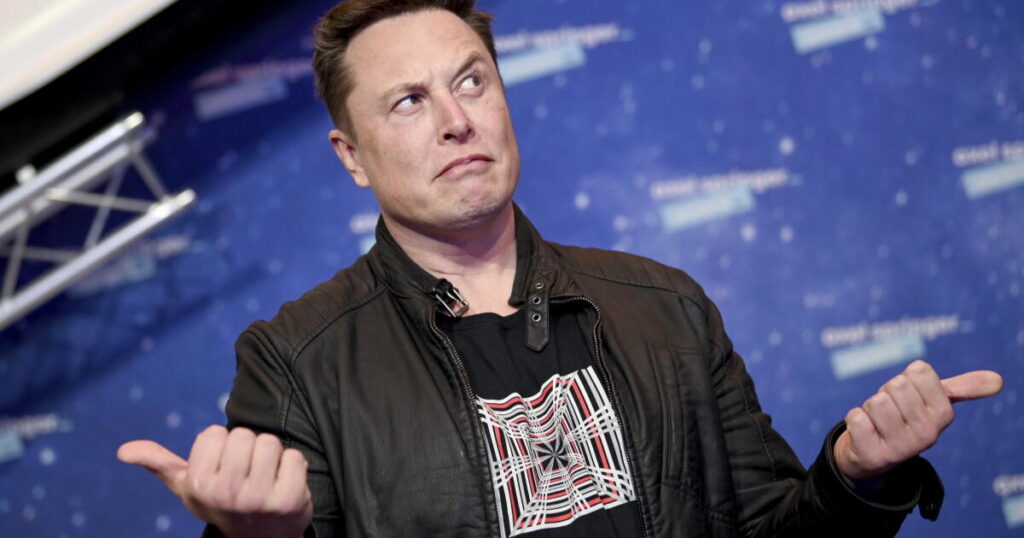
Here’s a rule of thumb when you’re pondering who would be a major beneficiary of any idea floated by Elon Musk about the future of his multiple companies: If you don’t place Musk at the top of the list, you might want to reconsider your math.
That issue arose, and not for the first time, when Musk in effect blessed the idea of merging Tesla and SpaceX, his two biggest public companies. That happened on Oct. 20 during a conference call with Wall Street investment analysts to discuss SpaceX’s third-quarter financial results.
Responding to the observation by a participant that there was “a lot of anticipation” of such a merger, Musk called the deal “a good idea” with “a lot of merit.” Tesla shares gained about 3.4% the next day.
At the call, Musk revealed that both companies had empaneled “special committees” of purportedly independent directors to consider the transaction. He cautioned that it would require shareholder approvals at both companies, including more than 50% of all Tesla shareholders. (Musk owned about 20% of the shares as of Sept. 30, by far the largest single stake.)
To justify the combination, Musk invoked the fabulous future of artificial intelligence: “We are pretty much in the super-intelligence singularity,” he said, “and there’s a lot to be gained from cooperating on developing super-intelligent software, chip design, the Terafab, obviously robotic, mass to orbit with the Starmind constellation.”
The subtext is that a merger would create a $3.5-trillion behemoth — America’s fifth-largest company by market value, in the reckoning of Reuters. That might well enhance Musk’s stature as the world’s richest person.
Since it can be hard to follow Musk’s imagination without a program, you need to know that the Terafab is an enormous factory being jointly developed in Texas by Tesla, SpaceX and Intel to make AI chips and estimated to cost as much as $120 billion, with construction scheduled to start Dec. 1. Starmind is his plan to place AI data centers in space.
As my colleagues Laurence Darmiento and Caroline Petrow-Cohen reported, the merger would almost certainly be the largest ever.
Bringing the discussion back to planet Earth, however, there is reason to question whether this merger would make economic sense. (I sought responses from Tesla and SpaceX to questions critics have raised about the wisdom of a merger, but didn’t hear back.)
Those doubts may have been subsumed for the moment by Musk’s showmanship. On Oct. 15, for instance, he unveiled the Tesla Roadster, a flying car, with a demonstration featuring its becoming airborne for a few seconds and performing a barrel roll like an aircraft. Musk said production of the car will begin in 2028.
The news media duly fell into line. “With Tesla Roadster debut, Elon Musk shows ‘flying cars are real,’” CBS News asserted in a typical panegyric. The Wall Streeters too: “Elon, thank you for making flying cars real,” gushed Adam Jonas of Morgan Stanley at the conference call. “That was freaking insane.”
Never mind that Tesla cautioned those planning to plunk down $50,000 to reserve the vehicle that “Roadster is still underdevelopment … and so we cannot guarantee when your vehicle will actually be delivered or if it will be delivered.”
I’ve observed in the past that the rationale for corporate mega-mergers often has nothing to do with the benefits to consumers, which are typically imaginary anyway, but with the payouts for insiders. That goes double when the same insiders are on both sides of the deal.
The best example of how this works comes from — who else? — Musk himself. That was the 2016 merger of Tesla with his SolarCity, a rooftop solar provider.
As was clear at the outset and became clearer in retrospect, this was essentially a bailout of one Musk company by another, with Tesla’s shareholders hung out to dry by forcing them to rescue the failing SolarCity. Tesla shares fell by more than 10% the day after the deal was announced.
That said, there was never much doubt that the deal would be consummated. At the time, the seven Tesla directors included Musk and four others close to him: Brad Buss, the former chief financial officer of SolarCity; Antonio Gracias, a member of the board of SolarCity and SpaceX; venture investor Stephen Jurvetson, a board member of SpaceX; and Kimbal Musk, Elon Musk’s brother. SolarCity’s eight-member board included Musk and four other intimates: Lyndon and Peter Rive, who are company co-founders and Musk’s cousins; John Fisher, a business partner of Jurvetson’s; and Gracias.
Compare that to the current lineup of Tesla directors. They include Ira Ehrenpreis, a friend of Musk’s who is also on the SpaceX board; Kimbal Musk, Elon’s brother; J. B. Straubel, a former Tesla executive and SolarCity director; and board Chair Robyn Denholm, a longtime Musk acolyte who once testified that the wealth she had collected as a Tesla director was “life-changing.”
Among the directors of SpaceX are, in addition to Ehrenpreis, Gracias, a former board member of Tesla, Musk’s Boring Co. and SolarCity and current board member of Neuralink, another Musk enterprise; Jurvetson, a former Tesla director; and Roelof Bota and Luke Nosek, former executives at PayPal, which Musk co-founded.
Finding “independent” directors for the special committees charged with weighing a SpaceX-Tesla merger therefore would be a challenge. Musk groused to the investment analysts about the “kabuki dance where two groups of people are talking, and I can’t be in the conversation.” But of course Musk inserted himself into the conversation simply by expressing a positive view in public.
It’s possible that Tesla shareholders might gain through a merger, but that’s entirely dependent on the price offered for their shares, which are down nearly 13% so far this year. Operationally, Tesla hasn’t been doing spectacularly well lately. In the third quarter that ended Sept. 30, profits fell 43% from the same period a year earlier. Operating expenses have ballooned by 39% year over year, according to the company’s financial disclosure.
Musk seems to be losing interest in the car business — he has been converting Tesla’s auto factory in Fremont, Calif., to building humanoid robots, another of his hobby horses, while ending production of Tesla’s S and X models.
What about SpaceX? In the estimation of Yahoo Finance, at its closing share price Monday of $146.90, the company absurdly boasts a forward price/earnings multiple, which is based on guesswork about future earnings, above 180. Other estimates vary, but they’re all based one way or another on vapor.
Among big U.S. tech corporations with relatively stable operating records, Apple’s multiple based on actual — not conjectural — earnings is about 40, Google’s is 16, Meta’s is 22, and even Nvidia, that darling of AI fans, is at 27.
Investors in SpaceX are doing what craps players call betting on the come. Musk has contributed to this frenzy; the SpaceX prospectus issued before its initial public offering in June claimed that its products and services would have a “total addressable market” worth $28.5 trillion.
The company said almost all of that figure would come from its artificial intelligence business, which was — and is — in its relative infancy. For context, the gross domestic product of the U.S. is about $32.6 trillion.
The company’s only profitable business segment this year has been its space-based Wi-Fi service Starlink, which recorded $5.2 billion in operating profit on $12.8 billion in revenue in the first nine months of this year. Its rocket launching business, for which it’s best known, lost $1.2 billion on $3.3 billion in revenue, which might explain why Musk is talking up the future of AI rather than rockets. Indeed, the company lost $3.3 billion on AI in the period on $10.9 billion in sales.
As Fortune’s Shawn Tully points out, SpaceX’s AI business is a vast capital suck. In the first nine months of this year, the company collected a total of $13.1 billion in cash but expended $40 billion in capital on AI, among $48.1 billion in total capital spending.
The more closely one examines the merger idea, the more one must wonder what would be the point. Musk’s various companies already operate as arms of Musk Inc. — Tesla reported selling $430 million in Megapacks, a commercial-scale battery, to his xAI and SpaceX and $143 million in vehicles to SpaceX last year. Engineers from his companies were seconded over to X, formerly Twitter, after Musk bought the social media platform in 2022.
Musk talks as though his vision is to cobble together a conglomerate by defining all his interests as elements of a “super-intelligence” future. But they’re very different enterprises. The conglomerate era, it should be recalled, dwindled away in the 1980s, when investors recognized that in most cases the parts were more valuable than the whole. Since then, mega-companies have generally been built around recognizable industries, like entertainment.
At this moment, the only thing Musk’s disparate companies have in common is Elon Musk. Is that enough to bet on?
The post Who would gain from a merger of Musk’s SpaceX and Musk’s Tesla? Take a wild guess appeared first on Los Angeles Times.