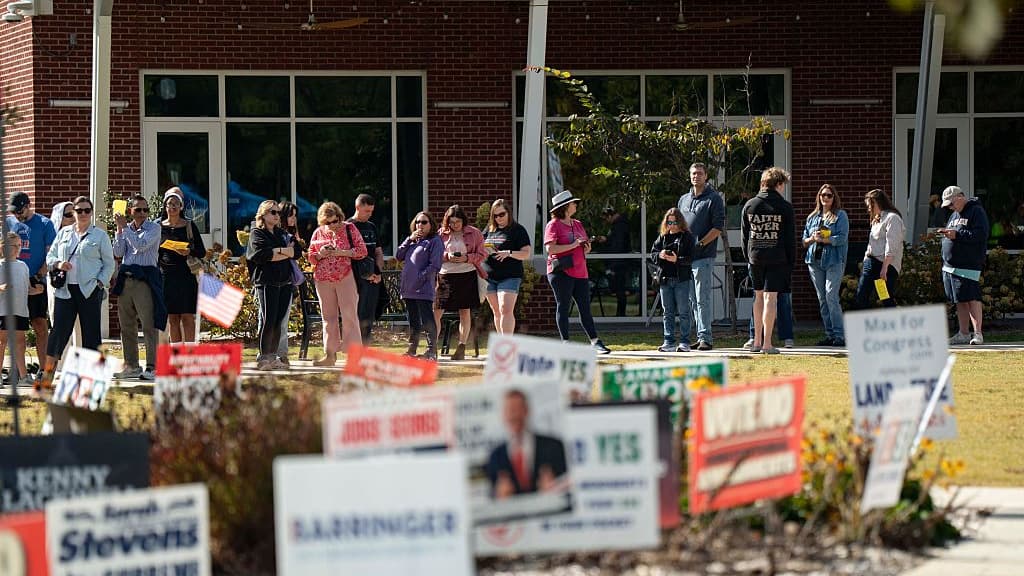
Election Day is still a week away. But with early voting for the midterms underway in nearly every state, tens of millions of Americans have already cast their ballots, offering an initial glimpse into how the pivotal elections may play out.
As of Tuesday afternoon, nearly 33 million people have voted since early voting windows opened in some states over a month ago, according to tracking by the University of Florida’s Election Lab. Around half of those votes have been cast in person, while the other half were submitted by mail.
With days of early voting left to go before Election Day on Nov. 3, that figure already represents more than a quarter of the roughly 122 million Americans who voted in the 2022 midterms.
Michael McDonald, a political science professor at the University of Florida who runs the Election Lab, stresses to TIME that early voting data cannot in and of itself be relied on to predict the outcome of the elections. But he says it can reveal other informative aspects of voting behavior.
“Once you start seeing consistency across multiple days of voting and across multiple states, it starts giving us more confidence that whatever we’re seeing in terms of relative engagement, that’s likely going to carry through to election day,” McDonald says.
Here are some of the notable trends emerging in the early voting data as Election Day nears.
Democrats are outpacing Republicans in early ballots
Registered Democrats so far represent a larger share of early voters in the midterms than Republicans, having cast roughly 45% of early ballots compared to 31% cast by GOP voters, according to the University of Florida’s Election Lab data. Another 24% of Americans who have voted early are not registered with either party.
This data is only available for the 27 states that have a formal party registration system, and signifies only the party with which a voter is registered, not the candidates selected on their ballot.
Experts caution that Democrats’ higher turnout in the early vote does not guarantee they’ll maintain that edge, with tens of millions more Americans still expected to show up at the polls.
Republicans are anticipated to make up ground on Election Day, as they have in recent years. A Pew Research survey conducted following the 2024 midterm elections showed that nearly 40% of registered Republican voters cast their ballot in person on Election Day, compared to 28% of registered Democratic voters.
“We expect the Democrats to build up a lead in the early vote, and Election Day tends to be a Republican day, so you can’t just look at the early vote as it is now,” McDonald tells TIME.
Polling has shown, however, that Democratic engagement and enthusiasm is higher than it is for Republicans in the lead-up to the elections. According to a PBS News/NPR/Marist poll released on Tuesday, 52% of likely voters said they would back the Democratic candidate in their House district, while 44% would back the Republican candidate. Independent likely voters favored Democratic candidates by 13 points.
More Democrats than Republicans also said in the survey they were very enthusiastic about voting, at 71% and 61% respectively. Another poll from the Pew Research Center earlier this month similarly showed greater engagement and stated motivation from voters backing Democrats: 78% of voters who voiced support for the Democratic candidate in their House district said who controls Congress “really matters,” compared to 69% of voters who backed Republican candidates who said the same. Such polls have suggested a “blue wave” of Democratic support might determine the midterms, but Republicans have pushed back against the numbers.
Read More: Polls Point to a Blue Wave. Here’s Why Republicans Say They’re Wrong
Bernard Fraga, a political science professor at Emory University, tells TIME that the relative lack of Republican enthusiasm in polls and trailing GOP turnout in early voting shows that support within the party, and for President Donald Trump, has waned.
“This is a story about Democrats who voted in 2024 persisting, and Republicans who voted in 2024 so far at least staying home,” he says.
The midterms come as Trump’s approval rating has hit near record lows amid widespread dissatisfaction with his handling of the war in Iran and the economy. A Reuters/Ipsos poll released on Monday put Trump’s approval rating at 32%, up one percentage point from last week, when the same poll recorded the lowest approval rating of his second term.
Fraga says that Republicans are frustrated with what he describes as “failures” of the Trump Administration, which he asserts have decreased GOP voters’ support for their party and led them to stay home rather than casting ballots early.
“Even for steadfast Republican voters, they look at the state of the economy, for example, and say that they’re not too enthusiastic about voting,” he says. “Reading the trends, it’s clear that Democrats are enthusiastic and mobilized to a much greater degree than even the Republican voters.”
Simon Rosenberg, a long-time Democratic strategist, contends that independents are also more likely to be voting in favor of Democrats, given recent polling, which has shown that more independent likely voters support Democratic candidates. One YouGov poll found that 54% of independents said they’d vote for Democratic candidates, versus 27% who said they’d vote for Republican candidates. Another PBS/NPR/Marist poll showed that independents favored Democrats by a margin of 25 points.
Given such polling, Rosenberg believes that the number of people voting for Democratic candidates is actually higher than the partisan breakdown in early voting data explicitly indicates.
Hispanic voters are turning out early in higher numbers than other recent elections
Rosenberg says that the most significant data coming out of early voting is the number of Hispanic people voting early.
So far, Hispanic early voting participation is outpacing its levels at the same point in the election cycle in 2022 and 2024. Presidential election years such as 2024 typically yield higher voter turnout, which Rosenberg says makes the 2026 figures to date all the more notable and surprising.
“It’s almost certain that this heightened performance will carry over through Election Day, and that this will become one of the big storylines of the election,” he says. “It’s a universal trend that we’re seeing all across the country.”
This trend is most noticeable in states with high Hispanic populations, like Texas.
In one of the most closely watched—and expensive—Senate races this year, James Talarico is vying to become the first Democrat elected to the Senate from Texas since 1988 in a tightly contested battle against the state’s Republican Attorney General Ken Paxton.
Over 4 million votes have been cast early, or an estimated 41% of the total votes expected in the race, according to tracking by VoteHub. As of Monday, Talarico held a narrow two-point lead in the early vote.
The state’s Hispanic population, one of the highest in the U.S. per capita, represents 24% of the vote as of Monday, according to VoteHub, a percentage point higher than the share it made up in the final vote tally in the 2024 election. Another analysis reported by The Texas Tribune showed that the Hispanic early vote in Texas has already surpassed the early vote numbers from 2024 and 2022.
“What we can see here is just eye-popping numbers for Hispanics,” McDonald said about the group’s early voter turnout not only in Texas, but around the U.S. “If Hispanics are showing up in force now, it’s almost with certainty going to change the overall … diversity of the electorate in this election cycle.”
As a result, McDonald contends that “we’re going to see larger swings to the Democrats in more diverse states.”
Polling has indicated that Hispanic and Latino voters, a demographic that helped propel Trump back to the White House two years ago, widely disapprove of the President and the Republican Party heading into midterms. Sixty-six percent of Latino voters surveyed in late September by an NBC News/Telemundo poll said that Trump’s deportation policies have gone too far, while 75% disapprove of his handling of the economy and the cost of living. The poll also found that more Latino voters hold a negative view of the GOP than at any point since 2016.
Another Reuters/Ipsos poll released on Oct. 5 showed that just 24% of Hispanic Americans approved of Trump’s performance in the White House, the lowest such rating the President has received across both of his presidential terms. And just 52% of Hispanic voters who responded to the poll planned to vote Democratic, double the level of support for Republicans among the demographic.
How predictive is early voting data?
Rosenberg cautions that early voting “can tell you a lot, but it can’t tell you everything,” and that voter turnout can shift from day to day.
He notes that early voting returns showed Kamala Harris leading in the 2024 presidential election, and that she still lost after a strong gain in Republican turnout for Trump.
But he contends that “the lack of intensity that we’re seeing in many rural and Republican counties around the country does not bode well for them for Election Day.”
Fraga says that in general, political scientists are skeptical of using early voting data to predict election outcomes. This has been especially true, he notes, in the aftermath of the COVID-19 pandemic, which saw Democrats cast early votes by mail at a significantly higher rate than Republicans, who were more likely to vote early at polls, a dynamic that made it harder to draw on the early vote to confidently predict outcomes on Election Day.
Now, though, “the partisan distribution of voters has become somewhat more stable,” he says. “So we can use that information to now have a better comparison, and as a result, early voting data sheds a lot more light on what’s likely to happen in November.”
“It’s not determinative. It’s not going to predict what’s going to happen,” Rosenberg says. “But every campaign in the country right now is living and dying on this early vote data.”
Richard Hall contributed reporting.
The post What Early Voting Data Is Showing About the Midterm Elections appeared first on TIME.