Neura Robotics is not a household name. It’s not even the most prominent business in Metzingen, a German town of 22,000 people that is also home to the fashion brand Hugo Boss.
But in just a few months, Neura’s founder, David Reger, has attracted investment from some of the world’s most powerful technology companies, including Nvidia and Amazon, and received invitations to meet the leaders of Europe’s three largest economies.
The company’s rise underscores the importance of artificial intelligence and robotics, technologies that could help Europe transform its ailing manufacturing sector and take on Chinese competition. Neura is among companies at the forefront of Europe’s efforts to seize the potential economic gains as A.I. makes the leap from the digital world to the physical.
“We are not efficient anymore,” said Mr. Reger, who raised as much as $1.4 billion in June. “But I do believe that this can be solved.”
Whether A.I.-powered robots can live up to their promise remains unclear. Companies need to teach them to perform complex tasks, a challenge that requires the collection of vast amounts of data.
European robots are also far outnumbered.
After rolling out 2.3 million industrial robots, almost half the global fleet, China is moving into the next frontier. Unlike the mostly one-armed machines that have been used for decades to perform repetitive tasks, the next generation of robots is expected to see, hear, feel and — most important — learn.
One of the keys to Europe’s strategy is a tech hub on the edge of Munich Airport. Inside the facility, as many as 100 humanoids and other robots have embarked on a 24-7 training mission. On a recent morning, a day after joining business leaders in Berlin for a discussion with Chancellor Friedrich Merz of Germany and Prime Minister Andy Burnham of Britain, Mr. Reger opened the “robogym” to a journalist for the first time. He declined to provide details of the meetings with the government leaders.
Wearing a black blazer, a black shirt and black pants, Mr. Reger, 38, introduced the team. The robots picked up car parts and placed them into containers, stacked boxes and carried out other tasks, mimicking the movements of human trainers who guided them remotely. One robot practiced tightening its grip on a glass, learning how to respond when water is added.
When one robot learns a new skill, they all get smarter as the data is fed into a cloud-based platform, or a shared brain. Neura has signed up dozens of automotive, logistics, pharmaceutical and other companies to carry out their own training in the gym, declining to identify them. More than 2,600 have applied for space in one of the sites, Neura’s chief said.
The training center, developed with the Technical University of Munich, is part of a wider plan. By the end of the year, Neura aims to have five gyms operating globally, including one already opened in Hangzhou, China. Ten more are expected to follow.
Unlike generative A.I. models trained on enormous amounts of internet data, physical A.I. depends on the costly collection of real-world data. Mr. Reger likened it to learning how to swim. You can’t simply watch videos; you have to get in the water.
China, however, is building most of the pools.
More than 90 humanoid data collection centers are running across China, according to Interact Analysis, a consulting firm. And the campaign, fueled by state support and a need to replace retiring workers, shows no signs of slowing down. At least 50 more sites are under development. Europe has fewer than 10 facilities.
It’s not just the scale of China’s operation that is making headlines. A Chinese humanoid in August broke Usain Bolt’s record in a 100-meter sprint, while dozens of others ran a half-marathon in Beijing. At the Paris Motor Show, robots developed by China’s Agibot danced to the Dua Lipa song “Levitating.”
“The skill is undeniable, but a lot of it, especially in the humanoid sector, is around what we’d call entertainment robots versus industrial robots,” said Arnaud Robert, the president of Hexagon Robotics, a Swiss company that is working on a pilot with BMW at one of the German automaker’s plants in Leipzig.
That leaves an opening for European companies, he said.
A.I. robots are hitting the factory floor in Europe for the first time, with Germany emerging as the main training ground. Robots are expected to move into production at the BMW site by the first quarter of next year. Agile Robots, in Munich, is working with partners including Google DeepMind. Another company, Humanoid, aims to integrate robots into the operations of Schaeffler, a German auto supplier, by the end of 2026.
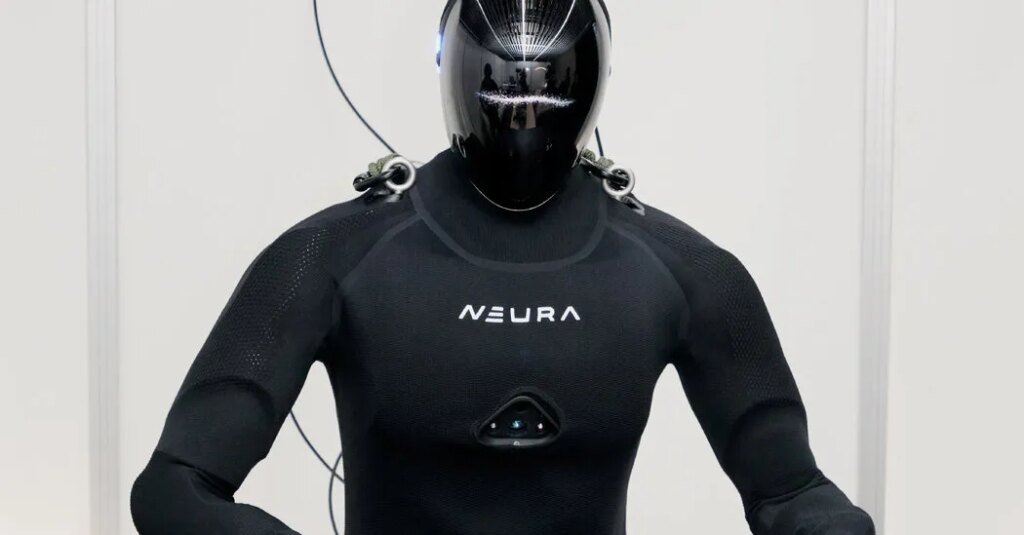
While Neura advances with the gyms, it is teaming up with another supplier, Bosch, and other companies, equipping more than 1,000 workers with sensor suits to record their movements and capture other data during their regular shifts.
European companies want to be judged on their ability to develop technology that translates into tangible results. But they will need to prove that their robots can operate safely and efficiently — and at a low enough cost to make them economically viable.
Smart robots in factories, warehouses, hospitals and hotels are forecast to play a critical role as countries cope with aging populations and shrinking work forces. The number of humanoids deployed worldwide could rise to one million in 2030 from 15,000 last year, if costs fall and the technology does not encounter regulatory headwinds, said Zornitsa Todorova, a researcher at Barclays.
“The next 10 years will be the decade of the robot — and at the moment, it looks like that decade might belong to China,” Ms. Todorova said. Still, Europe’s focus on safety and expertise in hardware, such as actuators that enable robots to move, provide an edge, she said.
Neura raised funds this year from several prominent companies, including existing partners Nvidia and Amazon. Leading the investment was Tether, the cryptocurrency company, which is valued at more than $180 billion and has faced scrutiny from lawmakers and regulators. Neura said part of the $1.4 billion was tied to milestones that it was on track to achieve.
Growing up as the eldest of 11 siblings in Rottweil, 50 miles from Metzingen, Mr. Reger dreamed of living overseas, eventually heading to California. Instead of finding a tech job in Silicon Valley, however, he got his start working with a Christian organization to help homeless people in San Francisco.
After returning home, he developed a deeper appreciation for Europe and its health and social systems. Rather than attending a university, he taught himself engineering and got a job in Switzerland, where he built his first robots.
Mr. Reger, who also met with France’s president, Emmanuel Macron, in September, said he aimed to become “Europe’s largest taxpayer,” combining A.I. and robotics to help create an economic engine for Europe that is even bigger than the car industry. Failing to reap the gains, he said, would be costly.
“This is a competition,” Mr. Reger said. “If you see other countries get more efficient through robotics and we don’t, it’s going to be very difficult to come out of this situation.”
The post In the A.I. ‘Robogym,’ Machines Train to Be More Like Humans appeared first on New York Times.