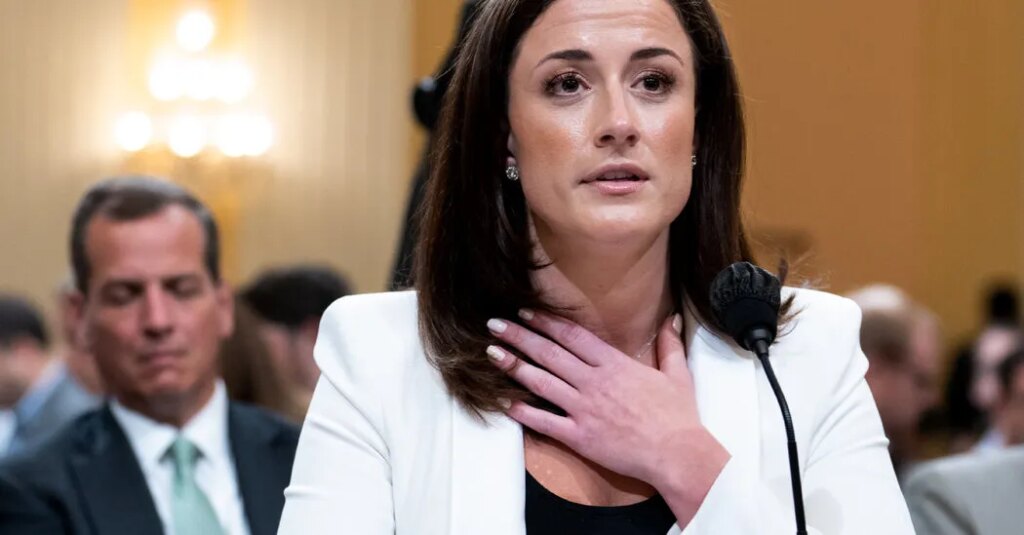
A federal grand jury in Washington on Tuesday rejected an effort by the Justice Department to indict Cassidy Hutchinson, the former White House aide President Trump targeted after she gave damning testimony to a congressional committee investigating the Jan. 6, 2021, attack on the Capitol, according to people briefed on the matter.
The rejection of the indictment — known in legal circles as a “no true bill” — was the latest extraordinary setback in Mr. Trump’s wide-ranging campaign to go after his political opponents. The Justice Department has repeatedly failed to build criminal indictments against the president’s rivals.
Some Justice Department prosecutors had been deeply skeptical that there was a case to be made against Ms. Hutchinson, concluding that it would be difficult to win a conviction against her.
But in an unusual arrangement, the investigation was directed to the department’s civil rights division, which normally focuses on issues like police violence and election integrity. The civil rights division is led by Harmeet Dhillon, a Trump loyalist who has effectively reoriented the unit to align with Mr. Trump’s agenda, including by extracting agreements from elite universities that were favorable to the administration.
It was once rare for grand jurors to rebuff prosecutors and turn down a request for an indictment, given that the Justice Department has traditionally sought criminal charges only in cases it expects to win. But such failures have become more common for the department under Mr. Trump, who has pushed prosecutors to seek indictments even in cases in which evidence is lacking.
While the Justice Department announced charges in recent days against two former F.B.I. agents and the former F.B.I. director, James B. Comey, none of them were charged by a grand jury, a hurdle prosecutors will need to clear to move forward with a criminal prosecution.
Ms. Hutchinson, a former aide to Mark Meadows, a White House chief of staff during Mr. Trump’s first term, emerged as a key witness against Mr. Trump during the public hearings held by the special House committee that investigated Jan. 6.
She had been seen as a Trump loyalist. But during her testimony, which was watched by over 13 million Americans, she portrayed Mr. Trump as a leader willing to do almost anything to cling to power.
Among Ms. Hutchinson’s disclosures was how Mr. Trump, despite knowing that the crowd assembled on the National Mall might have been armed and violent, encouraged people to march toward the Capitol.
Ms. Hutchinson also testified about a conversation she heard in the White House that recounted Mr. Trump lunging at a Secret Service agent inside his protective vehicle, after he was told that he could not join his supporters at the Capitol for security reasons.
Ms. Hutchinson made clear during her testimony that her account about Mr. Trump’s behavior in the vehicle came to her secondhand. It was later contradicted by some of the Secret Service agents assigned to protect the president. When the special counsel, Jack Smith, indicted Mr. Trump in 2023 on charges of seeking to overturn the results of the 2020 election, he did not rely on Ms. Hutchinson as a witness.
The attempt to indict Ms. Hutchinson was the administration’s latest bid to use the vast prosecutorial powers of the federal government against Mr. Trump’s perceived enemies. Many of those efforts have failed as judges and grand juries have pushed back.
Charges brought by the Justice Department last year against Mr. Comey and Letitia James, the New York attorney general, were thrown out by a judge who ruled that the prosecutor handpicked by Mr. Trump to file the indictments had been improperly appointed.
Still, the Justice Department pushed through a new indictment of Mr. Comey in April, accusing him of threatening the president by posting a photograph of seashells on a beach in North Carolina spelling a message: “86 47.” Prosecutors say that “86” was a mafia slang term for assassination, and that “47” referred to Mr. Trump’s position as the 47th president.
Other cases that Mr. Trump wanted built against former President Joseph R. Biden Jr. and Jerome H. Powell, then the Federal Reserve chair, fell apart in the investigative stage, before they could be presented to grand juries.
And in February, a federal grand jury in Washington rejected an indictment against six Democratic lawmakers Mr. Trump wanted targeted. Those lawmakers, who had worked in the miliary and intelligence communities, put out videos in which they reminded intelligence and miliary personnel that they were obligated to refuse illegal orders.
Devlin Barrett contributed reporting.
The post Grand Jury Declines to Bring Charges Against Cassidy Hutchinson appeared first on New York Times.