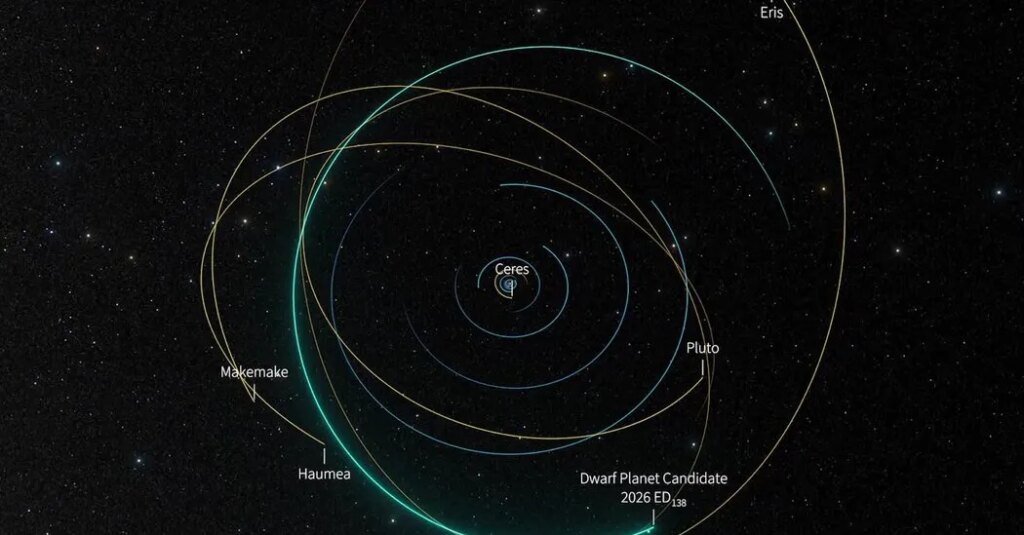
In 2006, the International Astronomical Union stripped Pluto of planethood and placed it in a new category: dwarf planet. This term now describes bodies big enough to be round but not big enough to be the gravitationally dominant bullies in their orbital paths.
Twenty years later, the Vera C. Rubin Observatory has delivered evidence of the newest possible dwarf planet, which is currently about 4.3 billion miles from the sun.
“This is hopefully just the first of many finds,” Mario Jurić, the lead solar system scientist for the Rubin Observatory, said during a news conference on Tuesday at a meeting of the I.A.U.’s division for planetary sciences in Spokane, Wash.
The discovery does not directly argue for or against the existence of Planet Nine, a body between the size of Earth and Neptune that some astronomers predict exists even farther out in the solar system.
“But it is evidence that we have the capacity to find things and that there are amazing things left to be found,” said Matthew Holman, an astrophysicist at the Center for Astrophysics in Cambridge, Mass.
Even if it turns out that Planet Nine does not exist, “there could easily be a Mars-sized object out there that just hasn’t been found yet, or bigger,” he said.
Operated by the National Science Foundation and the United States Department of Energy, Rubin repeatedly scans the night sky from a mountaintop in Chile. Dr. Jurić said the observatory has already discovered about 2,300 objects beyond Pluto. “That’s increasing the known population by about 50 percent,” he said.
This newest one, with the temporary designation of 2026 ED138, is the biggest of the bunch.
“In some senses, it’s not a big surprise,” Dr. Holman said. “But that doesn’t mean it’s not exciting.”
Indeed, simply spotting ED138 did not require a world-class telescope like Rubin. “It is, in fact, bright enough that very capable amateurs can find it with their equipment,” Dr. Holman said.
In any single image, ED138 appeared simply like a bright star. Someone looking at images taken of the same part of the sky on different nights would be unlikely to notice that one of the bright dots had shifted position.
But computer software developed by Dr. Holman and a colleague, Kevin Napier, did notice a couple of weeks ago, when it analyzed images Rubin had taken between March and July.
Crucially, the software connected a dot on one night with others on later nights and figured out that they are the same object in motion. The pattern of dots revealed ED138’s orbit, which is tilted at an angle of almost 25 degrees from those of the planets. The brightness indicated it was a pretty large object.
“One of the things that you need to do when you discover something potentially of this size is really try to verify that it’s true,” Dr. Holman said.
Tracing the orbital path back in time, the team found that the same dot also appeared in earlier images taken by other telescopes, confirming the discovery.
“When you know where to look, it’s easy to find,” Dr. Holman said. “But before that, it’s a needle in a haystack.”
Based on the brightness, distance and assumptions about the reflectivity of ED138’s surface, the astronomers could estimate its size. If ED138 is relatively bright and shiny, it could be as small as 370 miles, Dr. Holman estimated. If it is dark, it could be as wide as 930 miles.
In the astronomical union’s definition, a dwarf planet has to be large enough so that its gravity has pulled it into a round shape. For icy bodies like those in the outer solar system, scientists expect that objects more than 250 miles in diameter are likely to meet this requirement. However, ED138 and other dwarf planet candidates are too far away to confirm their shapes.
The astronomical union has not added to the dwarf planet roster since it named the first five in 2006. Those are Ceres, the largest asteroid; Pluto; Eris, the world that led to Pluto’s demotion; and two objects beyond Neptune, called Haumea and Makemake.
At the top end of the size estimates, ED138 would rival Haumea and Makemake. Both Pluto and Eris are considerably larger, more than 1,400 miles wide.
At the lower end of the size estimates, ED138 would rank around the 20th largest among dwarf planets and dwarf planet candidates.
Dr. Holman speculated that ED138 originally formed closer to the sun, somewhere around Jupiter and Saturn, and was then flung outward when it passed close to one of the giant planets.
In the coming years, astronomers could learn more about ED138 as other instruments such as NASA’s James Webb Space Telescope take more detailed measurements.
If it turns out that ED138 possesses a moon — common for many of these objects in the outer solar system — the moon’s orbital period would provide a measurement of both objects’ total mass.
Astronomers could also learn more based on what they do not see. ED138 is currently passing through a crowded part of the sky where it is likely to pass in front of distant stars in the Milky Way galaxy, briefly blocking out their starlight. That will provide better estimates of ED138’s size and could even offer hints about whether it possesses an atmosphere.
“All kinds of really wonderful science could come from that,” Dr. Holman said.
The post A New Dwarf Planet (Probably) Spotted Beyond Pluto appeared first on New York Times.