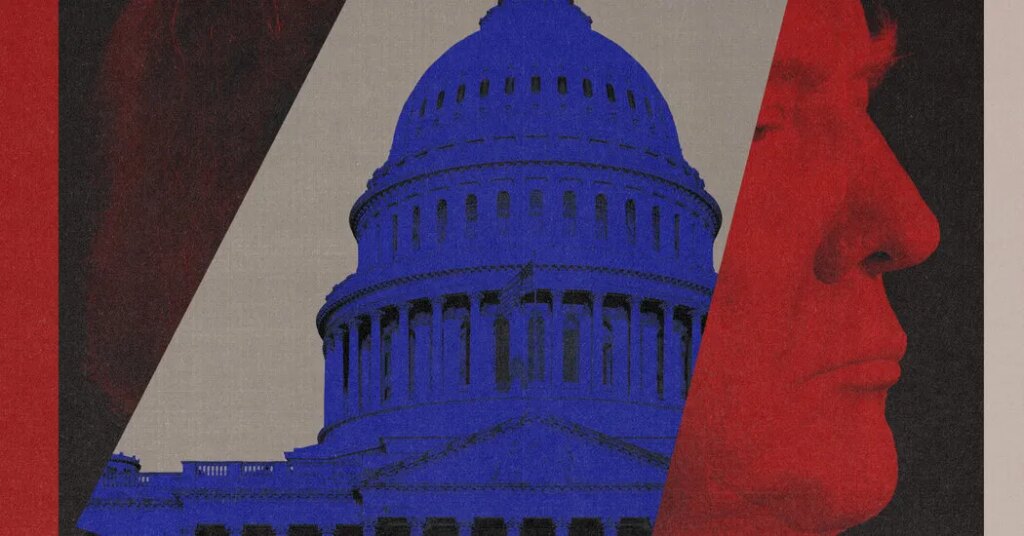
If, as expected, Democrats take control of at least one chamber of Congress in the midterm elections, power in Washington would shift from unified Republican control to divided government.
How will President Trump respond to that? What will Democrats do with institutional power? Will the open presidential primaries of 2028 for both parties have any effect on all this?
Frances Lee, a political scientist at Princeton, assessed these questions in a written conversation with John Guida, an editor in Times Opinion. It has been edited for length and clarity.
John Guida: Let’s assume, based on consensus polling, that we have divided government, with Democrats controlling at least the House for the next two years. What might come next for President Trump, Republicans and Democrats? Let’s start with Trump.
Frances Lee: Divided control of national government will make Trump less solely responsible for outcomes. He will be able to blame Democrats for not acting on his priorities in ways that were less available to him when dealing with Republicans during his first two years of office. He may be able to get some mileage out of that conflict.
Guida: How did Trump handle a newly Democratic House in the final two years of his first term?
Lee: That Congress, the 116th (2019-20), actually turned out to be a remarkably legislatively productive two years. That’s largely a story of the extraordinary response to Covid: $3 trillion in new spending in 2020 alone.
But there was more that got done than Covid, at least on second-tier issues: legislation implementing a new North American trade agreement; paid parental leave for federal workers; legislation to reduce generic drug prices; and multiple national parks enactments. So some degree of bipartisan cooperation persists, even in a Congress that also featured two presidential impeachments! It’s not the case that national government is totally gridlocked during divided government, even in today’s polarized politics.
Guida: Do you think the aggressive use of executive power in Trump’s second term makes that cooperation more difficult? I’m thinking of areas like immigration, investigations by the Justice Department of political opponents or in conflicts between the White House and Congress over spending authority.
Lee: It’s rather astonishing how aggressive Trump has been in using unilateral executive authority even under conditions where his party also controlled Congress. It’s honestly hard to see how he could do more on that than he has already done. He attempted to personally reset the United States’ trade relationship with practically every country in the world.
Obviously, with Democrats likely in control of at least one house of Congress, there will be more aggressive oversight as Trump uses these powers. They will have agenda control and will be able to highlight overreach, missteps and abuses of power. We should naturally expect very tough interbranch conflict. In Trump’s first term, the administration routinely stiff-armed congressional oversight.
Guida: How might Democrats handle that?
Lee: On issues like immigration, they will certainly hold more hearings on what the administration is doing. They will be able to shine a light on the collateral harms of the policies in ways that they are not able to do now. But Democratic leverage over ICE and C.B.P. (the U.S. Customs and Border Protection) will be less than normal, because those agencies are already funded for the balance of Trump’s term, as a consequence of the parties’ inability to reach agreement on appropriations for those agencies this spring. Republicans then went on to fund them via a party-line reconciliation.
Guida: You said above that Trump will be able to share blame in particular for things that don’t happen. In polling, voters have prioritized issues around affordability. Is there any chance of dealmaking between Trump and Republicans and Democrats in Congress?
Lee: Trump’s departures from conservative orthodoxy do open up some potential for cross-party dealmaking on issues such as capping credit card interest rates or lowering prescription drug costs.
That said, Trump is not strong as a legislative leader. He even has difficulty cooperating with his own party allies. He is constantly surprising them with new demands or withdrawing support at the last minute. Probably the most significant legislative effort this Congress on affordability issues was the 21st Century ROAD to Housing Act. This was a big bipartisan deal to lower some of the regulatory obstacles to building new housing and to open up some new financing alternatives to home buyers and home builders. But in the end, Trump pulled the rug from his own party leaders in Congress and refused to sign the package. It became law without his signature. If he has this much trouble working with his own party’s House speaker and Senate majority leader, how hard will it be to get anything done working with Democrats?
Trump prefers to do things on a unilateral basis. This is not likely to change in any way in his last two years as president. This approach clearly leaves his legacy more vulnerable to reversal by successors than if he could actually get legislation enacted. Indeed, much of what he did this way in his first term wound up being undone by President Biden.
Guida: A cliché in politics is that the 2028 election begins the day after the midterms. How much, if at all, do you think the incentives of 2028 might shape what happens in the next two years?
Lee: The Republican Party will be facing large questions about its basic policy commitments in both foreign and domestic policy. The factional lines are already drawn: whether there will be a return to the values of Reagan Republicanism or whether instead policy will follow more directly from Trump’s heterodoxies on trade, international alliances, entitlements and many other matters.
Democrats have clearly been facing considerable frustration and restiveness from their base voters on whether they have been standing up to Trump sufficiently. It will not be easy for them to cooperate with the administration, given these political pressures.
Both parties have an interest in credit claiming for doing something on the issues that matter most to Americans, such as affordability. But I have my doubts as to whether those interests will take precedence over the larger internal party pressures. After all, nothing that Congress can do legislatively is likely to move the needle much on affordability on any near-term basis. So my suspicion is that the next two years are unlikely to see major policy action on domestic policy issues.
Guida: You have emphasized that in American politics right now, power changes hands frequently between the parties from election to election. When Democrats or Republicans gain power, they often use it to enact items from a narrow partisan agenda.
Lee: Intense party competition for majority control of Congress limits bipartisan dealmaking. If there is reason to think that the majority party will shift or is likely to shift, then the party with less power now will prefer to hold off on cutting deals on major issues in hopes of getting something better in two years.
Beyond that, both parties will be preoccupied with driving narratives in the media aimed at winning advantage in that future electoral contest. The minority party will want to denounce the party in power for doing a bad job.
It cannot do that effectively at the same time as it is striking deals with that party and shaking hands on policy enactments that they can both support. The minority needs to withhold cooperation, propose partisan alternatives and message about how they would do a better job.
So all these dynamics will be very much in play across the next two years.
Guida: Is this arrangement, which has structured so much about politics, at the root of voter dissatisfaction that has been endemic for decades?
Lee: It undoubtedly fuels voter frustration. Every election they’re told that this is the most important election of their lifetimes. But then they discover that major breakthroughs don’t happen on the policy front after elections are over. Legislation generally requires significant bipartisan cooperation to get done, with the exception of reconciliation enactments that get around some of the normal veto players.
In an environment like this, there is a preoccupation with politics over policymaking. Nobody is able to think long term about policy, because our politics is so profoundly unsettled and there is no confidence about who is likely to have power after the next set of elections. Indeed, every election seems to yield a rough 50-50 outcome: This just doesn’t provide much clarity to elected officials about what voters actually want from national politics.
Guida: You have identified how our “unsettled politics” have shaped our system in two distinct ways. One is in how policy is made, more and more often by executive power; the other, in how parties respond to the shorter time horizons imposed by power shifting back and forth so often between them.
Lee: The parties often look to presidents to achieve policy outcomes that they cannot legislate.
This is one of the surprising features of our current politics. Even though Trump continually outrages Democrats with his actions, Democrats are not forcefully criticizing his aggressive use of presidential power. They criticize his specific policy actions, but they rarely denounce them as usurpations of legislative power. Clearly, Democrats would like to see a future Democratic president act boldly as well. So the current conditions incentivize presidents to go around Congress. And Congress tolerates, even sometimes promotes it.
The short-time horizons manifest in a “go for broke” attitude when parties have trifecta control. No one seems to expect it to last. So the idea is to do as much as you can as quickly as you can.
Guida: Your recent paper on the Trump-Republican One Big Beautiful Bill Act of 2025 digs into the process of how big laws are typically achieved today. They require unified, one-party control of the presidency and Congress. And the bills are often done through the reconciliation process, which allows the majority party to avoid a filibuster and pass bills on a simple majority vote.
Lee: It is a way of enacting huge party wish lists. In each presidency with unified control since the Clinton years, the administration has used a reconciliation enactment to get some big policy wins on their priorities. This is how both George W. Bush and Trump got their signature tax cuts done. Obama used it to get his health care reform done after Democrats lost their 60-vote majority in the Senate. It’s how Biden did his Inflation Reduction Act.
These are tough bills to pass and it’s not unusual for parties to fail at the effort. They are swinging for the fences, and sometimes they strike out, as Republicans did when they attempted to repeal and replace Obamacare in Trump’s first term and as Biden attempted to do with the Build Back Better agenda. But this is a party’s ticket to getting some big wins. Trump utilized it with his One Big Beautiful Bill, which put through his full domestic policy agenda, including making his earlier tax cuts permanent along with an array of other priorities, in one single legislative vehicle.
Guida: What do these massive bills miss by being done on a party basis?
Lee: This kind of “go for broke” attitude winds up producing backlash. The minority party denounces them vociferously and campaigns against them. Neither party’s agenda is all that popular. And these big bills are likewise usually rather unpopular. These efforts generally get interpreted as overreach. In our polarized era, no party has been able to hold onto trifecta control for long. So this dynamic perpetuates insecure majorities.
Guida: Is insecure-majority politics sustainable?
Lee: We seem to be stuck in a recurring cycle. It has been a very long time since we’ve seen a truly decisive election in American politics. There has been no landslide since the 1980s. This fact means that elections fundamentally don’t settle much in terms of the future direction of policy. Parties try to make the most of any opportunity they get.
But the meaning of elections is contested. The two parties don’t agree on what to conclude from election outcomes. There is not so much sense that the “people have spoken.” The party out of power expects to be able to get back in — and soon. And they have generally been right about that.
Guida: We have seen potential emerging realignments come and go: the emerging Democratic majority, Trump’s multiracial working-class coalition in 2024, which polling strongly suggests has crumbled. Is it possible to see the emergence of a majority party in 2028?
Lee: This is one of the most mysterious features of our contemporary politics. We have been stuck in this trench warfare, closely competitive party politics for decades now.
But this pattern of politics is not the norm for U.S. history. It used to be conventional wisdom that American politics could be understood in terms of a “sun party” and a “moon party,” meaning that there was a dominant party and a secondary party and the major issues of the day would get fought out among factions in the dominant party. That seemed to be the pattern across the 20th century, where the New Deal coalition dominated national politics for so long. The Jacksonian Democrats were similarly formidable during the 19th century. The Republican Party predominated from 1894 through until the Great Depression, with the exception of a brief stretch of closely contested politics during the Progressive Era. Why is our own era so different?
Guida: You don’t seem very confident that the political system will change much in the next two years. What in the future might bring about change?
Lee: Top leadership of both parties will be very much up for grabs looking to 2028. Not just in terms of personnel, but also in terms of ideological commitments. Will Trump leave office regarded by his own party as an embarrassment, as has happened to a number of other recent presidents? Or will he be a kingmaker?
That outcome will have major effects on whether the G.O.P. continues following the Trump mode or whether there is some return to conservative orthodoxies. Things are also wide open in the Democratic Party. It is a fluid time in national politics.
Frances E. Lee, a professor of politics and public affairs at Princeton, is the author of “Insecure Majorities: Congress and the Perpetual Campaign” and, most recently, “A Case for Congress.” John Guida is an editor in Times Opinion.
Source photographs by Kent Nishimura and Thanasis/Getty Images
The Times is committed to publishing a diversity of letters to the editor. We’d like to hear what you think about this or any of our articles. Here are some tips. And here’s our email: [email protected].
Follow the New York Times Opinion section on Facebook, Instagram, TikTok, Bluesky, WhatsApp and Threads.
The post What Would Divided Government Mean for Trump? For America? appeared first on New York Times.