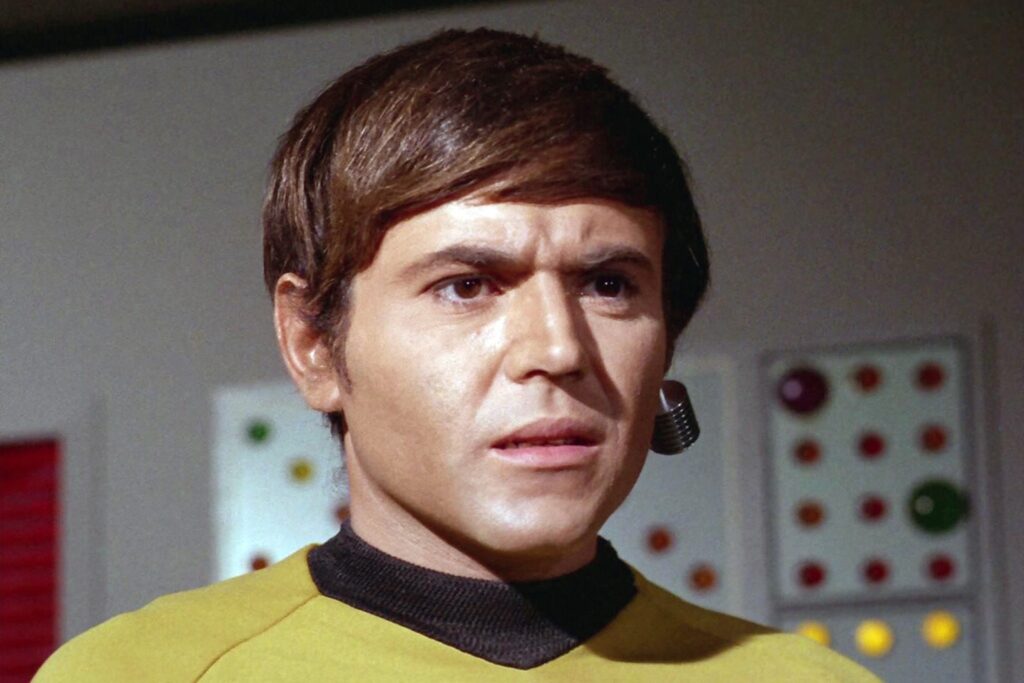
Walter Koenig, an American actor whose skill with accents earned him an enduring place in popular culture as Chekov, the Russian ensign and starship navigator in the “Star Trek” TV and film phenomenon, died Oct. 25. He was 90.
Mr. Koenig died Sunday night in Los Angeles, his agent, Zachery McGinnis, said. The cause was “old age,” he said.
The son of Jewish immigrants from Lithuania, Mr. Koenig (pronounced “Kaynig”) was a journeyman on stage and TV who developed a specialty in ethnic parts. He was a Swedish businessman in the sitcom “Gidget” and a French resistance fighter on the drama series “Jericho,” among other roles, before he joined “Star Trek” in 1967 in the second of its three original seasons.
The NBC series delivered allegorical tales about violence, prejudice and war — the turbulent social issues of the Vietnam and civil rights era — in the guise of a 23rd-century intergalactic adventure set aboard the starship Enterprise.
William Shatner as the heroic Capt. James T. Kirk led a cast that also included the logic-driven, half-alien first mate Spock (played by Leonard Nimoy) as well as a rainbow federation of nationalities and races, including Nichelle Nichols as communications chief Uhura, James Doohan as chief engineer Scotty and George Takei as the helmsman Sulu.
Airing amid the Cold War, “Star Trek” presented a utopian vision of the future. When producer Gene Roddenberry decided to add a Russian crew member, he sought an actor capable of a serviceable accent but who also had the teen heartthrob appeal of Davy Jones, a moptopped singer with the Monkees.
As Pavel Andreievich Chekov, Mr. Koenig had the requisite smooth, boyish face but, for good measure, was fitted with a Jones-like wig to cover his premature and expanding bald spot (he was 30). The response from viewers was immediate, he told the Television Academy Foundation, recalling that he received canvas bags stuffed with hundreds of letters from young girls declaring “I think you’re groovy” and “I love your hair.”
His fear — barrels of hate mail directed at him for playing a sympathetic Russian — never materialized, perhaps because his fans were mostly youngsters with little interest in Cold War politics.
The only negative feedback, he said, came from college-age Russian studies majors who accused him of botching or exaggerating Chekov’s Russian accent when he spoke lines about “nuclear wessels.” “There are no W’s in the Russian language, and as a result I shouldn’t be inverting V’s and W’s when I talk,” he said they told him.
“However,” he added to the Las Vegas Sun, “my father spoke that way, and my father was a Soviet-bloc immigrant who spoke Russian fluently. . . . So that was a little annoying, from time to time, to be told I don’t speak correctly.”
Over his two seasons as Chekov, Mr. Koenig said he struggled to find motivation beyond a steady paycheck in what he felt was a cipher of a role. By his telling, he was given little to do beyond telling Kirk, “Aye, aye, Captain” or “warp factor 4, Captain.”
For all its later acclaim and perpetual reruns in syndication, “Star Trek” received poor reviews and ratings and was canceled after three seasons. An animated “Star Trek” aired in the early 1970s, but Chekov was left out because of what Mr. Koenig described as the stinginess of the producers.
Communities of costume-wearing fans known as “Trekkies” or “Trekkers” soon burst forth at large-scale conventions, where Mr. Koenig was a mainstay. The groundswell of support — not to mention the success of “Star Wars” in 1977 — led to six “Star Trek” films featuring most of the original cast, including Mr. Koenig reprising his role.
He also had a cameo in “Star Trek Generations” (1994), starring Patrick Stewart as a new Enterprise captain named Jean-Luc Picard and a fan-funded TV series in the 2010s called “Star Trek: Renegades” in which Chekov obtained the rank of admiral.
Mr. Koenig participated in many video-game spin-offs, part of the entertainment and merchandising empire equaled perhaps only by the James Bond, Star Wars and Harry Potter franchises.
By Mr. Koenig’s account, “Star Trek” spin-offs brought him moderate financial security, but the role of Chekov hindered the rest of his career. After the show went off the air in 1969, “I didn’t get an interview for a part for two years,” he told the St. Petersburg Times. “It wasn’t that I interviewed badly. … They wouldn’t even let me in the door. Most of the ’70s, I didn’t work at all, and I blamed it on typecasting.”
He said he was too old to play youthful characters but not mature enough for roles as doctors and lawyers. During a prolonged despair, he later ruefully recalled, he considered selling vacuums door-to-door or driving a taxi. He began writing scripts for TV series such as “Family” and “The Incredible Hulk” but was frustrated when they were rewritten to the point of unrecognizability.
He returned to acting and worked in regional playhouses. In one of his most acclaimed performances, he played an aged Tom Sawyer in a 1990 Los Angeles Art Theatre staging of “The Boys of Autumn,” about the Mark Twain character’s reunion with his mischievous boyhood buddy Huck Finn.
Reviewing the show for the Los Angeles Times, critic Ray Loynd called Mr. Koenig’s Tom and Mark Lenard’s Huck “vivid and even sublime performances.”
After recovering from a heart attack in 1993, Mr. Koenig won a recurring role on “Babylon 5,” a syndicated sci-fi show, as a sinister mind reader named Bester.
“It’s fun to be the bad guy,” he told the St. Petersburg Times in 1998. He said he was “tickled” to be seen not as “one-trick pony, but as someone they might respect for more than what I’ve done on ‘Star Trek.’ That would be nice.”
Walter Marvin Koenig was born in Chicago on Sept. 14, 1936, and grew up in Manhattan. His father (whose surname had been Koenigsberg) bought and resold “everything from sunglasses to elevators, whatever he felt might turn a profit.”
Mr. Koenig entered Grinnell College in Iowa as a premed major and transferred to the University of California at Los Angeles, where he received a bachelor’s degree in psychology in 1958. At UCLA, he took an acting class on a lark and so enjoyed the chance to shed his natural “wallflower” personality that he said he felt a calling.
He spent two years at the Neighborhood Playhouse workshop in New York. Back in Los Angeles, he won the roles that culminated in “Star Trek.” He said he had never watched the series before he was offered the part of Chekov, other than once coming across the show while flipping channels and finding its obviously phony “Styrofoam rocks” a laughable turnoff.
His first marriage, to actress Anjanette Comer, ended in divorce. In 1965, he married actress Judy Levitt, and they had two children. In addition to his wife, survivors include their daughter, actress and writer Danielle Koenig. His son, actor Andrew Koenig, had depression and died by suicide in 2010.
He is survived by his daughter and a grandson.
Mr. Koenig wrote a memoir, “Warped Factors: A Neurotic’s Guide to the Universe” (1997).
“One of the great frustrations in my life is that the breadth and depth of my contribution as an actor, as far as the general public is concerned, has been the character of Chekov,” he told the Los Angeles Times in 1992, calling the part a “minor contribution.”
“What I would like is for the attention, the positive feedback, to come with a contribution that is worthy of it,” he continued, before referencing his work as Tom Sawyer in “The Boys in Autumn.” “When I do this play and people say, ‘You were really good,’ ‘We really like watching you work,’ ‘We really like you,’ then it means so much to me. Then it is not just because I was part of something famous.”
The post Walter Koenig, Russian navigator Chekov on ‘Star Trek,’ dies at 90 appeared first on Washington Post.