Republican campaigns and political action committees have spent nearly $3 million at President Donald Trump’s businesses since he returned to office, according to a Washington Post analysis of federal campaign finance records.
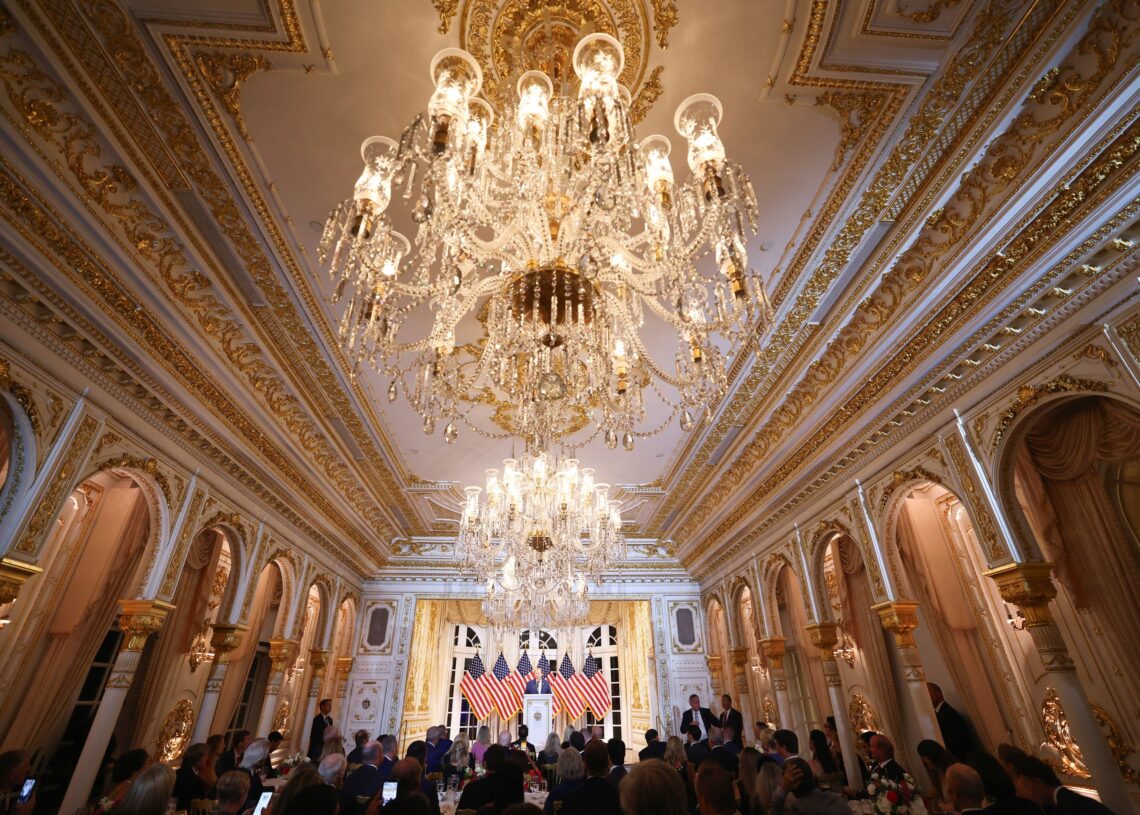
The spending has continued even after Trump’s Washington hotel — once the hub of his first-term political and fundraising orbit — stopped operating under the Trump Organization. Instead, GOP money has shifted south to Mar-a-Lago.
Spending at the Florida club has more than tripled, adjusted for inflation, compared with the same period of his first term.
From January 2025 through last month, Republican Senate and House campaigns and political groups spent $2.9 million on fundraisers, rooms, meals and other expenses at Trump’s resorts, The Post found. That is down from $3.3 million in inflation-adjusted dollars during the comparable period of Trump’s first term.
But the decline came despite the loss of the Washington hotel, a property that once accounted for much of the spending. While overall spending has decreased slightly, the continuing money spent shows an enduring financial link between the Republican Party’s political apparatus and the private businesses of the president who leads it.
At Mar-a-Lago, spending has more than tripled since the first term in today’s dollars, according to the analysis, which included the most recent publicly reported data through September. And though Trump still derives income from his Florida properties, those profits in his second term have been eclipsed by his more lucrative cryptocurrency ventures.
“The fact that the D.C. hotel doesn’t exist now makes it all the more astounding that they’re generally keeping up with their spending from the first term,” said Robert Maguire, the research director for the Citizens for Responsibility and Ethics, who reviewed The Post’s analysis. “They don’t even have a place that’s close to Congress anymore, and they’re still making their way down to Florida as much as possible.”
The spending has included fundraisers at Mar-a-Lago, meals and rooms at Trump resorts. Campaigns have bought gifts from Trump’s merch shops and wined and dined donors at Trump properties. Lawmakers and lobbyists are willing to fly hundreds of miles from their districts and Washington to spend money at properties the president owns.
The pace of spending has slowed in recent months — as Trump’s approval rating has dropped to lows and polling has shown Democrats are likely to win control of the House. From June to the end of September, Republican groups spent $336,000 at Trump businesses, down from $949,000 during the comparable period of Trump’s first term, or $1.3 million in today’s dollars.
The analysis excludes spending by Trump’s campaign and his related affiliated political committees. Federal filings also do not capture unreported spending by so-called dark-money groups.
The Republican National Committee was the largest spender, with nearly $1.8 million in charges at Trump properties, followed by Trump’s flagship super PAC, MAGA Inc., and the National Republican Congressional Committee. Next on the list: the PAC and House committees supporting Rep. Ronny Jackson (Texas) and GOP candidate Joe Mitchell (Iowa), two of Trump’s most ardent backers.
The RNC and NRCC said Trump’s properties are the best venues for their fundraising efforts.
“From donors to members to grassroots supporters, our stakeholders love these venues, and their popularity is part of the reason the RNC has been able to raise a record-setting war chest this cycle,” RNC spokeswoman Natalie Baldassarre said in a statement.
“We hold events where donors want to show up, and that’s Mar-a-Lago,” NRCC spokesman Mike Marinella said. “Every one of those events raised far more than it cost, perhaps that’s why the NRCC has repeatedly broken fundraising records as we continue to outraise the Democrats.”
Jackson, who used to be Trump’s personal physician, has maintained a close relationship with Trump, receiving a nomination to lead the Department of Veterans Affairs in the first term. He withdrew from consideration amid allegations of misconduct, including alcohol abuse.
Team Ronny PAC, a joint fundraising committee with Jackson’s campaign, Texas Red and the NRCC, has spent more than $120,000 at Trump businesses. The PAC had one tab over $48,000 at the Mar-a-Lago Club in April the week of Jackson’s birthday party that featured a cake topped with a stethoscope and a poolside bar. Trump did not attend.
Jackson’s spokeswoman did not respond to requests for comment.
Mitchell’s campaign spent nearly $90,000 at Trump businesses, mostly at Mar-a-Lago. Mitchell is running in Iowa’s competitive 2nd Congressional District, where Democrats have cited the spendingat the Palm Beach resort as evidence that he’s out of touch with voters.
Drew Johns, Mitchell’s campaign manager, said Mitchell traveled to raise money for his campaign and accused his Democratic opponent of courting out-of-state donors.
“He traveled to raise money for his campaign just like his opponent, who frequently goes to the East and West Coast to convince radical leftists donors to try and buy a congressional seat that belongs to the people of Iowa,” Johns said in a statement.
Have a tip? Reach out to us.
Send a Signal message to Meryl Kornfield at merylkornfield.59
Less media attention has been paid to campaign spending at Trump properties than in his first term, as it has grown less novel and bigger conflicts compete for the public’s attention. Trump’s reported income — more than $2.2 billion in 2025 — has largely come from new ventures rather than his properties this time around. The president took in more than $1.4 billion from cryptocurrency, digital tokens and related partnerships last year, according to his most recent disclosure.
“The numbers in the billions have frequently been thrown around with respect to the crypto companies dwarf all the spending at his hotels and restaurants,” said Andrew Mayersohn, a researcher at OpenSecrets, which ran a tracker of campaign spending in the first term.
The post Trump’s D.C. hotel is gone. Republicans still pay millions to his businesses. appeared first on Washington Post.