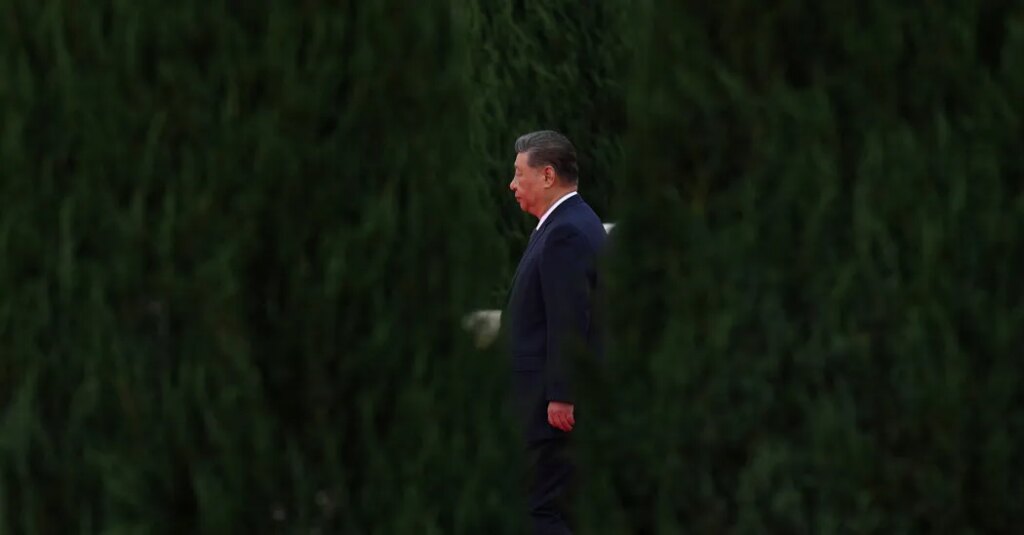
For more than a decade, the Chinese leader Xi Jinping has used a storm of corruption probes and loyalty campaigns to bring the country’s officials to heel.
Now, as Mr. Xi, 73, prepares to claim five more years in power, he is complaining that some officials are still disloyal, apathetic and corrupt, and has said that tougher measures are needed.
The relentlessness of Mr. Xi’s campaign for control was on display this month when the Communist Party announced an investigation into Huang Qifan, the former mayor of Chongqing, a city in southwest China. Mr. Huang remained prominent after leaving office and had survived the downfall of several party officials under whom he had served. Such investigations almost always culminate with the imprisonment of the official.
The news about Mr. Huang came just before the party’s elite Central Committee prepared to gather this week in Beijing. During a four-day meeting, the group of several hundred officials is expected to lay the groundwork for Mr. Xi to secure a fourth term as party leader next year and also approve strict rules for scrutinizing officials.
The party is preparing for its next party congress, a gathering that takes place once every five years to announce a leadership overhaul. During that congress, in late 2027, Mr. Xi must appoint a new cohort of younger officials to work under him. That backdrop might explain his renewed fixation on enforcing obedience, experts say.
“What does Xi want his legacy to be? I think first and foremost, it is a stronger Communist Party, perhaps even more than a stronger China,” said Neil Thomas, a senior fellow on Chinese politics at the Asia Society Policy Institute. “The first is the foremost prerequisite for the latter as far as he’s concerned.”
Another five-year term would cement Mr. Xi’s status as China’s most dominant leader in decades, particularly because he has no obvious successor.
But Mr. Xi “remains perpetually disappointed by the people expected to carry out his wishes,” Mr. Thomas and his colleagues wrote in a preview of the party meeting.
The current Central Committee had 376 members when it formed at the last party congress in 2022. But Mr. Xi’s purges have taken a toll. At the committee meeting last year, attendance was down to 315 officials, and the number this week could fall to around 300 or fewer, given the officials who have been expelled, investigated or disappeared.
Mr. Xi said in a speech early this year, which was published this month, that too many officials fail to faithfully implement orders and instead feign obedience. Some were “two-faced,” concealing their disdain for party rules and values behind a mask of loyalty, he said. Likening corrupt officials to diseased trees, he said, the party should “pull out the sick trees that should be pulled out, chop down the ones that should be chopped down.”
A big part of Mr. Xi’s agenda is the grinding chore of running the Communist Party with its 101 million members, many of them officials. That party apparatus is how Mr. Xi oversees the world’s second biggest economy and controls 1.4 billion people. Since taking power in 2012 he has revived his party’s power by extending its reach into factories, villages, schools and virtually every corner of society.
The Revolution of the Self
Mr. Xi appears to believe that the problems in Chinese officialdom are rooted in a lack of discipline and ideological backbone. His remedy for that is “self-revolution,” a program of constant inspections, self-evaluations and criticism sessions intended to keep cadres on their toes.
“Self-revolution” is not slowing. In 2023, inspectors punished 49 officials in provincial or ministerial-level posts and 24,000 in county-level posts; last year, the corresponding numbers were 69 and 35,000, according to official statistics.
Mr. Xi’s purges have lately been most intense in the military. Early this year, China’s topmost general, Zhang Youxia, was detained and accused of corruption and disloyalty. Since 2022, around 100 senior officers have been put under investigation, or simply disappeared, likely under investigation.
“The anticorruption campaign is not a campaign anymore, because it’s become so normalized,” said Ling Li, a lecturer in Chinese politics and law at the University of Vienna. “On the one hand, it has made the carrot for officials smaller because of the reduced opportunities for corruption. On the other hand, the sticks are getting heavier.”
The scrutiny of officials is likely to grow ahead of the party congress next year. China’s economy has slowed under the weight of a prolonged housing crash, which has also devastated the revenues of local governments that long relied on land sales. Mr. Xi wants to ensure that despite all that pain, officials stay committed to his rule and to his agenda of building China into a technologically advanced superpower.
“History shows that in times of difficulty, divergent voices may emerge when the party congress congregates,” Ms. Li said. “An injection of fear will make consensus easier to achieve.”
One jolt of fear may come from the downfall of Mr. Huang, the former Chongqing mayor.
Mr. Huang, 74, retired from major official posts eight years ago, but he enjoyed an outsize public profile, making speeches and writing books on economic issues. But then investigators announced that he was under investigation for “severe violations of party discipline and the law.” Last week, the party also said Xia Linmao, a deputy mayor of Beijing, was under investigation.
Is a Former Anti-Graft Enforcer in Trouble?
Other recent moves by party investigators suggest that Mr. Xi’s suspicions may extend even higher, perhaps to Wang Qishan, 78, the former leader of the Central Commission for Discipline Inspection. Mr. Wang oversaw Mr. Xi’s anticorruption campaign in its first phase, and is now retired.
Several of Mr. Wang’s longtime aides — including Zhou Liang, a financial official, and Li Xiaohong, a disciplinary official — have been detained on suspicion of corruption. Dong Hong, another former secretary of Mr. Wang, was imprisoned on corruption charges in 2022. This year, two of Mr. Wang’s former subordinates were demoted from the Central Commission for Discipline Inspection, suggesting that they too might be under a cloud.
The reasons that Mr. Wang’s aides have become targets are not clear, and Mr. Wang himself has not been accused of wrongdoing. But the cases have prompted speculation that Mr. Xi is wary of the influence that retired officials could retain through their networks and protégés.
“I could see Xi thinking that Wang, even though he did so much of Xi’s hatchet work for him, stands as one of the few people with the wherewithal and maybe the sheer chutzpah to be a pain for Xi,” said Jonathan Czin, a researcher on Chinese politics at the Brookings Institution who formerly worked in the Central Intelligence Agency. “It’s about Xi’s mind-set and his perception of risk.”
The downside of the seemingly endless scrutiny is that Mr. Xi may find it harder to ensure millions of junior officials remain motivated. A recent study has found that officials are often afraid of taking risks. They are sometimes flat-out demoralized.
“Local governments, especially those in rural areas, don’t have the capabilities and resources to meet all the demands that cascade down from the center,” said Benjamin Hillman, a professor at the Australian National University who was a coauthor of the study. “Local officials sometimes have to fake it.”
The post ‘Pull Out the Sick Trees’: Xi’s Constant Purges Pave Way for Next Term appeared first on New York Times.