Narendra Modi, the barrel-chested strongman leader of India for the past dozen years, has finally met his match — and it looks a lot like Mohini Majumdar. Just 20 years old, slender and voluble, Majumdar is an English student at Delhi University: an unlikely antagonist for an omnipotent autocrat.
Yet early on Oct. 10, she shared an early morning taxi to the center of Delhi with a gaggle of classmates. Dressed casually in flowing cotton and sensible shoes, Majumdar and her friends could just as easily have been on their way to a stroll in one of this city’s splendid gardens. But their plan, she told me, was to march across the street to a place called Jantar Mantar, a historic monument at the center of Delhi that has for decades served as a designated ground for protest.
They had been there before, over the summer, joining thousands of other young people in raucous, meme-driven protests after a leaked paper led to the cancellation of a college entrance exam. Eventually, under the banner of the upstart Cockroach Janata Party, they forced the resignation of India’s education minister. It was the first time Modi’s government had dismissed a top official under pressure from public protests.
Now, they were back for an even bigger fish: Modi’s handpicked chief election commissioner, who had overseen the deletion of more than 130 million people from the country’s voter rolls in a murky process that threatened to undermine faith in the voting process in the world’s largest democracy. “These kinds of protests really prove that you should be political, and everything is political in our life,” Majumdar told me as she waited for the march to begin.
She never did get to march that day. A few minutes after I spoke with her and her friends, a column of police officers decked out in camouflage descended on the students, manhandling them into a waiting bus. The officers drove them 40 minutes north of the city center and held them in a police station until after dark, eventually letting the women go; only when they refused to leave did the officers also release the men.
So great was the threat these students presented to Modi’s rule that his government reportedly deployed over 50,000 security personnel to the streets, shut down dozens of metro stations, blocked long-distance trains from arriving in Delhi and threw up yellow steel barricades across the capital, leaving its usually teeming streets eerily deserted. Majumdar was one of thousands of people detained that day by the authorities in an all-out attempt to quash the protest.
Despite these efforts, Modi appears more vulnerable than at any time since he was first elected prime minister. Young people like Majumdar, educated, middle-class and Hindu — the children of a generation that rocketed him to power — are in open revolt, incensed by the government’s derogation of education and democracy. Willing to risk detention and the baton blows of the feared lathi, they are setting out to make Modi, who has carefully managed his image as a civilizational figure who will lift India into glory, an object of fun. Majumdar, undeterred by her detention, joined another protest the very next day.
“The moment you oppressed me, the fear was gone,” she told me.
For Modi, it is a stunning turnabout. For over a decade, his rule seemed durable and unshakable. His rise to power, initially inconceivable and then inevitable, was a foretaste of the world to come. Before Brexit blew apart Britain, before Donald Trump ascended to the American presidency, before an influx of Syrian refugees turned European politics rightward, Modi led the world’s largest democracy toward a vision of nationalist, right-wing populism, promising a civilizational restoration.
Today, India is once again in the vanguard — this time leading, perhaps, in the opposite direction. As Modi has consolidated his power over this vast nation and its sprawling state apparatus, many Indians have grown weary of the bargain he has offered: growth and national prosperity in return for a hardening authoritarianism. Beset as Modi is by crises within and without, his iron grip on power is clanging against the steel of India’s messy democracy. As governments struggle and discontent flourishes worldwide, the country offers a lesson for us all.
When I moved to India as a correspondent for The New York Times in 2009, I discovered a place brimming with optimism and ripe with possibility. Fresh off an election victory, the Congress Party formed a sturdy coalition government led by Manmohan Singh, a soft-spoken, teetotal technocrat with a Ph.D. in economics. Unfettered by its most irksome left-wing coalition partners, his government would be free to make deep reforms and get India’s economy soaring.
It didn’t work out that way. Indians saw their dreams of prosperity founder in the wake of the global financial crisis, while their government was snarled in scandals of grubby self-dealing. An anti-corruption protest movement sprang up, expressive of deep discontent that Modi’s right-wing Hindu nationalist party rode to power. Modi pointed to the prosperous state he governed, Gujarat, and promised to do the same for the rest of India.
Abstemious and devout, Modi offered himself up as a servant leader with no personal interests to pursue beyond the uplift of the nation. For many Hindus, his assertion of Hindu pride and even supremacy proved enticing. That he allegedly stood by idly as hundreds of Muslims died in religious riots in the state he governed in 2002 — his role in this tragedy led the United States to deny him entry for nine years — was mostly ignored by the public.
One of the voters who rolled the dice on Modi was a man named Surender Kumar. I met him outside a popular market in Delhi, where he was waiting for passengers in his motorized rickshaw. Back in 2014, he was angry about corruption and thought it was time for a change. He cast his ballot, with some hesitation, for Modi’s Bharatiya Janata Party. But a dozen years on, he is disappointed. “The government came with certain kinds of promises during the elections, and none of them we see right now,” he told me. “Just to protect kingmakers in the government, they are letting kids be beaten.”
Though Kumar’s parents had been penniless manual laborers, he managed to leave their world of physical toil behind. Driving his rickshaw could net him between $200 and $300 a month, before expenses, a decent working-class living. But his son and daughter, growing into adulthood during Modi’s tenure, haven’t been able to make a similar leap.
Kumar could not afford private school or tutoring classes for them, so neither made it to college. His daughter studied cosmetology and opened a small beauty salon, but has struggled to make a go of it. His son works at McDonald’s, earning what his father describes as pocket change. Inflation eats away at his own earnings: The price of the natural gas that fuels his rickshaw has more than doubled, he told me. “You can’t name a thing which has retained its price,” he said. “Rice, cooking oil, mustard oil, cooking cylinders.”
Further up the economic ladder, among the middle-class Hindu families that make up many of Modi’s most fervent supporters, the struggle to provide economic advancement for the next generation is both all-consuming and increasingly uncertain.
In a sprawling, tree-filled apartment complex at the northern edge of Delhi, Shivani Sharma, a teacher, described a life that revolved around a singular goal: getting her 17-year-old daughter, Sanskriti, into a good public university and launched into a well-paying career. This has involved expensive private schools and costly tutoring sessions to sharpen her math and science skills in preparation for the relentless battery of highly competitive government-administered entrance exams.
“You have to have a very good score,” Sharma said. “Only then you can get entry into the Delhi University,” the prestigious school where she had gotten her bachelor’s degree in the 1990s.
For middle-class families, admission to a good public university is akin to a lottery ticket — the tuition is low and the credential confers real prestige. If Sanskriti does not make the cut, the family may have to come up with upward of $15,000 per year to pay for a private college. As it is, they struggle to keep up with her current educational expenses. In addition to running a school with her husband, Sharma earns extra money by tutoring children in the neighborhood. Her husband has a part-time job in a clothing showroom.
“We live simply,” she told me. “We don’t take international tours. We don’t wear expensive clothes. We don’t spend money here and there. We try to save money for our daughter’s education.” Sharma grew up in a big family, with five sisters and a brother. Yet none of her siblings has more than two children, she said. “We didn’t opt for the second child because I knew it’s very expensive and it’s very difficult to raise both the children and give them a good lifestyle and good education,” she told me.
Given the stakes, the leaked exam paper — expressive of deep corruption in the education system — rattled Sharma. “Some children committed suicide,” she said. “Only insiders can leak the paper. Who else can leak the paper? It’s a lot of corruption.”
Even a bachelor’s degree from a prestigious college is no guarantee in a country where graduate unemployment is at nearly 40 percent for those ages 15 to 29 and starting salaries are abysmally low. Food delivery drivers often earn more than entry-level tech workers with engineering degrees. To improve Sanskriti’s chances in life, Sharma said they are considering sending her abroad for a master’s degree. That would probably cost $100,000, an unfathomable sum that would require them to go into debt.
Young people across the country increasingly see this as a fool’s bargain, a debt-filled dead end. And they are not afraid to say so, loudly and publicly. Aditi (she goes by one name), the 29-year-old president of the students’ union at Jawaharlal Nehru University, is emblematic. Her parents are stalwart supporters of the B.J.P. But like many members of Gen Z, she rejects the empty promises of Hindu nationalism. “People have gotten bored with Modi’s narrative,” she told me. “Young people have tasted blood.”
Modi’s government has faced down discontent before. In 2019, a new citizenship law that targeted Muslims was rightly seen as an affront to India’s foundational ideal of secularism, enshrined in its constitution. But Modi was mostly able to wave that away as minority special pleading. Protests the next year by farmers, heavily drawn from India’s Sikh minority, could be dismissed as separatist agitation, even as the government mostly ceded to the farmers’ demands.
But this time, the protests have been driven in part by the concerns of the aspirational Hindu families that are the bedrock of Modi’s coalition. For many of these Indians, it may have been possible to ignore the ugly aspects of Modi’s rule, indeed to retreat from politics altogether and focus on building futures for themselves and their children. But many are realizing that all their hard work can be scuppered by a purloined exam answer sheet; by the devaluation of college degrees, which command little premium in an oversupplied labor market; and by a compromised election commission that could silence their most fundamental individual choice in a country of over 1.4 billion people.
Modi’s centralization — the very thing that seemed destined to consolidate his power — has become a booby trap. He captured and muzzled the mainstream press, especially television news, only for an enormous ecosystem of independent and influential journalists to rise up on YouTube and Instagram. He centralized the process of college examinations, leaving him no one else to blame when evidence of systemic leaking of exam papers emerged. His control over the election commission has left him with few options when faced with difficult questions over deleted voters.
Modi has also discovered that despite his efforts to project global leadership, his power quickly fades at the water’s edge. After promising to elevate India to great-power status, he has found himself stuck, subject to the mundane gravity of global events over which he has little control. He has suffered a series of embarrassments on the world stage, especially at the hands of the Trump administration.
What’s more, the pressure valve of migration is tightening. On the upper end of society, the dream of sending a child abroad, especially to the United States, is dying. On the lower end, uncertainty in the Persian Gulf is making migrant labor there a shakier proposition too. For a country that is the world’s largest receiver of remittances, amounting to roughly 4 percent of gross domestic product, that’s a big problem. That’s before you consider rising prices for fuel and tariffs on exports.
There will be no sudden fall for Modi. Though leaders in neighboring South Asian countries like Nepal, Bangladesh and Sri Lanka have been swept aside by youth uprisings, there is little chance of that happening here. India may seem like a chaotic and cacophonous place, and in many ways it is. Yet India’s government has always changed through the orderly process of elections, and Modi will not face the national electorate again until 2029.
But something profound has shifted. Modi’s aura of omnipotence and serene competence has been shattered. The protests have transformed his main challenger, Rahul Gandhi of the Congress Party, as well. They have given him the chance to shed his image as the pampered and ineffectual scion of a storied political dynasty. The political landscape, settled for so long, is suddenly altered.
India’s democracy has always been improbable. It is a society of boggling diversity and deep divides of religion, ethnicity and caste. Inequality, always pervasive, has deepened as the country has grown richer in ragged, uneven ways. And yet its constitutional democracy has endured, with the brief exception of Indira Gandhi’s emergency rule, since its independence from Britain nearly eight decades ago.
It is telling that this unexpected challenge to Modi’s power was catalyzed by affronts to two fundamental features of Indian democracy. As the political scientist Pratap Bhanu Mehta explained to me, taking exams and voting in elections are perhaps the two most important pillars of individual agency in India. Each contains the possibility of self-actualization, something that can seem nearly impossible in a country that is simultaneously so multitudinous and so hierarchical.
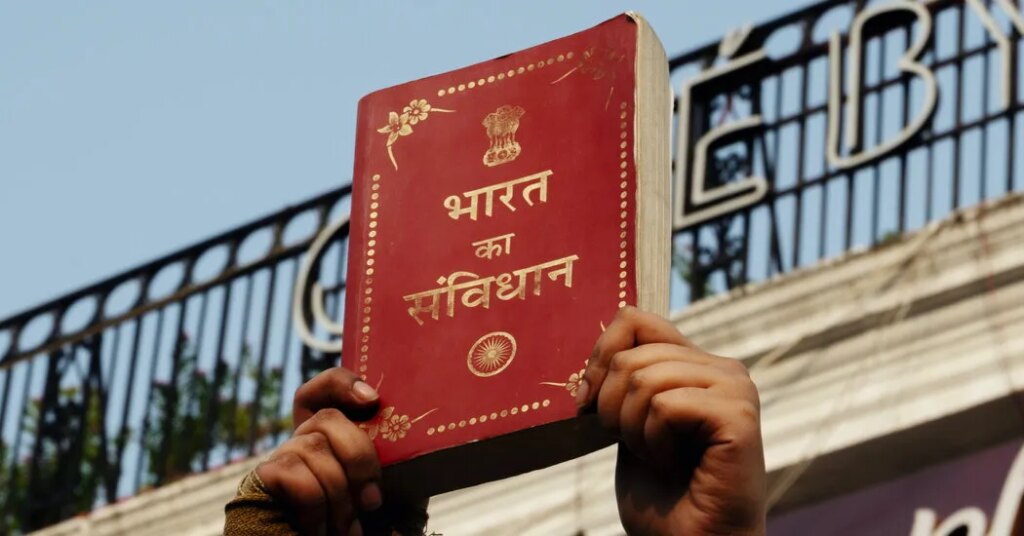
Exams hold the promise that anyone from anywhere, with enough hard work, can improve his or her station in life. Even more fundamental, if diffuse, is the individual franchise, which carries the notion that each citizen has an equal role in choosing who governs India. These two pillars, Mehta told me, are “the self-conscious revolt against caste, kinship, religion.” This is perhaps why copies of the Indian Constitution have figured so prominently in the protests, along with images of its main architect, Bhimrao Ramji Ambedkar.
It is easy to harbor romantic notions about Indian democracy. It is a project never before attempted in human history — for so many people with so much diversity to live together by common assent, under a written constitution that guarantees rights for all. For the past 12 years, India has engaged in a different experiment, one all too willing to brush aside the unfulfilled aspirations of the Constitution in the name of material progress and Hindu pride.
But a new generation of Indians has risen up, insisting that the price of that trade is far too high. Armed only with witty slogans and astonishing bravery, these young people have revived their country’s glorious tradition of nonviolent dissent. As peers from Paris to Tirana, Milan to Madrid, take to the streets demanding radical change, they would do well to look to Delhi as a guide.
Cinematography by Baljinder Singh.
The Times is committed to publishing a diversity of letters to the editor. We’d like to hear what you think about this or any of our articles. Here are some tips. And here’s our email: [email protected].
Follow the New York Times Opinion section on Facebook, Instagram, TikTok, Bluesky, WhatsApp and Threads.
The post I Went to India and Found It Has Lessons for Us All appeared first on New York Times.