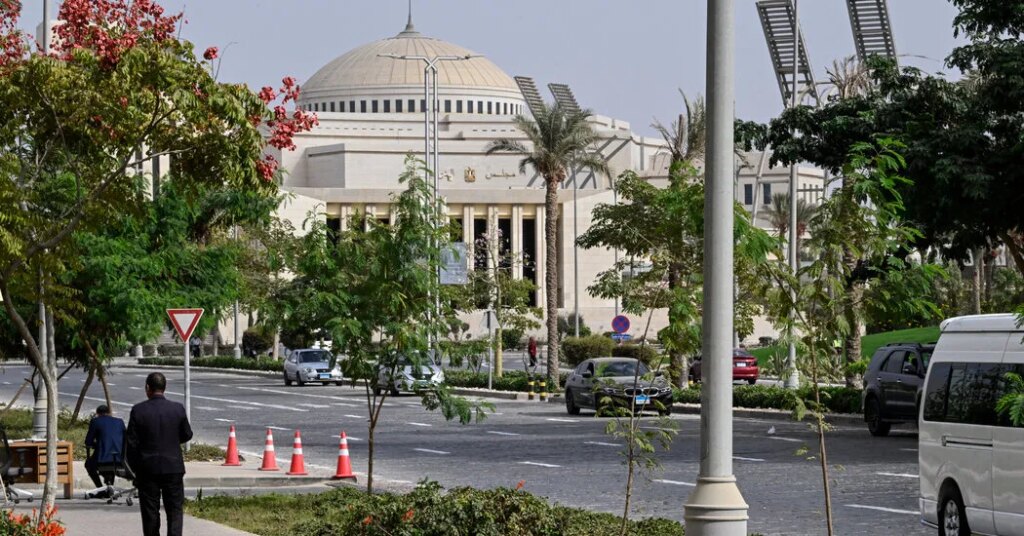
Egypt’s Parliament authorized the country’s military on Monday to provide support to Saudi Arabia in its escalating war against the Iranian-backed Houthi militia, Egyptian state media said.
The move, requested by President Abdel Fattah el-Sisi last week, risks drawing the Arab world’s most populous nation deeper into regional turmoil at a time when U.S. and Israeli officials are said to be drawing up plans for renewed attacks on Iran.
Egyptian officials have stressed that the military support will be purely defensive. Mr. el-Sisi said last week that Egyptian forces would operate only inside Saudi borders, and would not be involved in direct attacks on Houthi targets in Yemen, according to state news media.
In a statement, the Parliament said that the military support was aimed at “defending the kingdom’s territory, sovereignty and holy sites against any external aggression.”
Saudi Arabia has not commented on the Egyptian Parliament’s decision, and neither country has publicly confirmed a Saudi request for Egyptian military assistance. The kingdom has in recent weeks exchanged increasingly deadly strikes with the Houthis, who have hit Saudi airports and oil sites.
As the conflict escalated, President Trump rebuffed Saudi appeals last month to launch U.S. strikes against the Houthis. But the United States is providing significant military support, including intelligence in support of the kingdom’s Yemeni allies and refueling for Saudi warplanes conducting defensive air patrols, according to one current and one former U.S. official, who spoke on the condition of anonymity to discuss operational matters. And last week, the British government said it would send fighter jets to help defend Saudi Arabia’s cities and critical infrastructure.
Egypt had long sought to stay out of rising regional tensions, and to instead support diplomatic initiatives to end the U.S.-Israeli war with Iran. That position may have become less tenable as the Saudi-Houthi conflict began threatening shipping through the Red Sea, a vital waterway for global trade that feeds into Egypt’s Suez Canal.
Saudi Arabia is also an important regional ally for Egypt and an important economic backer. Hundreds of thousands of Egyptians work in the kingdom and send remittances back home.
“Egypt can’t afford to let Saudi descend into deeper instability,” said H.A. Hellyer, a senior associate fellow focused on Middle East security at the Royal United Services Institute, a London-based research center. “From Egypt’s point of view, it is reliant on Saudi Arabia being a strong linchpin of the regional security order.”
The decision to send forces to Saudi Arabia is nonetheless fraught for Egyptians, who have not forgotten Egypt’s long and costly involvement in Yemen’s civil war of the 1960s, when tens of thousands of troops were deployed in the country.
Critics have since argued that it severely drained Egypt’s finances and military preparedness for its 1967 war with Israel, when Israel seized the Sinai Peninsula and occupied it for over a decade.
On Monday, with the Parliament expected to make a decision on whether to commit military support, Egypt’s pound hit record lows against the dollar.
Though it remains unclear how many troops Egypt will send to Saudi Arabia, the decision is nonetheless a symbolic boost for the kingdom as it seeks to garner regional and international support.
Egypt’s Parliament began debating the authorization in two closed-door sessions last week at Mr. el-Sisi’s request. The final vote on Monday required at least two-thirds of lawmakers to endorse the decision.
Earlier this month, Egypt’s National Defense Council, whose chairman is Mr. el-Sisi, said that Egypt would provide “all necessary and possible forms of support” to defend the kingdom but did not specify what that would entail.
When Saudi Arabia led a yearslong military intervention against the Houthis in 2015, after the militia seized control of the Yemeni capital, Sanaa, Egypt contributed air and naval support. Egyptian warships also helped protect shipping through the Bab al-Mandab Strait, the southern entrance to the Red Sea.
In recent months, that strait has again become a point of contention.
In July, the Houthis announced a blockade on Saudi shipping in the Red Sea, firing on passing tankers. Then last month, they staged a lightning advance along Yemen’s coast, seizing territory adjacent to the Bab al-Mandab from the internationally recognized Yemeni government, which is backed by Saudi Arabia.
The threat to Red Sea shipping is of critical concern to Egypt. The Suez Canal is a major source of foreign currency. Yet some Egyptians remain wary of the decision to send forces to fight another Arab force, particularly as it risks embroiling their country in the broader regional conflict.
One lawmaker, Abdel-Alim Dawood, told an Egyptian newspaper, Al-Masry Al-Youm, that he declined to vote, fearing “an explosion in the region that would serve Israel’s interests.”
The post Egypt Approves Sending Military Support to Defend Saudi Arabia From Houthis appeared first on New York Times.