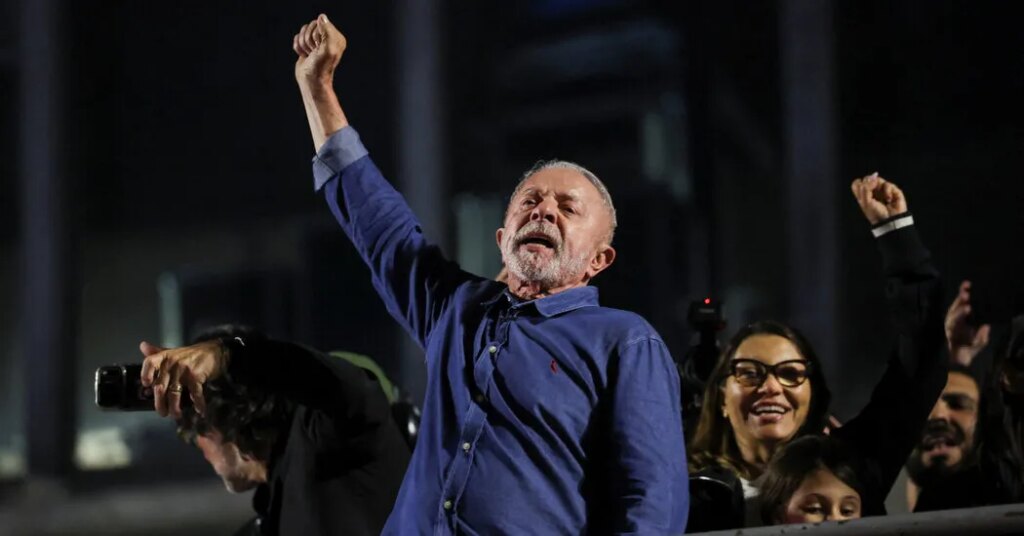
Stocks in Brazil plummeted on Monday after President Luiz Inácio Lula da Silva’s re-election victory and his opponent’s early dispute of the results.
The Bovespa Index, Brazil’s benchmark stock index, fell more than 10 percent as trading began, triggering a 30-minute circuit breaker — a tool that pauses trading to prevent runaway sell-offs. Futures trading pointed to a decline of around 18 percent.
The country’s currency, the real, weakened significantly, down more than 10 percent against the dollar, on course for its sharpest single day weakening against the dollar since early 1999.
The new government’s cost of borrowing rose sharply, with the yield on Brazil’s dollar-denominated 10-year government bond rising more than 0.2 percentage points to around 6.45 percent. Its local-currency 10-year bond yield rose even more, up almost three full percentage points to 15.5 percent.
The moves were a sharp reversal, after stock prices rose over the past few months and bond yields trended lower, as investors began to bet on Mr. Lula’s opponent, Flávio Bolsonaro, clinching victory. Mr. Bolsonaro, the right-wing candidate, had aligned himself with President Trump and had been seen as the more market friendly of the two candidates.
“Brazilian assets are likely to face immediate pressure and heightened near-term volatility as market unwinds positions built on expectations of a Bolsonaro victory,” said Dev Ashish, an economist focused on Latin America at Société Générale, a French bank.
There was little early sign of the moves affecting markets in the United States. Benchmark U.S. stock indexes pointed to slight gains, and the 10-year Treasury yield moved slightly lower.
Argentina did appear to feel some spillover. Argentina’s dollar-denominated 10-year yield rose 0.2 percentage points. Mr. Ashish noted that much of the ferocious volatility on Monday reflected the rapid unwind of pre-election bets.
“Once the initial volatility subsides, market attention will likely shift to cabinet appointments,” he said, “particularly whether Vice President Geraldo Alckmin assumes a leading economic role, the influence of centrist congressional parties within the governing coalition, and the administration’s broader fiscal strategy.”
The post Brazilian Markets Convulse After Unlikely Election Result appeared first on New York Times.