

For years, one of the biggest unanswered questions about the artificial intelligence boom has been surprisingly simple: Can the companies building the world’s most powerful AI models actually make money?
After spending hours poring over Anthropic’s IPO filing on Monday, we finally have an answer: Yes. And potentially lots of it.
A couple of Chinese AI labs went public earlier, revealing appalling financial results that sowed doubt about the industry’s economics. Now Anthropic has provided a much more compelling demonstration of how this business can work at enormous scale.
Anthropic’s financial numbers
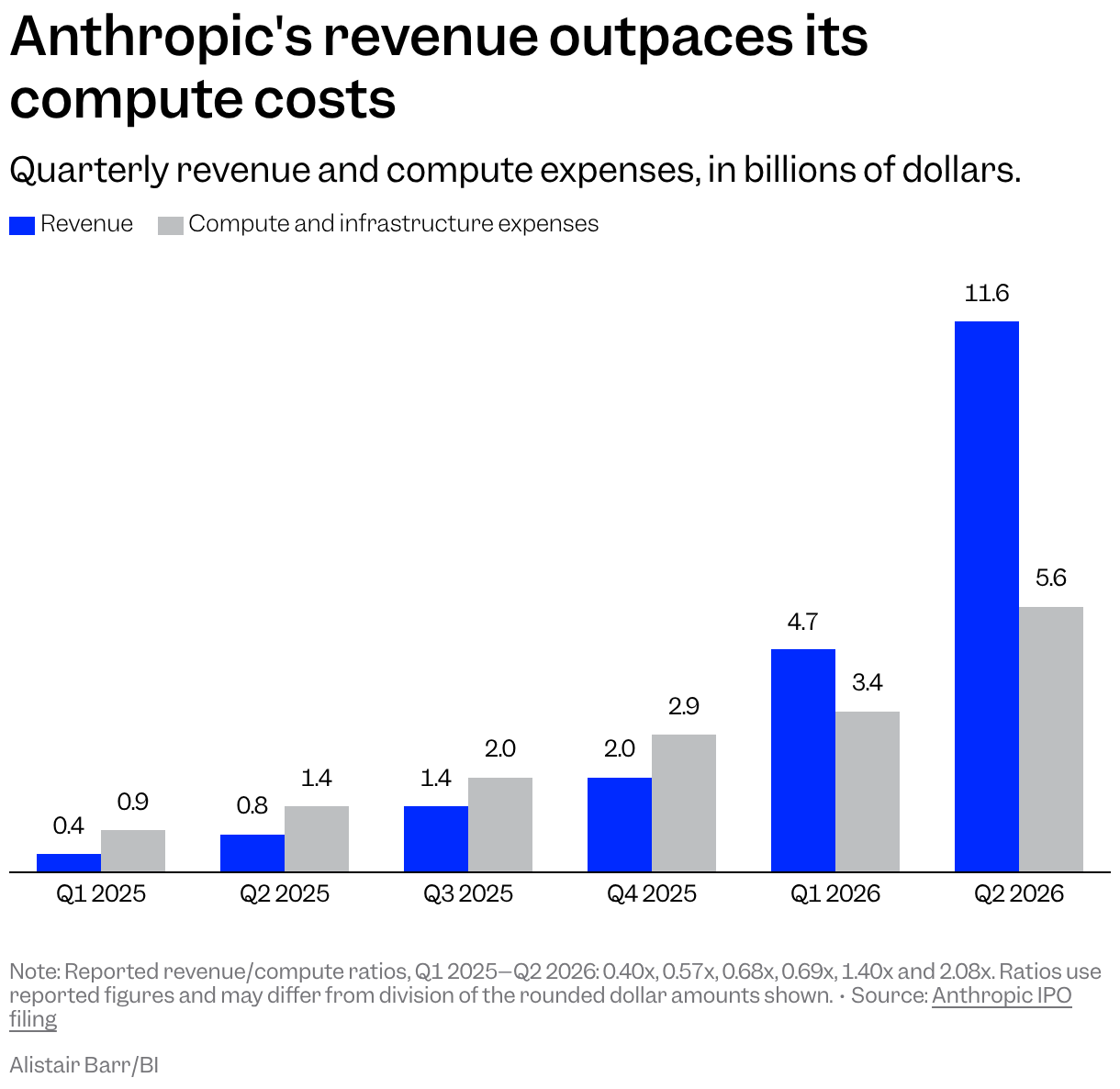
The numbers are remarkable. Anthropic generated $11.6 billion in revenue during the second quarter of 2026, up 1,368% from a year earlier.
During that same period, its spending on computing and infrastructure increased 300%, while other expenses rose 741%
So, the company is bringing in money much faster than its most important costs are rising.
For every dollar Anthropic spent on computing in the second quarter, it generated $2.08 in revenue, up from just 40 cents in the first quarter of 2025. That’s a more than fivefold improvement over five quarters.
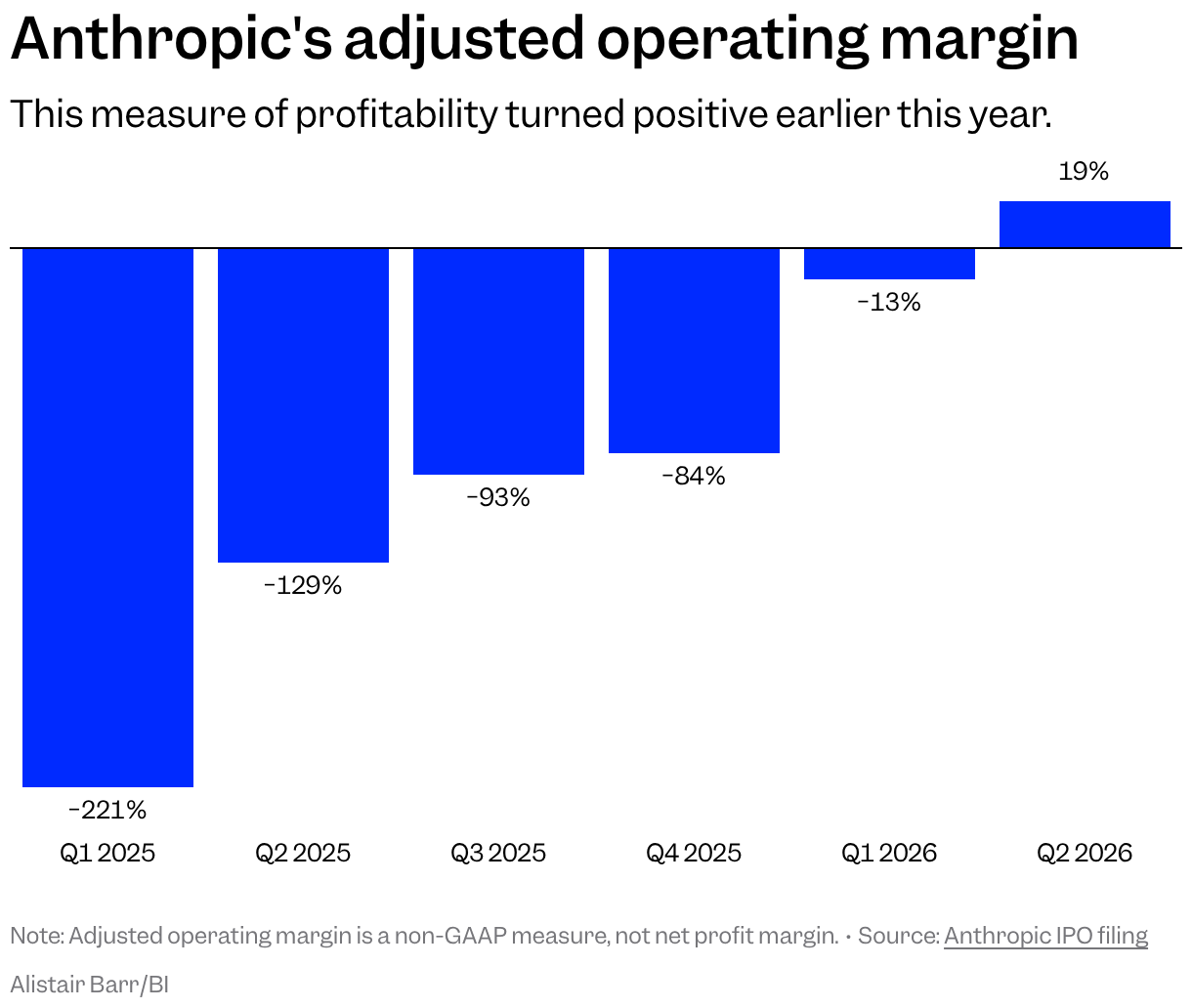
The result: Anthropic recorded $974 million in quarterly operating profit, representing an 8% margin. Its adjusted operating profit margin reached 19%, compared with -129% a year earlier.
“Frontier-lab unit economics can turn positive at scale,” Mark Mahaney, a top tech analyst at Evercore ISI, wrote in a research note on Monday.
Better than Meta and Google
There’s more evidence that Anthropic has built an unusually efficient business.
Over the year ending September 30, revenue increased roughly 1,200%, while its employee count grew about 170%. Revenue per employee jumped from $1.4 million to more than $6.6 million.
For comparison, Mahaney estimated that Meta generates about $3.2 million in annual revenue per employee, while Google generates about $2.5 million.
That comparison isn’t perfect. Anthropic relies heavily on cloud providers, whose employees handle much of the computing infrastructure and distribution work. The improvement is still striking.
A customer concentration surprise
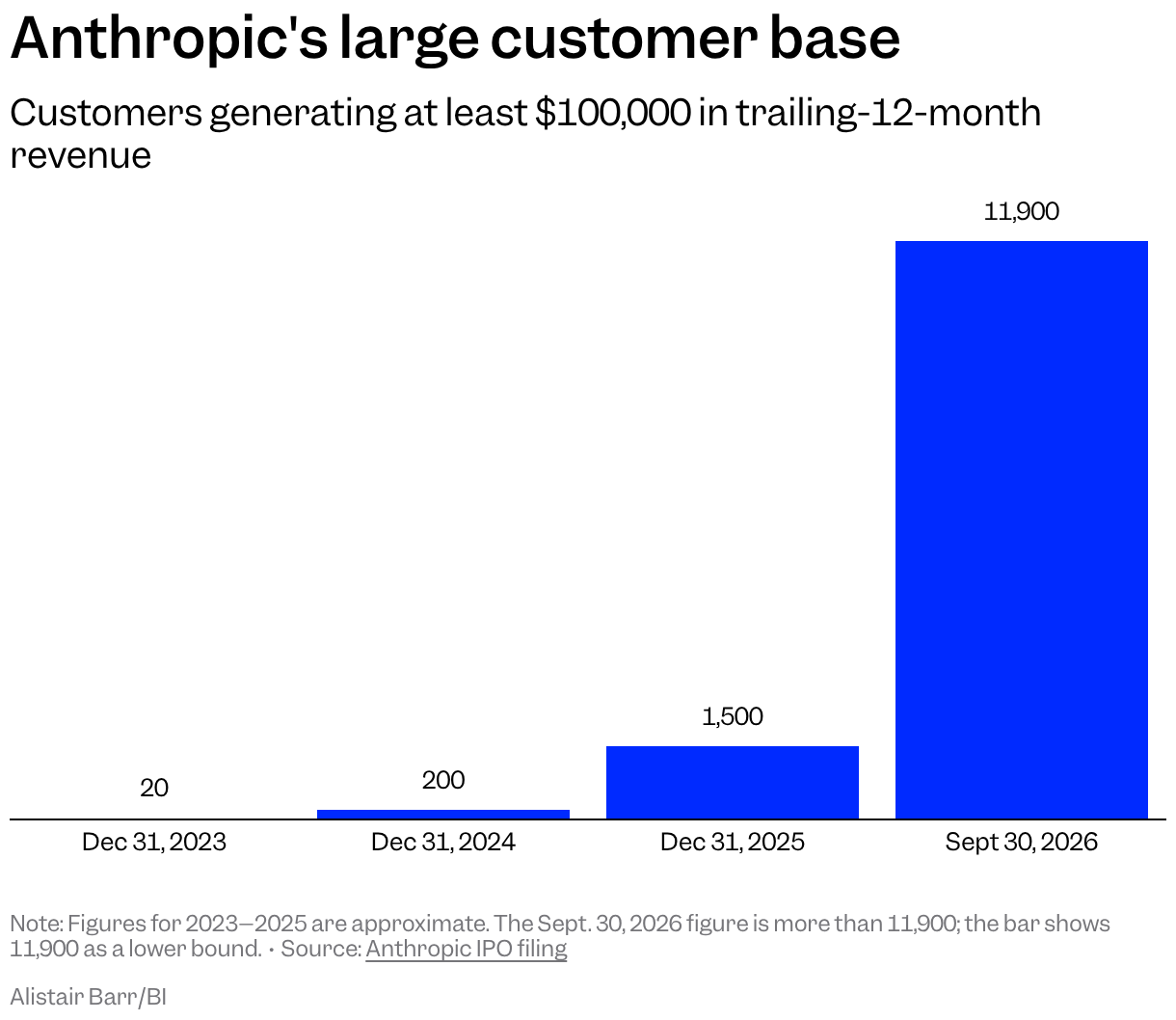
Another surprise: Anthropic doesn’t depend as much on a handful of enormous customers, as some investors had feared.
The company had more than 11,900 customers generating at least $100,000 in annual revenue as of September, compared with over 950 a year earlier. More than 1,900 customers spend at least $1 million annually.
No single customer accounted for more than 10% of revenue during the first nine months of 2026. Its five largest customers represented about 21% of third-quarter revenue, down from roughly 36% in the first quarter.
“Concentration may be better than feared,” Mahaney wrote.
The IPO filing shows a cash cushion
Anthropic has a formidable financial cushion. Its June 30 balance sheet showed more than $130 billion in cash and short-term investments.
And Mahaney estimated that the company has burned through just $9 billion since it started more than five years ago. That’s a long runway.
Now, don’t ask me whether all this makes Anthropic worth $2 trillion, $1.5 trillion, $1 trillion, or considerably less. If I knew that, I’d be making a lot more money as an investor. And even professional investors don’t know.
An $800 billion caveat for Anthropic
Some enormous caveats: Much of Anthropic’s revenue comes from customers paying for what they use, rather than signing long-term contracts. Meanwhile, some of its computing agreements require minimum payments whether or not it needs all the capacity.
Mahaney estimates that Anthropic has entered into nearly $800 billion in computing arrangements, although only about $266 billion was fixed or guaranteed as of June.
That’s still a staggering amount.
“The commitments assume revenue compounding that is not contracted,” Mahaney wrote.
Translation: While the company has committed to spending hundreds of billions of dollars on AI computing infrastructure, it hasn’t secured the future revenue needed to pay for all of it.
Importantly, most of the potential $800 billion exposure isn’t fixed. Many arrangements depend on capacity being delivered, can be adjusted, or include cancellation provisions.
In-house compute and capex
Another wrinkle: Anthropic warned Monday that its spending will increase as it shifts toward leasing AI chips and operating more of its own computing infrastructure, rather than relying entirely on Amazon, Google, and other cloud providers.
That could make future cash flow considerably less attractive, even if operating profits continue to improve.
Still, the central takeaway from Anthropic’s IPO filing is difficult to ignore.
For years, investors have wondered whether selling AI could become a genuinely profitable business, rather than an extraordinarily expensive scientific experiment.
Anthropic has now shown that it can. The next question is whether it can keep doing so as the bills get much, much bigger.
Sign up for the AI Insider newsletter here. Reach out to me via email at [email protected]
Read the original article on Business Insider
The post Anthropic’s IPO filing answers one of the biggest questions about the AI boom: Can AI labs actually make money? appeared first on Business Insider.