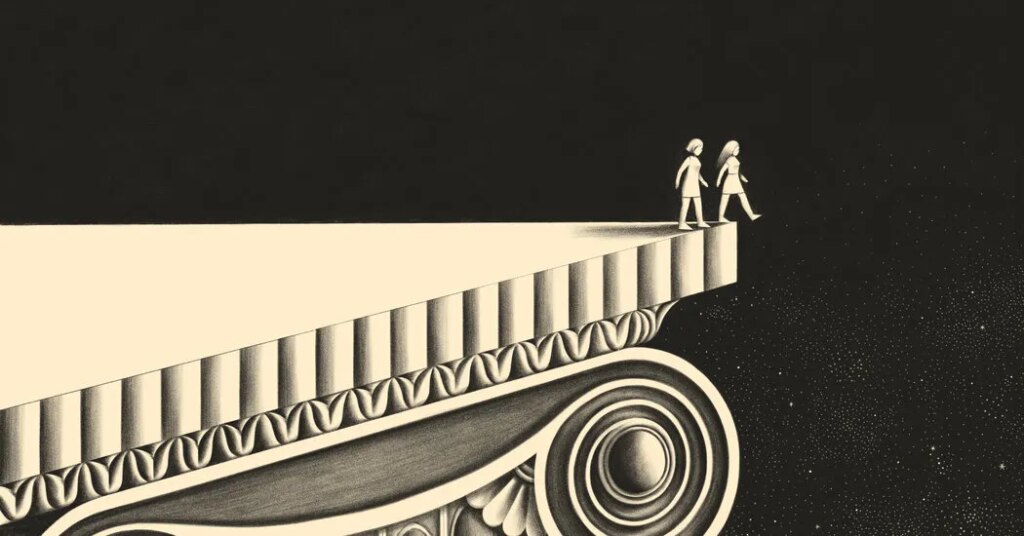
THE BRIGHTNESS, by Chad Harbach
A few decades ago, the British bookseller WH Smith began handing out an annual prize called the Thumping Good Read Award. It’s mostly gone to thrillers and crime novels. If such a prize existed for ambitious and bold-hearted realist literary fiction, Chad Harbach’s new novel, “The Brightness,” would be near — and possibly at — the top of this year’s pile.
“The Brightness” is a sequel, 15 long years in the making, to Harbach’s 2011 novel “The Art of Fielding.” The previous book was a Midwestern campus novel, set at the fictional Westish College in Wisconsin, on the shores of Lake Michigan.
It was about an infield throw gone wrong and an intergenerational, cross-racial gay love affair. It also detailed the coming-of-age of the college president’s daughter, a self-destructive young woman named Pella, who resembled Hester Prynne’s daughter, Pearl, in ways that go beyond their names.
The novel was a critical and commercial success and it deserved to be. In baseball terms, it was a mighty line drive into deep center field that became a stand-up triple. It was that rarity: a serious novel, one that drew complicated sustenance from Melville, Hawthorne, Thoreau and Wharton, that was seriously entertaining.
Fifteen years is a long time. Fifteen years ago, Taylor Swift was a country singer and Prince William still had hair. Yet “The Brightness” is so full of life, surprises, close observation, spiraling and interlocking plots, sharp new characters wheeling into view, striking set pieces, overlapping literary allusions and neo-Updikean craftsmanship that one can feel, on nearly every page, where every month of that time went.
The book has its flaws, including a slightly overdetermined quality (the neo-Updikean craftsmanship can get up your nose), an art-world subplot that feels extraneous and a slackening near the end. But it’s a worthy sequel. Though he juggles heavy intellectual and emotional themes, Harbach mostly manages to bear them lightly, as if he were a seal balancing a very large, very dark beach ball on his snout.
Set four years after “The Art of Fielding,” “The Brightness” is a largely a campus novel too, albeit a more gothic and moonstruck one. It has some affinities with Donna Tartt’s 1992 book “The Secret History.” The male characters from “The Art of Fielding” fall away here to make way for a brace of furiously literate and curiously ravishing (everyone in this cupidinous novel is ravishing) women.
In part “The Brightness” is about three female students, Dahlia, Irma and Pammy, who might have dropped sideways out of “Girls,” Lena Dunham’s fond and excruciating comedy-drama series. They semi-ironically call themselves (with shades of Updike) the Witches of Westish.
Together they plan and execute a culture-war provocation that lobs a grenade into the campus’s self-satisfied jock culture. I won’t give that provocation away, but it has echoes of the Shitty Media Men list that in 2017 drove several prominent editors and writers largely out of public life. As with that list, there is collateral damage.
The girls become media heroes, and media martyrs. The novel’s title has several meanings, but it refers at first to a feminist website called The Brightness that signal-boosts the girls’ exploits. (It will put some readers in mind of Jezebel, once part of the Gawker media empire, which had its heyday in the late 2000s to mid-2010s.)
Harbach is a founding editor of the literary magazine n+1, that impeccably footnoted lefty rumpus room, and he knows as much about the undersides of the Manhattan cultural world as he does about baseball and so much else. When he writes a hangover or a dance-off scene, it’s a hangover or dance-off scene for the ages.
In part, too, “The Brightness” is about an exclusive and sprawling gay wedding on Block Island (this newspaper’s Weddings section is all over it), where many of the central characters, from this novel and its predecessor, come to wreck themselves. High on the groom’s supply of aphrodisiacal weed, as if it were Puck’s flower juice in “A Midsummer Night’s Dream,” life-changing mistakes are made.
The groom is Owen, a young Black gay man, the winner of a Fulbright-like scholarship while at Westish. Now he’s a precocious 24-year-old writer with a hit novel called — this is one of the book’s metafictional winks — “The Art of Fielding.”
But “The Brightness” ultimately belongs to Pella, the college president’s wastrel daughter. She has finally graduated, in her late 20s, after rushing into and out of an ill-advised marriage. She is in need of solace, a strong post to lean against, and she wishes to put her wild-child days behind her.
She has fallen in love and moved in with Mike, the baseball team captain in the last novel, now a beloved young coach at Westish. She feels safe but smothered, especially when she compares herself to her young friend Irma. This novel finally debouches into New York City, where Pella has decisions to make.
Everyone in this novel seems to be reading Wharton, especially “The House of Mirth.” In an age of lapsing literacy, it’s gratifying to read a novel that treats America’s literary history as a usable past. Pella sees herself in Lily Bart, that novel’s protagonist. She compares being a woman to being an athlete. Pella is outraged to feel that her time, by certain estimations, is already running out. She says to a friend:
When you read the first page, how do you know Lily Bart is screwed? Because she’s 29 and single. She’s still a total babe, but that doesn’t matter. She’s on the wrong side of “11 years of late hours and indefatigable dancing.”
Like Lily, Pella has no career — no container to fit the riot in her soul. It’s a bold move for a male novelist in 2026 to put a woman at the center of a novel, as if he were Flaubert creating Emma Bovary or Tolstoy Anna Karenina. Pella is never quite as vivid as those heroines, but she is a strong and sympathetic controlling presence, one with a roomy humanity, and the reader feels lucky to be able to tag along beside her.
More vibrant are Dahlia and Irma, two of the campus “witches” — Irma especially. She was home-schooled by religious parents and spends her summers waiting tables at Cracker Barrel, but she has an impish demeanor and a startling intellect. She has a “homespun fervor” and masses of hair piled atop her head: “Prairie hair, premodern hair — it was the girl equivalent of a waist-length beard.”
Perhaps only a bald man could write so vividly, as he does throughout this novel, about hair. A big beehive is always about to come undone somewhere. Like Dolly Parton’s Jolene, some women have flaming locks of auburn hair. More saliently, Harbach writes about the blood that flows beneath that hair. This novel is not a soft-focus progressive love-in. Bad witches compete with the good ones for elbow room.
Harbach, on the back flap, resembles both a former shortstop and a younger version of the pitchfork-wielding farmer in Grant Wood’s painting “American Gothic.” This doesn’t matter, except that it reminds you how important Harbach’s Midwestern sensibility (he was born in Wisconsin) is to his work.
His stuff has a candor, simplicity and seriousness that puts you in mind of the work of Sherwood Anderson (born in Ohio), Willa Cather (raised in Nebraska) and Jonathan Franzen (born in Illinois). There’s a grounded sense of observing from a level field. Like those Midwestern writers, Harbach is, for all his knowingness, a little bit square. This helps. It’s like he’s seeing the world for the first time.
Some of the light here is filtered through old stained-glass windows, more literary then ecumenical, and it’s a light that touches the oldest things in our makeup.
If this series becomes a trilogy, there’s little doubt that Irma, with her bedraggled radiance, will own the final installment. (In one important way, she owns this one, too.) Irma could also be talking about Pella as well when she declares, with equal parts terror and optimism: “My truck’s packed. But I don’t know where I’m going.”
THE BRIGHTNESS | By Chad Harbach | Little, Brown and Company | 657 pp. | $32
The post A Bold and Ambitious Campus Novel, 15 Years in the Making appeared first on New York Times.