The more I look for people reading books in public, the more I notice people staring at their devices instead. This month I entered several library branches where just about every table was taken up with people on their laptops; the same happened in multiple cafes and even inside bookstores.
Yet just as despair was setting in, I saw a little boy strapped into the back seat of his mother’s bicycle, turning the pages of a book. Then there were the five people I met around the DMV, who were not only reading books in public, but also willing to take the time to tell me about them.
(These interviews have been edited for length and clarity.)
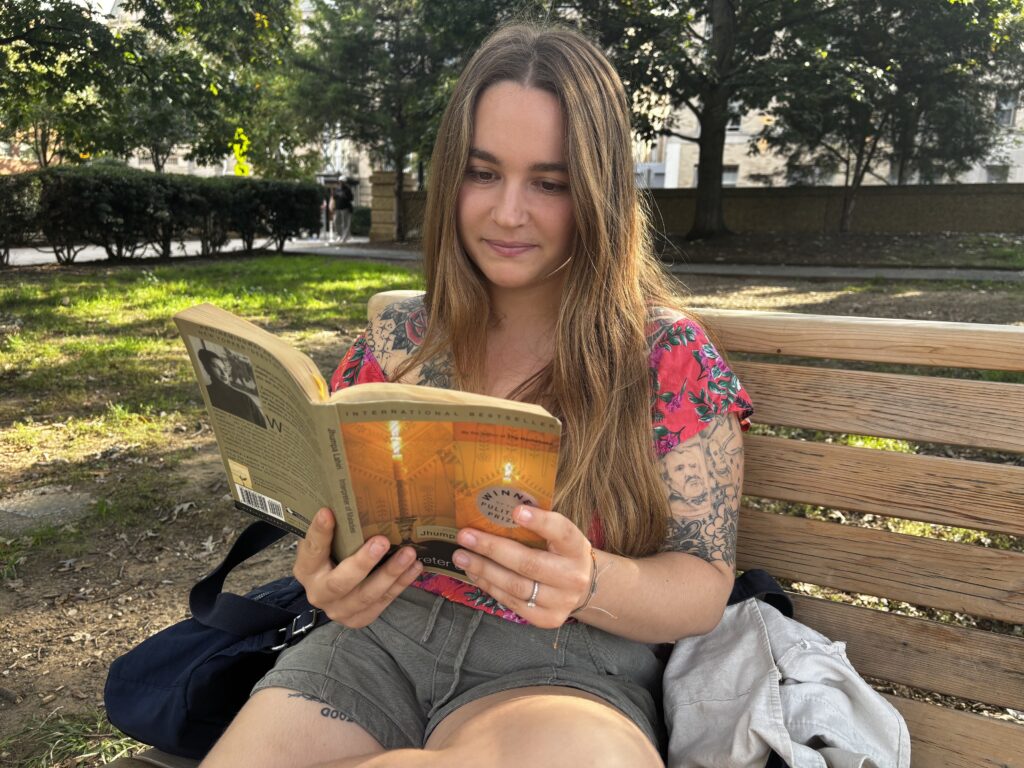
Ella Peels, 25, in Meridian Hill Park, reading “Interpreter of Maladies,” by Jhumpa Lahiri.
Hello. That’s a great book. What made you choose it?
I just finished a novel, which I really liked, but I wanted to read short stories just to break up the pace. My mom sent this collection to me. It’s very marked up with someone else’s notes, but I haven’t been paying attention to that.
What was the novel?
“The Hundred Secret Senses,” by Amy Tan.
Another great book.
It was so good. I am a little sad to be done with that one, but these stories are really good in a totally different way.
Where did you get these books?
The Tan novel I got at a Little Free Library. That’s where I get most of my books, or people give them to me. I rarely buy them.
Did you study English in college?
Yes, I went to St. John’s College in Annapolis. It’s a “Great Books” program.
You must have been reading some pretty intense material.
Yes! And now that I’ve graduated I get to read whatever I want, and it’s so freeing. I loved what I read in college. You go through the great books of Western civilization, so you go back to Socrates and read through to 20th-century writers. My favorite books were the works of David Hume and Virginia Woolf, and there was a great short story by Herman Melville called “Benito Cereno.” It’s a sleeper but it blew me away.
What have you been doing since finishing the program?
I graduated in 2023, then I got married and moved here this May. My husband is an electrician, and we have a 2-year-old son. I have been staying home with my son, and I love being a mom, but I have been looking for a little more intellectual stimulation, so I applied to law school and am hoping to go this August in D.C. or in California, where I’m from.
What appeals to you about law school after all your literary studies?
Law school is a natural progression from my studies because the Great Books program helps you develop your critical thinking skills and learn how to be precise with your words. Also, my son was born around the time of the election of the current administration, and the crisis in this country’s treatment of immigrants is something I want to help alleviate. A law degree would give me a powerful tool to help do that. So I hope to study immigration law.
I’m glad to hear that doing all that reading in school didn’t burn you out of reading for pleasure.
Oh, it just intensified my love of reading. I’m so much better at it now.
How do you get better at reading?
The format of St. John’s is that you read the books and then you talk about them in very small class discussions. So I’ve learned from my teachers and classmates how to more fully appreciate works of literature and how to interpret them in different ways. Also, if you think of the brain as a muscle, given how much I read in school, I now have a very strong muscle for reading. I have an appreciation for the pace of reading, which is very different from any other form of entertainment. It’s easy to lose that when there are so many ways of ingesting entertainment that are easier than reading.
That’s very well put. I found that when my kids were little it was hard to find the time and energy to read. How do you do it?
My son is in a co-op program right now, but before that I read during his naps. My favorite thing to do is to read outside, so now that he’s in this program, this is as good as my life gets right now!
It does sound wonderful. What do you think we can do to get people to be as enthusiastic about books as you are?
That’s a really good question. I can say that with my son, I read to him constantly. We read like five books before nap, five books before bed, and he’ll constantly bring me books. I have this parenting rule: If he ever brings me a book and wants me to read it, I’ll stop whatever I’m doing and read it with him. I try not to be on my phone around him, too. I don’t know how to get adults to read, but I can do this as a mother.
Arnel Cruz, 20, on the Red Line from Glenmont, reading “1984” in Spanish.
“1984”! What a great book. What made you decide to read it?
I saw a video on Instagram about it.
That’s fantastic. What other books have you liked recently?
My last book was “Solito,” by Javier Zamora. It’s beautiful. I cried when I finished that book.
Yes, it’s a very touching book. Where are you headed today?
To work. I work at a restaurant downtown. I came from El Salvador when I was 16, and right away I started working in construction. Then I changed to become a cook.
Which do you prefer, construction or cooking?
Cooking. It’s better but still the kitchen is very hot.
What do you think of “1984” so far?
It’s a little scary. But we’ll see. I have only read about 20 pages.
What do you like to cook?
French food, Mediterranean and Italian.
Did you read much back home?
No, I started reading when I got here. I see books on social media, and I sometimes get them on Amazon. (Amazon founder Jeff Bezos owns The Washington Post.)
Are there other books you have been hearing about that you want to read?
Yes. When I finish this one I am going to start “Noches Blancas” [“White Nights” by Fiódor Dostoevsky] and then “El Extranjero” [“The Stranger,” by Albert Camus.]
Those are nice choices. Where did you hear about them?
Instagram. I see one video and then I keep getting more.
Yes, that’s how it works! Thank you for talking with me, and have a good day at work.
Emma Heuges, 34, reading “The Gene: An Intimate History” by Siddhartha Mukherjee, at Franz Sebastian Salon in Bethesda.
I was pleasantly surprised to see that book at your work station. Do you typically read between clients?
Yes. I come over here to sit and read while I’m waiting. That’s usually the only time I have to read because I have two young kids and I work here full time.
That’s a pretty hefty book.
It is. I’m reading it because of the medical condition that I just found out I have.
I’m sorry to hear that.
Thank you. It’s not a big deal. I’m just trying to understand it better before I go to a specialist. I want to walk in and be able to have an in-depth conversation rather than just say, “Help me.”
That’s very smart. I hope you get the answers you want. Do you normally read about lighter subjects or fiction?
I would say it’s half and half. I read fantasy about 50 percent of the time, and then the rest of the time I like to learn. I read educational books.
What are some of those books?
A lot of government policy or medical science. I studied psychology in college. My husband has been a big influence on expanding my interests. He’s a server in a restaurant and a history fanatic. I always found history and policy really boring, but when you have someone in your life who really enjoys it, just like a good professor, they can infect you with that interest. After we put the kids to bed, we watch history and geopolitics lectures on YouTube.
So no “Ted Lasso” or “Real Housewives of Potomac” for you?
No, I get that kind of social culture at work.
Tell me about the fiction you like to read.
I like to read fantasy, so right now I’m reading a couple of series. One is by Sable Sorensen. The first book is “Dire Bound,” and the second is “Fury Bound.” I’m also reading “The Hirathean Path” series by Aria Ashbrook. Very escapist.
It sounds like fun. Have you always liked fantasy?
Yes, it started with Harry Potter when I was a kid. But I also like textbooks. I usually go to Goodwill on weekends and buy textbooks. That’s the format that my brain likes the most, and I can take notes. I like to hold a book. It feels like a weighted blanket, especially a textbook, and I love that.
It does sound comforting when you put it that way.
Bonita Herring, 75, of University Park, Illinois, at Reagan National Airport, reading “American Change Agent: A Life & Legacy of Seeking Diversity, Equality, and Inclusion,” by John F. Leeke and Ananda Kiamsha Madelyn Leeke.
What brought you to Washington?
I came here for the Congressional Black Caucus Conference. I served as the president of my sorority, Sigma Gamma Rho, from 2012 to 2016, so that’s how I started coming.
How did it go this year?
I thought it went well. There’s always good information that we share and workshops. My representative is Robin Kelly (D-Illinois) and this is her last term, so we honored her. We talked about a lot of issues that are affecting Black women. For example, how so many Black women have lost jobs this year and how that impacts the entire family, so that’s a major issue.
Yes, it is. What is your profession?
I’m retired. I used to work for the College of Education at Chicago State University. I worked in teacher training, preparing students to become educators.
That’s an important job. Tell me more about the book. I see you’re highlighting it.
The author is actually a friend. I bought the book from his daughter, who co-wrote it. And as you can see, I got into it. The author talks about being a change agent. He’s in his 80s, and he talks about what he’s done over the years. He talks about the importance of diversity, equity and inclusion and how that really did help us and how things are moving in a different direction now. A lot of it is about the Black community in different areas.
Do you typically read books about political and social issues?
I actually have not had a chance to read a lot. Life happens. I’m taking care of different people in my family and downsizing my house.
Does this book make you feel hopeful?
Well, I’m a senior, so it makes me feel hopeful for my daughter and my granddaughter.
Madison Conley, 22, on the Red Line to Silver Spring, reading “The Mirror of Infinite Endings,” by Stephanie Garber.
I see that you like fantasy.
Yes, but I read a little bit of everything. I also like reading the classics, like “The Scarlet Letter” and “Pride and Prejudice.” I have all the classics at home, in Louisiana. I also like historical fiction, so I loved “All the Light We Cannot See,” by Anthony Doerr. “The Lovely War,” by Julie Berry was my first foray into the genre. My favorite historical novel is “The Book Thief,” by Markus Zusak. I also love “Fahrenheit 451,” by Ray Bradbury, which is not historical fiction. I had to read it in high school, and I liked it so much that I bought a copy for myself. It’s all about the importance of reading, and that’s so true. Sometimes I read nonfiction, but in my graduate program here we read a lot of nonfiction, so I feel less like I want to read it as a pastime.
What are you studying?
National security and statecraft. I moved here in August. I was nervous that people wouldn’t be friendly, but that hasn’t been true.
It sounds like you read a lot.
I do. When I have a lot of free time, like during the summer, I probably read five books a month, and that’s usually fiction. This book is a companion book to the “Once Upon a Broken Heart” series. My all-time favorite in the fantasy category is very predictable: Sarah J. Maas’s “Court of Thorns and Roses” series. I was reading her books before they became popular and before they were not exactly appropriate for me, when I was in the sixth grade.
I imagine that your school reading is a lot more dry.
I wouldn’t say dry. The reading is very interesting, but outside school I wouldn’t pick up a book about statecraft.
That makes sense. What is your career goal after graduate school?
I’d like to be a language analyst, in the government or private sector. I did my undergraduate studies at Texas A&M. My major was international politics and diplomacy, and China was my concentration.
It sounds like you are well on your way. Good luck with it all, and thank you for talking with me.
The post What are you reading? We asked five local book lovers. appeared first on Washington Post.