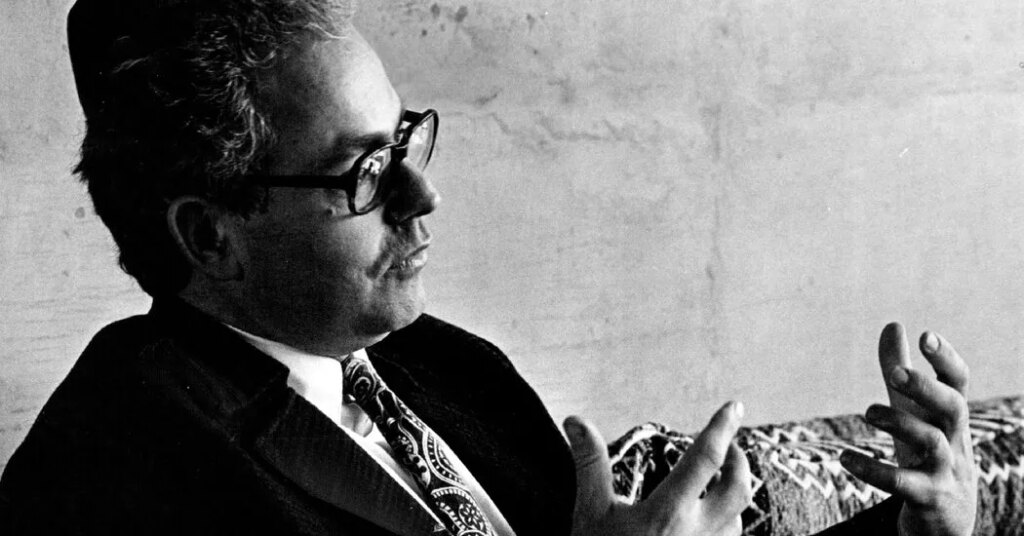
Uriel Simon, an influential Israeli biblical scholar who took a literary approach to understanding the Hebrew Bible and an activist who used religious texts to support peace and compromise with the Palestinians, died on Sept. 30 at his home in Jerusalem. He was 97.
His death was confirmed by his wife, Shulamit Simon.
Dr. Simon argued that biblical text was meant to be understood on its own, regardless of how it had been interpreted historically. While many biblical scholars focus intently on when, where and by whom a text was written or rewritten, Dr. Simon analyzed a text for “what message does it have for us today,” Jonathan Jacobs, a professor of biblical studies at Bar-Ilan University, outside Tel Aviv, where Dr. Simon taught for nearly four decades, said in an interview.
Dr. Simon scrutinized biblical stories as great literature, interpreting techniques like the use of repeated words. In the Book of Jonah, “great” is frequently used — the “great fish” that swallows the prophet, “great city,” “great storm,” “great joy” and “great displeasure” — to provide sharp contrast and irony.
He also paid close attention to what was not being said. In the Book of Samuel, a barren woman named Hannah becomes pregnant after deep prayer; reading between the lines, Dr. Simon gleaned a range of her emotions from despondence to defiance to gratitude for the power of faith.
He was one of the first scholars to focus on secondary characters in biblical stories as foils to the strengths, weaknesses and moral character of major figures.
And, while he believed in understanding the Bible as written, he paid extensive attention in the course of his interpretation to modern and traditional Jewish sources. He was considered a pioneer in applying literary analysis to biblical commentaries written in the Middle Ages, especially by the rationalist Rabbi Abraham Ibn Ezra.
Yonatan Grossman, a biblical studies professor at Bar-Ilan, said in an interview that Dr. Simon saw something of himself in Ibn Ezra, who cared “about the truth even if it went against the majority of rabbinical commentators on the Bible.”
One of Dr. Simon’s most widely discussed books was his commentary “Jonah” (1999). A troubling question for readers of the Book of Jonah is why a trusted prophet like Jonah flees when God calls him to travel to the city of Nineveh to preach against its wickedness, Ed Greenstein, an emeritus professor of biblical studies at Bar-Ilan, wrote in an email.
Dr. Simon’s answer, Professor Greenstein said, was that Jonah fled because he knew that God was compassionate, and if Jonah convinced the Ninevites to repent, God would forgive them. Dr. Simon rejected traditional views of the story’s central theme, such as atonement versus repentance. Instead, he viewed the plot as a conflict between Jonah’s sense of strict justice (penalizing those who violate the law) and divine mercy (those who repent should be treated with compassion).
While many scholars view the story of Jonah as satirical, Dr. Simon explained it as one of “compassionate irony,” writing that the prophet is a “genuinely pathetic figure in his hopeless struggle with his God” who is restored to his dignity.
He viewed biblical figures as complex, not merely heroic or villainous, such as in the story of King Saul, the first king of ancient Israel, and the Witch of Endor. Dr. Simon interpreted the witch, typically considered evil, as a compassionate woman who nourished the king in his final hours, even though he had condemned her outlawed sorcery, and Saul, a once charismatic leader, as a flawed, broken and frightened man, deserving of empathy.
Tall, wearing a kippa atop a corona of white hair, Dr. Simon used scholarship, charisma, humor and mastery of the pregnant pause to become a captivating speaker at synagogues and auditoriums filled with religious and secular Jews, who came to hear well-known biblical stories as if told for the first time.
“You almost felt like he was taking your hand and leading you down the path of the story,” Dr. Shepard Schwartz, a pediatrician in Modiin, Israel, who frequently heard Dr. Simon speak, said in an interview.
He was also a peace activist whose activism was driven by his understanding of the Bible. In “Seek Peace and Pursue It” (2002), he wrote that he considered peace a biblical imperative.
He was a founding member of the religious Zionist left-wing movements Netivot Shalom and Oz VeShalom, since merged, and became a leader within the political party Meimad, which is no longer active. He lent his name to those causes by attending rallies and protests, making speeches, writing articles and giving lectures and interviews. In a 2007 article, The New York Times called him a “noted religious dove.”
In his writing, he argued that the right to dwell on God’s promised homeland is conditional on the people of Israel’s adherence to moral and just behavior. In a 1978 interview with The Times, which echoes today, Dr. Simon called for compromise with Palestinians in the West Bank and Gaza Strip, and argued against those who said the Bible commands Israel to hold every inch of those occupied territories.
“When we say strength and peace, we believe that Israel has to be strong to make peace, but that it should pursue peace as intensively as it pursues security,” he said.
Uriel Simon was born on July 29, 1929, in Jerusalem. His mother, Tatiana (Rappaport) Simon, ran the household. His father, Akiva Ernest Simon, was a German-born educator and religious philosopher who was an early member of Brit Shalom, a peace movement that advocated a binational state with equal rights for Arabs and Jews.
Dr. Simon attended the Hebrew University of Jerusalem for his undergraduate and graduate degrees, receiving his Ph.D. in biblical studies in 1961. He served in the Israeli Army in 1948 and 1949.
At Bar-Ilan University, Dr. Simon served for a period as the head of its department of biblical studies and founded the Institute for the History of Jewish Bible Research there. He continued to write into his 90s.
He was influenced by the humanism of his father, his family said, and sometimes told the story of seeing his father swatting a mosquito and killing it.
“You believe in nonviolence and peace, but even you kill when it suits you,” Dr. Simon said to his father.
To which his father replied: “It is not hard to find inconsistency in human beings. That is what makes us human.”
In addition to his wife, a chemist whom he married in 1960, Dr. Simon is survived by a son, Itamar Simon, a professor of microbiology and molecular genetics; a daughter, Michal Nagen, the founder of a military preparatory academy for young Israeli women; and 12 grandchildren and 12 great grandchildren.
Shortly before he died, Dr. Simon was asked by a granddaughter whether he believed that souls lived on in the afterlife. He said yes, then paused and added, “But as you can imagine, given my current condition, I’m not exactly objective.”
The post Uriel Simon, Biblical Scholar and ‘Noted Religious Dove,’ Dies at 97 appeared first on New York Times.