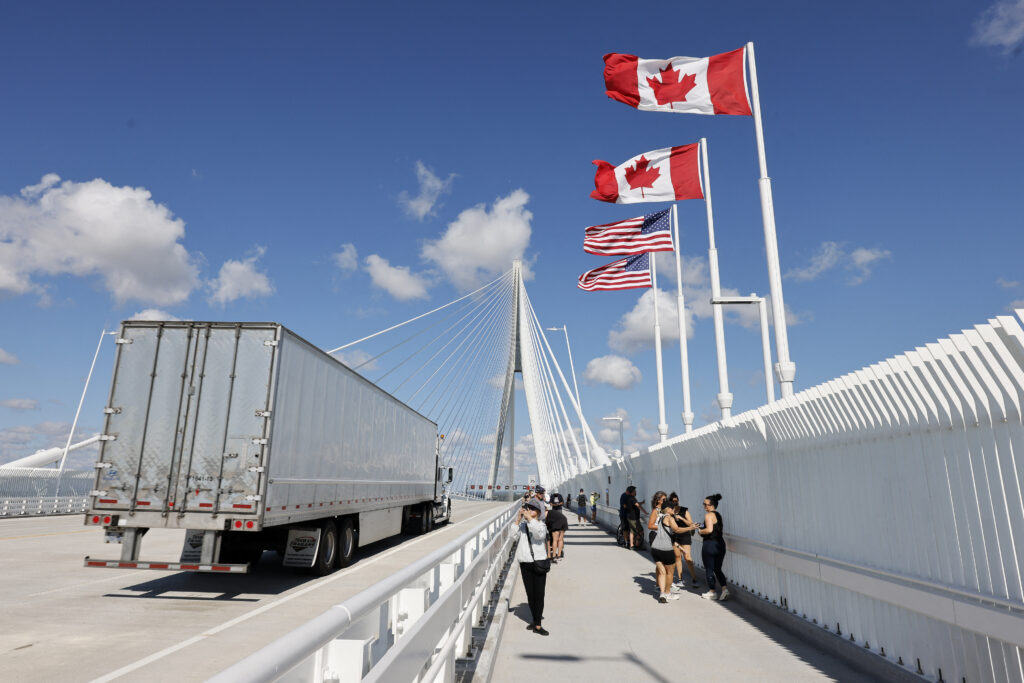
PORT HURON, Mich. — Only the St. Clair River separates this Michigan city from Canada, and residents have long crossed the Blue Water Bridge to shop, work and dine. But as President Donald Trump prepares to host a rally here on Sunday, Canadian license plates have become a rarer sight in local parking lots.
Trump is expected to become the first sitting president to visit this town of less than 30,000. Aides say his travel to the state’s reddest congressional district aims to drive turnout in a battleground state that could determine control of the U.S. Senate.
His venue choice is also drawing attention to a major political liability — the economic fallout from his trade war with Canada.
Often, presidents suffer from events they didn’t cause — the coronavirus pandemic in Trump’s first term, for example. This year, by contrast, Trump has seen some of the lowest presidential approval numbers ever recorded, and his decisions have driven the plunge.
The tariffs of up to 50 percent on Canadian goods that Trump announced in July provide a prime example.
At a time when voters are acutely focused on the cost of living, tariffs are a visible step that drives prices higher. And the trade war with Canada has hurt residents of border states especially hard.
In August, the National Taxpayers Union Foundation, a group that supports conservative fiscal policies like lowering taxes, released a report saying that tariffs have cost Michigan households an additional $5,619 compared with what they were paying in 2024. That was the largest impact felt by any state, the report found, and the statistic has had an effect on Michigan voters, said Richard Czuba, the founder of the Glengariff Group, which frequently polls the state.
The impact goes beyond costs. Port Huron’s economy has “taken a drop” because of the bitter tensions ignited by Trump’s feud with the United States’ northern neighbor, said Port Huron Mayor Anita Ashford. Canadians who were once key patrons of the city’s businesses are staying on their side of the border.
The tariffs have become a heavy burden for Republicans across the northern tier of the U.S., where economies are deeply integrated with Canada. In key battleground states, including Michigan, New Hampshire and Maine, Republican candidates have distanced themselves from Trump’s policy.
“And here in Michigan, we know that Canada is not our enemy,” Republican Senate nominee Mike Rogers says in a widely aired ad, drinking a Labatt beer in a bar. “We need to end this tariff war — now.”
Rogers, who is locked in a close race with Democratic Senate nominee Abdul El-Sayed, is expected to join Trump at Sunday’s rally even as he runs a seven-figure advertising campaign opposing the president’s trade war with Canada.
“Mike’s made his position clear — if the tariff is good for Michigan, he’s for it,” Rogers campaign spokeswoman Abby Ronson said in a statement. “If it’s bad for Michigan, he’s against it.”
On Friday, Rogers said in a video on social media that he told administration officials that Michigan needs relief from Canadian tariffs, but that if the administration is going to impose levies on the country, it should apply them to trash trucks that cross the border from Canada into the state. Rogers said the administration enacted tariffs on Canadian trash trucks following his request.
Rogers is “looking forward to continuing to building on that success in the U.S. Senate,” Ronson said.
There are signs the White House recognizes that the tariffs on Canada have become a political albatross. On Friday, the administration lifted tariffs on some Canadian products, in an apparent bid to help Sen. Susan Collins (R-Maine), who requested exemptions for products including blueberries and apples. The partial rollback could also benefit Rogers and former senator John Sununu, who has criticized tariffs in his race for New Hampshire’s U.S. Senate seat.
Democrats have employed the tariffs as a weapon against Trump. On Saturday, former president Barack Obama ridiculed Trump’s trade war at a rally for Democratic candidates in Ohio.
“The big trade war he’s starting now is with that well-known evil empire — Canada,” Obama said. “Canada? I mean, these are the people who gave us maple syrup and Martin Short. … They’re like our friendly neighbors to the north, and he’s, like, picking a fight with them.”
Trump’s view of Canada is far more antagonistic.
His frustration with America’s northern neighbor dates to his first term and was formed, in part, by rocky interactions with then-Prime Minister Justin Trudeau, according to a former White House official, who spoke on the condition of anonymity because they were not authorized to speak publicly.
What initially started out as a personality clash between two world leaders soon morphed into a more substantial rift, as Trump began to view Canada as a country that historically undercut U.S. industries, including wheat and liquor, with its economic protectionism.
Canada’s tough negotiating tactics during the development of the U.S.-Mexico-Canada trade agreement in Trump’s first term further angered Trump and his aides. Ultimately, Trump came to see Canada as a “weak” country, said one Republican strategist, who spoke on the condition of anonymity because they were not authorized to discuss the matter publicly, contrasting that with his view of China or Russia as strong.
This perception carried into his second term, when Canada was one of the only countries to retaliate after what Trump called “Liberation Day.”
Other neighbors, including Mexico, have tried to placate Trump by cooperating on immigration policies or other parts of the Trump agenda. Canada has not.
“Mexico gets it in a way the Canadians do not,” said the former White House official.
In August, after trade talks between the countries collapsed, Trump imposed tariffs of up to 50 percent on about $20 billion in Canadian goods. Canada responded with retaliatory tariffs, which have especially hit Republican states that are important for Trump.
The U.S. Embassy in Ottawa recently accused Canada of interfering in the midterm elections with these retaliatory levies, an accusation Prime Minister Mark Carney has dismissed.
The White House has defended the tariffs as part of its efforts to protect American workers and raise wages for families in the U.S.
White House spokesman Matthew Middleton said the U.S. offered Canada a “generous” trade deal, but Canada rejected it.
“The President will continue to lawfully exercise his authority, along with all other tariff authorities authorized by Congress to put the American people first,” Middleton said in a statement.
Voters don’t see it that way, said Brent Buchanan, the founder and CEO of the Republican polling firm Cygnal. Few are supporting Democrats solely because they disagree with Trump’s tariffs, but they are shifting their votes because they think Trump is not focusing on the affordability challenges they elected him to fix.
Sixty-seven percent of Michigan voters oppose the tariffs on Canadian goods, according to a New York Times/Siena poll taken in September. Roughly one-third of Trump’s 2024 voters in Michigan opposed the tariffs, the poll found.
Trump won the presidential election in 2024 in part because voters who were not ideologically aligned with him were frustrated with the economy, and they wanted to return to the economic success they enjoyed in Trump’s first term before the pandemic, Buchanan said.
“They’re frustrated now, and they blame it on him,” he said. “They gave him the credit in 2019 for that amazing economy, and they give him the blame for this one.”
If Trump wanted to help Republicans on the ballot, he would announce an end to the Canada trade war during his Michigan stop, Buchanan said.
Part of the political problem for Trump is simply that most Americans hold positive perceptions of their northern neighbor, especially in key battleground states along the border where people commonly work, worship and shop alongside Canadians.
“Michiganders view Canadians far more favorably than they view Donald Trump,” said Czuba. “The only place I’m seeing a modicum of support on tariffs is with the MAGA base, and even there you start to see them peel off.”
Michigan’s auto industry is deeply integrated with Canada’s, built up over decades of advantageous trade conditions that encouraged cross-border cooperation. The tariffs on raw materials, parts and equipment have driven up costs for Michigan manufacturers, which include the Detroit Three automakers — General Motors, Ford and Stellantis — as well as hundreds of auto parts suppliers and machinery companies. Those costs have been passed along to consumers as car prices climb.
The trade instability has also slowed down businesses’ investment decisions, said Glenn Stevens Jr., executive director of MichAuto, an advocacy organization for the auto industry within the Detroit Regional Chamber.
“There’s no question it has impacted the cost of producing a vehicle and that it has made its way to the showroom,” he said. “You’ve got to look at what the consumer is dealing with, from ground beef to the fuel pump to the average transaction price of a vehicle. The pressure is real, and people talk about it.”
Republicans chose Port Huron as the site of the president’s Sunday rally because it spans a handful of media markets, said one official with the Republican National Committee.
But outside pollsters and strategists questioned why the White House would position the president there. The venue where he is scheduled to speak has a capacity of less than 5,000, which is far smaller than the crowds he previously drew in the state.
He is scheduled to speak at the rally less than 90 minutes before kickoff in a highly anticipated football game between the Detroit Lions and the Green Bay Packers.
“You’re taking him to an area that is not even competitive during a major football game,” Czuba said. “It really begs the question of what are they trying to accomplish with this, other than just getting it over with?”
The post Trump started a trade war with Canada. GOP candidates became casualties. appeared first on Washington Post.