TEL AVIV — The AI-generated campaign ad shows former Israel Defense Forces chief of staff Gadi Eisenkot, the leading challenger to Prime Minister Benjamin Netanyahu in the country’s elections on Tuesday, running with open arms through a field abloom in flowers.
He appears about to embrace a young man in a shirt emblazoned with “Israeli Unity.” But at the last moment, he rushes past to hug Palestinian Israeli lawmaker Mansour Abbas instead.
“Eisenkot,” the narrator warns in the ad posted on Netanyahu’s X account, “has no government without the Arab parties.”
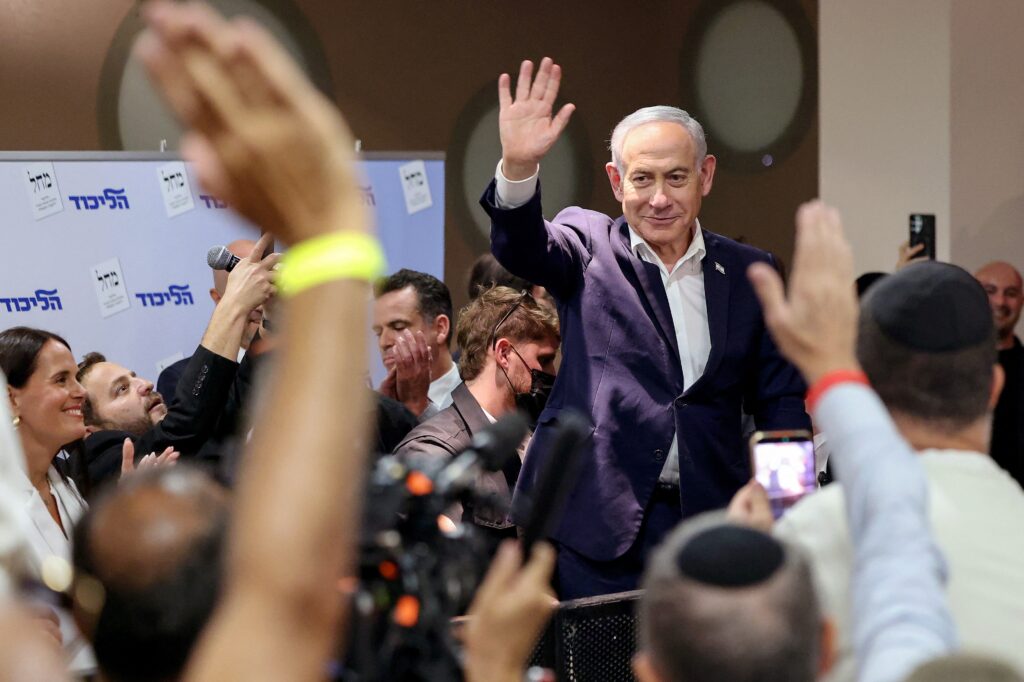
Polls here show Eisenkot’s Yashar bloc narrowly leading Netanyahu’s, but still falling short of the 61 seats need for a parliamentary majority. Netanyahu says Eisenkot won’t be able to govern without the so-called Arab parties, and he’s framing cooperation with them as an existential threat.
“Populist leaders typically define an external and an internal enemy, and for Netanyahu, Arabs serve as the ultimate enemy,” said Gayil Talshir, a political scientist at the Hebrew University of Jerusalem.
An irony, Talshir noted, is that Netanyahu was “the first to open the door to political cooperation” with Abbas, the leader of the United Arab List — he reached out in 2021 as he struggled to form a government.
Their talks failed, and Abbas joined a coalition led by Naftali Bennett and Yair Lapid instead. The so-called change government collapsed after a year and a half, but it broke the long-standing taboo here against Jewish-Arab coalitions.
Israel’s roughly 2 million Palestinian citizens make up about 20 percent of the population.
“The delegitimization of the Arab public has always existed and been used as a political maneuver to mobilize voters,” said Rula Daood, who co-chairs A Place for Us All, an Arab-Jewish party that is not running in this election.
On election day in 2015, Netanyahu released a video warning that the “right-wing government is in danger” because “Arab voters are coming out in droves to the polls” — remarks condemned as racist and for which he later apologized.
“Netanyahu is leveraging the October 7th attack to continue incitement against Israeli Arabs,” Talshir said. Based on focus groups targeting his base, she said, Netanyahu knows the “Arab issue” is what frightens the Israeli right the most.
Netanyahu’s latest campaign slogan is “Right or Palestine.” A government of his opponents backed by the Arab parties, his campaign warns, “will establish a Palestinian state with East Jerusalem as its capital.”
Eisenkot said his main goal is to form a coalition with Zionist parties, but he has not ruled out working with the Arab parties, projected to win some 14 to 15 seats in Israel’s Knesset.
“We must not surrender to [Netanyahu’s] scare campaign about ‘them going with the Muslim Brotherhood,’” Eisenkot said this summer at the Herzliya Conference, an Israeli security summit.
“I am not saying yes or no to a Haredi or Arab party,” he said. “I will sit with anyone who believes … that Israel is a Jewish and democratic state.”
As the campaign has intensified, Eisenkot has tightened his requirements. “Parties that do not recognize Hamas as a terrorist organization that the State of Israel is obligated to destroy,” he said recently, “will not be part of any government we form.”
The framing “does leave some room,” said Mairav Zonszein, a senior Israel analyst at the International Crisis Group.
“Basically, he’s saying if you’re a Palestinian politician and you want to work with me, then you need to meet these demands, and then we can work together,” she said. “And that’s, I think, significant.”
Yair Golan, leader of the left-wing Democrats party, is one of the few Zionist party leaders calling explicitly for Arab parties to be included in government. “Anyone who wants a healthy society and a functioning government should welcome having ministers from the Arab society,” he said last year.
Avigdor Liberman, leader of the right-wing Yisrael Beiteinu party and a key member of the anti-Netanyahu bloc, takes the opposing view. “It is not possible to rely on lawmakers from Ra’am and the Joint List,” he recently wrote on X, referring to the two main Arab slates.
Palestinian citizens of Israel say systemic discrimination, marginalization and neglect have deepened under Netanyahu’s right-wing government.
During the tenure of National Security Minister Itamar Ben Gvir over the past four years, violent crime in the Palestinian Israeli community has surged to record levels. The 252 Palestinian Israeli citizens killed in crime-related violence in 2025 made it the deadliest year on record, according to the Abraham Initiatives, an Israeli coexistence organization that tracks the violence. The pace has since increased, with 144 more such deaths in the first half of 2026.
“The primary responsibility lies with the government to ensure our safety,” said Daood, 40, who lives in Jaffa, a mixed city. “If children have no informal after-school programs and there is no one putting criminals in prison or collecting weapons, our society will only continue to deteriorate.”
This crisis is changing how many Palestinian Israeli citizens view the upcoming elections.
“There is a sense of despair,” said Ibrahim Abu Ahmad, 34, a Palestinian Israeli political activist from the city of Shafar’am. “People don’t leave their homes after 7 or 8 p.m.”
He expects higher-than-normal Palestinian Israeli turnout in the elections.
“The rise in murders within Arab society is pushing us to act,” he said. “The current government must go, and without voting, it just won’t happen. … Netanyahu will really see us moving in droves to the polls.”
Palestinian Israeli turnout over the past decade has hovered around 50 percent. Arik Rudnitzky, a researcher with the Arab Society in Israel Program at the Israel Democracy Institute, estimates it could reach up to 65 percent on Tuesday.
“In Arab society, there is a feeling that the upcoming elections are critical and decisive,” he said. “They have had enough of the current government, particularly the minister responsible for the police, who does not show the Arab public that he cares about them.”
Yousef Jabareen, chairman of the Joint List, a slate of Arab parties, said the violence was “not inevitable or the result of bad luck,” but a product of government policy. “Everyone understands that as long as Ben Gvir controls the police, [Finance Minister Bezalel Smotrich] controls the treasury and Netanyahu controls the government, no positive change will occur.”
Many Palestinian Israeli citizens doubt “that the Knesset and its representatives can truly help,” Daood said. But she also expects higher Arab turnout. Many “want Ben Gvir out — not just Bibi.”
“The more positive and constructive the Arab parties’ campaign is for the Arab voter,” Rudnitzky predicted, “the higher the turnout will be.”
Turnout could also get a boost from the decision of the Arab parties to run on a unified slate. In the previous election, in 2022, the left-wing Arab-Jewish Hadash and the centrist Ta’al ran together, while the Palestinian nationalist Balad ran separately and failed to pass the electoral threshold.
Removing Netanyahu’s government is the slate’s primary goal, Jabareen said, “but that never meant we will provide a blank check to anyone.”
The Joint List would back an alternative government from outside the coalition, he said, provided it met its demands, including fighting organized crime and pursuing negotiations toward a two-state solution.
But it is Abbas’s Ra’am, running separately, that is more likely to actually join a governing coalition.
The party received a major boost with the addition of Yoav Segalovitz, a former deputy minister of public security in the government of Naftali Bennett and Yair Lapid who was credited with curbing crime in Palestinian Israel communities. Segalovitz said he joined Ra’am “to offer partnership in the face of incitement and racism.”
Rudnitzky called the development novel, and said it could strengthen Ra’am’s legitimacy among Jewish parties “so they can no longer refuse a coalition partnership,” while also presenting a plan to combat crime and violence in Palestinian Israeli society.
“The Arab public wants its representatives to be members of the government,” Rudnitzky added, “not necessarily out of love for the state or the government, but from the understanding that this is the way to exert influence.”
“We can’t change reality unless we take an active role,” said Abu Ahmad, the political activist. “If we stay on the outside, we won’t be able to influence decisions on issues that affect us.”
“Arab-Jewish partnership is the future of this place,” Daood said.
The post Netanyahu casts Arab parties as a threat. They could be key to his defeat. appeared first on Washington Post.