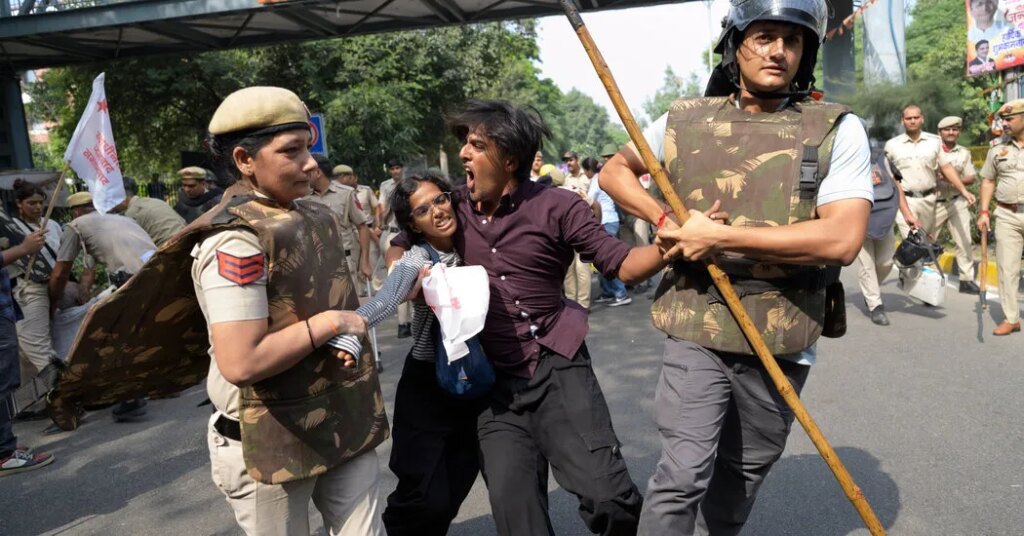
It’s been quite something to watch India’s student protests, which started this summer and have continued, off and on, into the fall. So far, they’ve forced the resignation of a minister and put Prime Minister Narendra Modi on the back foot — a rare occurrence.
It’s tempting to compare these demonstrations to the youth protests currently roiling Europe. But there’s at least one important difference: Young people make up a much larger share of India’s population than they do in Europe — which is one reason these protests have been so powerful. (When I read about them, my mind actually went to the student protests of 1968, which took place when the West itself had a youth bulge and which ended up reshaping Western societies profoundly.)
Today, I write about why the youth movement has Modi nervous — and whom he’d rather face off against instead.
A fight he knows how to win
This time, Modi was prepared.
As India braced for another round of Gen Z protests in New Delhi this month, the government swiftly barricaded a large area of the city center and deployed tens of thousands of security forces to stop crowds like those that had gathered during the summer from mobilizing.
But as my colleagues Mujib Mashal, Suhasini Raj and Hari Kumar reported, the police did allow one large gathering to go ahead: the one staged by the Congress Party and its alliance partners. Led by India’s opposition leader, Rahul Gandhi, they were able to march to the Supreme Court, where they raged against the prime minister’s strongman tactics and efforts to chip away at India’s democracy by removing millions of names from voter rolls.
Why would Modi’s government go to such enormous lengths to crack down on protests by a youth movement but let one by the opposition go forward? It might seem like a puzzle, until you appreciate — as Mujib points out — that it’s part of a strategy that Modi has adopted in the aftermath of this summer’s protests.
Modi is deliberately trying to make the ongoing demonstrations less about the youth movement that unleashed them, and more about his traditional opposition.
Because that’s a fight he knows how to win.
The devil you know
When young people first took to the streets this summer to protest against a botched university entrance exam and an education system they said was failing them, the government was caught by surprise.
Modi tried to contain the protests, first with police batons and tear gas, then with social media videos trying to connect with Gen Z, in its own style. It didn’t work. In the end, he had to sacrifice his education minister.
It was a rare political climb-down for a leader who has been in power for 12 years. The protesters went home, for a while at least. But, as Mujib writes, they were also emboldened.
India’s youth movement is a headache for Modi, and he’s been struggling to find a workable playbook. Partly that’s because India has a lot of young people: more than 40 percent of India’s 1.4 billion people are under 25. And partly it’s because the youth movement has cut across traditional political divides in India, making it much harder for Modi and his allies to box in and demonize.
It’s no coincidence that this movement first galvanized around the issue of dysfunction in India’s higher education system — specifically, leaked entrance-exam questions, Mujib told me. The sense that access to the university system is rigged — a system that Indians have long been told is their ticket to a better life — cuts across typical political lines.
“The anger was over an issue that couldn’t easily be dismissed as partisan,” Mujib said. This, for Modi, is something new. One detail that stood out to me: Many of the young protesters this summer said they came from middle-class families that support Modi’s party, the B.J.P.
The Congress Party, by contrast, is very much a known quantity. Modi has never lost an election against a rival from the Congress Party. His party beat Congress three times in national elections. And the man leading the losing side was always the same — Gandhi, who is still in charge today.
Mujib interviewed more than half a dozen senior members of Modi’s coalition to talk about the B.J.P.’s strategy in the face of these protests.
Modi’s approach is two-pronged, Mujib explains: First, quash any protests that could feel like a continuation of the Gen Z protests over the summer, which, by all accounts, unsettled his grip on power.
And second, allow the rallies of traditional opposition parties to go ahead, framing the fight squarely against a foe that Modi has repeatedly beaten at elections and is confident of beating again.
So far, Mujib writes, it seems to be working. Efforts to detain the leaders of the cockroach movement have slowed its momentum; meanwhile, Congress is planning its own rally for Nov. 1.
Common cause?
What happens next will depend in part on the extent to which Modi continues pursuing his crackdown. But it might also depend on whether Gandhi and the youth movement want to stand together.
For Gandhi, it’s potentially an opportunity. His longtime campaign against Modi’s strongman tactics has been validated and energized by this year’s protests. Images of him using his legs to push back against police officers trying to shove him inside a bus earlier this month went viral on social media, my colleague Anupreeta Das reported. So did a video of him climbing up a yellow police barricade to avoid being captured by security forces.
During the march to the Supreme Court earlier this month, he was joined by Neha Bora, a student who has become a breakout star of the youth protests.
In a sense, Gandhi is trying to do precisely what Modi wants him to do: weave the youth protests and political opposition into a unified force.
The question is whether such an alliance would undermine the power of the youth movement, which is in part rooted in its nonpartisan appeal.
Whatever happens, India’s youth movement has become a serious factor in Indian politics. Gandhi is hoping it will galvanize his political ambitions. And Modi is under pressure in a way he has not been in his 12 years at the national helm.
MORE TOP NEWS
Brazil’s high-stakes election
Brazilians cast their ballots yesterday in a fiercely fought presidential election that has the country on edge.
President Luiz Inácio Lula da Silva, a leftist who has repeatedly defied Trump, is facing a challenge from Flávio Bolsonaro, the right-wing son of former President Jair Bolsonaro, who is aligned with Washington on issues such as using lethal force to fight drug gangs. Follow our live coverage.
My colleague Ana Ionova explains in the video above how Bolsonaro has focused his campaign message on fighting crime, a strategy from the right-wing playbook in other Latin American countries.
OTHER NEWS
-
Venezuela’s leading opposition leader, María Corina Machado, returned to her country after nearly a year in exile. Read our recent interview with her.
-
Weekend protests in France ended with clashes but did not escalate into widespread looting.
-
Saudi Arabia reopened the Riyadh airport after a spate of deadly Houthi attacks.
-
The war in Iran is entering a dangerous phase ahead of elections in the U.S. and Israel.
-
The Israeli military raided Hebron, in the West Bank, after an attack killed two soldiers.
-
North Korea’s leader, Kim Jong-un, visited China for the first time in more than a year.
U.S. MIDTERM ELECTIONS
-
Barack Obama sharply criticized Trump during appearances on the campaign trail.
-
Americans in their 30s say the cost of living is keeping them from milestones like buying a house or starting a family. It’s affecting how they vote.
WHAT ELSE IS HAPPENING
-
Airbnb said it would restrict the chores required of guests after complaints from travelers.
-
The owners of Elvis Presley’s music sued Anthropic, saying it trained its A.I. models on more than 200 of Presley’s songs without permission.
TOP OF THE WORLD
The most clicked link in your newsletter on Friday was about an Emily Dickinson poem.
GEN Z SLOGAN OF THE DAY
“Bismillah, c’est les ténèbres”
The slogan has appeared on protest signs in France. It means “In the name of God, it’s the darkness,” which doesn’t make much sense. But it has become a rallying cry. Some suspect that the phrase was a clumsy attempt by the authorities to infiltrate the student movements.
MORNING READ
Cheese nerds are an excitable bunch. These days, if you want to see them get superexcited, just mention Canada.
Canadian cheesemakers have been winning awards, with one even running an organic operation in which cows rest on water beds after grazing. But the 50 percent tariffs that Trump imposed on Canadian cheese last month have caused havoc. Read more about how tariffs are affecting cheese.
AROUND THE WORLD
Moving to the end of the Earth
In 2014, Kelly Green made a decision that would change her life: She moved to Tristan da Cunha, a remote island in the South Atlantic. Two years before, she had met an islander on a visit to the British overseas territory.
She married him, and she’s now raising a family in the quiet outpost, where they grow potatoes and raise sheep. Only 220 people live on the island, which she reached after leaving South Africa and spending a week at sea. “Raising a family here is amazing,” Green said. Read more about life on Tristan.
RECOMMENDATIONS
Discover: A road trip through Lithuania and Latvia turns up extraordinary country inns.
Watch: The underdog love story “Wicker” argues that even the most reviled among us deserve passion.
Adorn: Check out the highlights from New York Bridal Fashion Week.
Consider: Here’s how to lower the likelihood of Alzheimer’s if you have a genetic risk.
RECIPE
This roast chicken recipe calls for 40 cloves of garlic — yes, 40. They are key to making a rich, garlic-infused butter sauce to pour over the chicken and a jammy garlic spread to slather on crusty bread.
WHERE IS THIS?
Where is this post office?
TIME TO PLAY
Here are today’s Spelling Bee, Mini Crossword, Wordle and Sudoku. Find all of our games here.
That’s it for today. See you tomorrow! — Katrin
We welcome your feedback. Send us your suggestions at [email protected].
The post Modi’s Plan to Stop India’s Protests appeared first on New York Times.