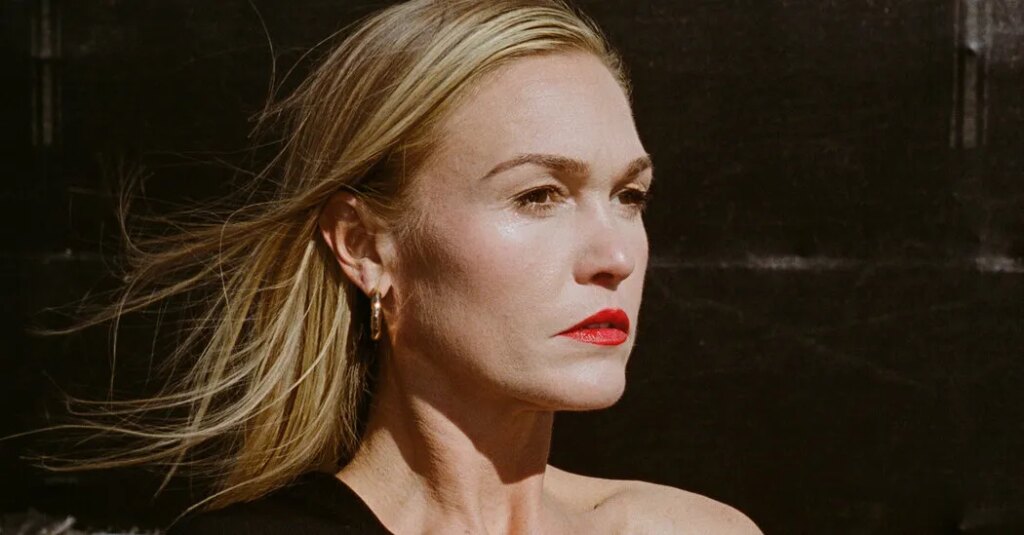
Critics often praise a dancer’s star quality. Julia Stiles is a star with dancer quality.
Stiles, 45, has never danced seriously. But certain corners of the internet seem unable to admit that. Years of memes have indelibly linked Stiles with Sara Johnson, the Juilliard-bound dancer she played in the 2001 film “Save the Last Dance.” (She did do some of her own dancing in the movie, but she also had dance doubles.) And with her long limbs and elegant posture, she looks like a dancer.
Now, 25 years after “Save the Last Dance,” Stiles has become an unexpected darling of the reality television staple “Dancing With the Stars.” As a contestant this season, she has playfully engaged with the “is she or isn’t she” confusion — and channeled the powerful millennial nostalgia for her early-career movies.
Her routine last week recreated, almost step-for-step, the famous audition scene from “Save the Last Dance,” with its awkward yet endearing blend of ballet and hip-hop. During Tuesday’s “Dedication Night” episode, Stiles paid poignant tribute to Heath Ledger, her co-star in the 1999 cult classic “10 Things I Hate About You” — and got many of the film’s other leads, including Joseph Gordon-Levitt and Gabrielle Union, to join her onstage.
It’s rare for “Dancing With the Stars” to attract a star of Stiles’s wattage. The show is hard, humbling work. Stiles, who has kept her personal life private and has been selective about her acting projects since her early aughts boom, doesn’t have an obvious reason to seek the disco-dappled spotlight of the ballroom.
But the dancer Ezra Sosa, Stiles’s professional partner on the show, said in a video interview that Stiles had jumped all the way in.
“It would be easy for someone in her position, with all her success, to just be like, ‘No, I don’t want to do another “Save the Last Dance” reference,’” Sosa said. “But she is down for anything.”
Including TikTok. With the support of Sosa — at 25, he is her “Gen Z tech savvy social media manager,” he joked — Stiles joined the platform a few weeks ago, shortly before the “Dancing With the Stars” season began. Her wryly self-aware videos, which often quote her own movies, have already earned her nearly a million followers.
In a video interview from Los Angeles on Wednesday, Stiles said her experience on the show had been both joyful and surprisingly raw.
“I knew the show would be physically challenging, but it’s been a big emotional journey, too,” she said. “I can recite a monologue or do a play in front of an audience, and that doesn’t scare me. But to dance in front of people? I had to figure out how to tackle that.”
Here are edited excerpts from the conversation.
Did you ever study dance?
I did, just nothing rigorous. When I was a kid, I took modern classes at Dance Theater Workshop in New York City — very Martha Graham-inspired, all about dancing from the inside out. And I would do random classes at Steps on Broadway.
Why did you stop?
I stopped after “Save the Last Dance.” I was too self-conscious. Everyone suddenly expected me to be a professional-level dancer, and I wasn’t. And I was very “negative Nancy” about my body.
Did you return to dance as an adult, before “Dancing With the Stars”?
During the pandemic, I took Ryan Heffington’s classes on Zoom, the ones that were just big dance parties. But with the camera off — I still couldn’t deal with eyeballs on me.
Were you a “Dancing With the Stars” fan?
Oh, for a long time. I started out watching reruns and clips on YouTube, but by the time Witney [Carson] and Alfonso [Ribeiro] won [in 2014], it had become my Tuesday night football. I love it. For many years I’ve been in my Pilates classes, imagining myself on “Dancing With the Stars.”
Did the “Saturday Night Live” sketch you did with Chloe Fineman in 2023, where you recreated the “Save the Last Dance” audition scene, inspire you, too?
Yes! It’s all Chloe’s fault that I’m on “Dancing With the Stars.” [laughs] I was so happy to be in on that joke on “S.N.L.” I’ve wanted a do-over on that movie for a long time. I’m glad that people still care about it, but I also know they make fun of it. And I can see why — I can see how tense I was in that audition scene.
Dance-wise, what has been most challenging for you about “Dancing With the Stars”?
Holding a ballroom frame is so hard. Like for the quickstep, you’re supposed to lean away from your partner, so the two of you look like a martini glass. I think that I’ve got my back arched, and then Ezra pushes me 90 percent further back. And it still barely registers on camera.
Your routines acknowledge the deep affection fans have for your early films. What is it like to be at the center of that kind of nostalgia?
It’s moving and surreal. It seems like people are responding this way because they need something, and I don’t know what that is exactly or if I can give it to them. But I definitely feel lots of positivity and love.
How did you and Ezra approach the Heath Ledger tribute?
On the first day of rehearsals, I was crying the whole time. I really credit Ezra for opening me up. He told me that movement without intention and emotion is just steps. You have to infuse the dance with inner life. It was very different for me. I couldn’t hide behind a script.
It felt more vulnerable than acting?
I think a lot of the roles I play — like Kat Stratford [in “10 Things”] — are in some ways aspirational, where you’re living out something you’re not in real life. But this particular dance got me thinking a lot about me, who I was at 17 years old and who I am now and all the space in between.
You are a private person on a very extroverted show. How do you deal with that?
Twenty years ago, when I got this kind of attention, I didn’t trust it. I thought, as quickly as they praise you, they’ll tear you down. It made me retreat and kind of wilt.
But I did not come on this show to wilt or to boof all the choreography. I wanted to work hard and to keep myself open. You’re constantly in front of cameras, you’re constantly doing interviews, and you have to be open in the dances.
It’s also helped me be proud of my body. I’ve finally silenced that voice that was constantly critiquing every body part.
A common dancer struggle.
I think it’s a woman struggle.
What is your relationship with dance now?
I love it so much. What’s been interesting is the juxtaposition of going into dance rehearsals and focusing on your anatomy and physicality, and then doing these interviews where you’re asked to put words to your emotions and thoughts. I’m toggling between verbal expression and physical expression.
I think I prefer the physical expression. With dance, you have to be in the present moment. Your mind and body have to be connected, you have to be thinking about exactly the here and now. I find that really wonderful.
The post Julia Stiles’s Dancing Is Healing Millennials appeared first on New York Times.