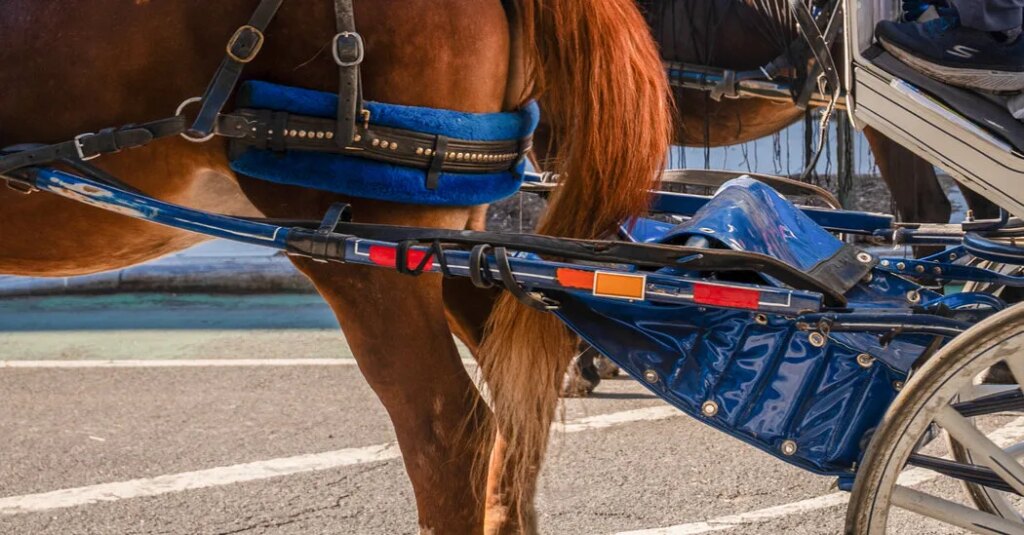
If you were to take a carriage ride through Central Park in New York City, you might hear your driver say, “Frederick Law Olmsted designed this park, in 1858, to be viewed from a carriage.”
You might also get a history lesson about how horses were integral to the city’s construction. Manhattan was a budding Dutch settlement in the mid-1600s when horses powered the gristmills and lumber yards whirring at its economic core. The Dutch were all about business, as were their horses. Over the next 250 years, as majestic structures rose from the weeds, they were formed from materials hauled in by horse.
If you are so inclined, it would be a good idea to book that carriage tour soon, because New York’s affair with the horse will end, after the passage of Romanch’s Law by the New York City Council on Oct. 22. Mayor Zohran Mamdani backed the bill, which will legislate the Central Park tourist carriages, on the job since the 1860s, out of existence in a phased withdrawal ending in June 2028. Some 380 creatures — 180 horses and 200 owners, drivers and stablehands — just got fired.
While it may be difficult to understand today, for centuries the fates of humans and horses were intertwined. Horses powered empires from Genghis Khan’s to the conquistadors’. No wonder conquering heroes are depicted on horseback.
They also powered human imagination. Rudimentary horse figures gallop alongside humans in the earliest cave art that was scratched into rock walls. One of the oldest surviving photographic images is a heliographic engraving by Joseph Nicéphore Niépce in 1825 of a man leading a horse. Even today the visual pioneer and presager of modern cinema Eadweard Muybridge is best known for his stunning 1878 study of locomotion titled “The Horse in Motion.”
But it is in the early films of Manhattan by Thomas Edison’s film company that we glimpse how the end is always in the beginning, with first electric trolleys and then horseless carriages taking their cut out of the street’s middle. (There was a human toll, too. On Sept. 13, 1899, Henry Bliss stepped off a streetcar on the Upper West Side and was struck by an electric-powered taxi — yes, an E.V. — becoming the city’s first recorded automobile fatality.) In Edison’s captures from the late 1800s, horses still dominate most means of transport, but by 1910 the animals are literally pushed to the side by mechanized means. How different those old movies look now as New York embarks on its lengthy goodbye to the hearty beasts without whom it could never have been constructed.
We live in a complicated world for both mankind and animals. Much as a newly furloughed worker faces unwelcoming prospects, a recently laid-off horse can scarcely plan its next move. “Free the horses” looks good on a placard until you learn that the federal Bureau of Land Management is selling off, with nary a trace, thousands of the wild mustangs under its charge in the desert West. Many of those horses and donkeys are being slaughtered. The free-ranging ponies have it no better on Assateague Island National Seashore, where seasonal traffic has a way of culling their herd.
Far from the big city, trotters in Amish country in Pennsylvania or upstate New York aren’t immune to the political pressure. Roadway fatalities that occur when speeding drivers hit the rear of one of the slow-moving buggies can ignite social media posts that call for banning them from the roads.
In rural America, a draft horse might still find a glimmer of hope as expensive mechanical harvesters, combined with soaring diesel fuel prices, make horse-powered harvests the economical winner. But even in Pennsylvania’s Lancaster County, Amish farmers with the requisite skills are bidding against real estate developers over the nation’s most fertile soil, often losing those battles.
Tourist steeds fare even worse, with carriage rides under assault worldwide in nearly every vista they roam. The sad truth is that while horses helped people build our modern world, they are no longer as useful and, as such, are in danger of being discarded with barely a mention that there would have been no New York City — or any city — without them.
Animal advocates say they’re working to find retirement homes for the four-legged employees; the new law prohibits selling the carriage horses for slaughter. “I have seen so many horses come alive in sanctuary after coming out of working careers their whole lives,” Allison Bowling, the executive director of the Red Feather Equine Sanctuary in North Carolina, told The New York Post.
Enter: the lawn ornament. That’s a horse person’s sarcastic term for the idyllic endgame envisioned by those who wish to retire all horses to green, work-free pastures. A lawn ornament might luck into a gentleman farm, with a little girl who’s read “Misty of Chincoteague” and a brush handy to untangle a mane. But with annual costs of up to $20,000 in feed and care for an old horse, even a cherished lawn ornament might lose its appeal should the stock market stumble. That’s when veterinary offices display homemade tear sheets offering horses free to good homes.
People who own horses and care for them daily will explain to you that even under the best circumstances, the life of a lawn ornament is far from ideal. Like many domesticated animals, horses thrive when given something to do. Daily physical and mental stimulation does a soul good — an axiom that applies equally well to horses and people.
Just as one can divine the future flickering within the frames of Edison’s earliest films, so too can we see our own challenges lurking in the economy’s shadows today. That’s because humans are confronting their own lawn ornament moment. If you think the steam engine was a displacer, take a look at artificial intelligence.
One can only hope that more thoughtful care is taken when the human work force is discarded than has occurred as New York’s horses and drivers face their extinction-level event. The bill calls for the retraining of drivers, but the Transport Workers Union Local 100, which represents carriage drivers and owners, has been dismissive. “It offers nothing concrete for blue-collar drivers and carriage owners,” said the union’s international president, John Samuelsen, in a statement. He added: “It is not progressive. It is anti-worker. It’s theft.”
The union says it will sue the city to stop the law, citing constitutional issues. The unspecified work force retraining on offer to the mostly immigrant carriage drivers will be of little use. What’s the A.I. skill set equivalent for people who are expert at handling horses, tourists and traffic in a dense urban environment?
The tidy explainers also gloss over the fact that the animals are property owned by businesses that may have a right to determine next steps. Horses have advocates; horse owners have lawyers. The P.R. window dressing was helpful in ramming through the bill, but real people and animals deserve a truly safe landing, not a Band-Aid to conceal the inconveniently uncinematic fallout.
Even though humanity seems ill suited to do so, two seemingly oppositional truths can be held in the same moment. If there is a goodbye to New York City’s horses, many drivers will shed a tear parting with an animal that they have nuzzled and loved. Yet it is also true that some animal rights demonstrators who have braved the cold holding their signs will shed a joyful tear at the animal’s release. Still, when the clip-clops in Manhattan finally go silent, we must ask if our greater society has held a dignified place for these horses or workers.
And if we don’t, what does that say for the swath of America’s work force that may soon face its own obsolescence?
Mary Haverstick is also the author of “A Woman I Know.”
The Times is committed to publishing a diversity of letters to the editor. We’d like to hear what you think about this or any of our articles. Here are some tips. And here’s our email: [email protected].
Follow the New York Times Opinion section on Facebook, Instagram, TikTok, Bluesky, WhatsApp and Threads.
The post What New York City Will Lose When It Ends Carriage Rides appeared first on New York Times.