At first blush, the proposed venture looks like it would further the Trump administration’s goal of global “energy dominance.”
An American energy company intends to buy Russian technology and use it to access a massive supply of natural gas in Alaska, liquefy it and export it to allies abroad.
The Kremlin and the White House were interested in the idea. President Vladimir V. Putin discussed the plan last month with President Trump’s peace envoys, Steve Witkoff and Jared Kushner, people familiar with the negotiations said, speaking on condition of anonymity to discuss sensitive diplomacy. It is one of a series of energy deals White House officials believe could help smooth relations with Moscow and eventually pave the way to end the war in Ukraine.
But it turns out that the company was not an All-American affair. The multibillion-dollar project has received secret funding from the same powerful Russian company that was to provide the technology, according to the energy executive who until last month led the U.S. firm and two others involved in company negotiations.
Joel Riddle, who was chief executive of the company, Polar LNG, until he resigned in September, said he had been misled about the sources of the start-up funding, which ostensibly came from a company in the United Arab Emirates.
Instead, Mr. Riddle said he learned, the true source of at least some of Polar LNG’s money was Novatek, a Russian energy giant under partial U.S. sanctions.
“It’s not only unlawful, but it’s not in the U.S. interest to have Russian technology controlling the commercialization of Arctic gas in the North Slope,” Mr. Riddle said in a brief interview.
These previously unreported tensions were also detailed in legal memos that Mr. Riddle attached to his resignation letter, which was reviewed by The New York Times. The memos, prepared by Baker Botts, an international law firm, said the Treasury Department’s sanctions enforcement unit had raised concerns that Polar LNG had ties to Novatek that might present “potential Russia-related sanctions concerns.”
Polar LNG on Friday issued a statement announcing a new acting chief executive, Tim Talkington, and described Mr. Riddle as a “disgruntled former employee.”
But in a statement to The Times, Novatek said on Friday that it, in fact, was moving to acquire “minority shareholder” status in the Polar LNG project — a striking effort by the Russian energy giant to seek ownership of American gas production.
The project, if it happens, is a long way off. In addition to the sanctions issues that would have to be negotiated, the technology envisioned is highly complex and must overcome some of the most brutal weather conditions in the United States. It also is competing with another Alaska gas plan that already has the support of the Trump administration. But that the Polar LNG deal is being discussed at all shows how business deals of almost any stripe are on the table during the talks with the Kremlin.
The sequence of events illustrates the unorthodox, opaque mixture of deal-making and high-stakes diplomacy that has defined Mr. Trump’s attempts to end Europe’s bloodiest conflict since World War II.
There is no indication that Mr. Witkoff or Mr. Kushner were aware of Polar LNG or its ties to Novatek, even as the broad outlines of the deal came up in their talks with Mr. Putin beginning last year. A U.S. official, speaking on condition of anonymity to discuss the closed-door talks, said that the deal had only been broadly mentioned and that no granular discussions had occurred.
The project, should it ever come to fruition, would doubly help Novatek, one of Russia’s biggest energy companies, first by using Novatek’s technology and second because the company would own an equity stake.
The Alaska gas discussions have taken place alongside talks to sell off part of another Russian energy giant, Lukoil, to the U.S. government and other investors, including some with business ties to Mr. Witkoff and Mr. Kushner, causing consternation among some Washington lawmakers and outraging some of Ukraine’s supporters. The pair have also discussed the possibility of U.S. involvement in future Russian gas exports to Europe. (The administration has said that Mr. Kushner and Mr. Witkoff were guided only by U.S. interests.)
Geoffrey R. Pyatt, who served as an assistant secretary of state for energy resources during the Biden administration, said the idea of bringing Novatek into the high north of Alaska is a terrible one. “It is terrible on environmental grounds, it is a terrible idea on economic and geopolitical grounds, and most importantly this feeds the belief that Putin can get an out-of-jail-free card.”
The efforts to bring Novatek equipment to Alaska have also included a businessman, Gentry Beach, with ties to the Trump family. A college friend of Donald Trump Jr., the president’s eldest son, Mr. Beach served as a finance vice chairman for Mr. Trump’s 2017 inauguration. Mr. Beach said in February that he had held negotiations with Novatek about bringing its natural gas technology to Alaska.
Mr. Beach could not be reached for comment. It was not clear if he remained involved in the project, or whether he was aware of Novatek’s potential ownership stake in Polar LNG.
A spokesman for Donald Trump Jr. said the two men were no longer close, adding that Mr. Trump was not involved in the Polar LNG project. Novatek’s statement said that Mr. Beach had no role in its discussions to take a stake in Polar LNG. The U.S. official said Mr. Beach was not involved in the administration’s discussions related to Novatek.
Mr. Riddle is one of at least three Polar LNG executives who recently resigned. As they departed, Trump officials were notified about their concerns related to the secret Russian financing. Mr. Riddle said the executives had urged administration officials to investigate the matter. The Energy Department, where the warning was sent, did not respond when asked about the matter.
“I felt like I did the right thing to notify authorities at the appropriate time,” Mr. Riddle said.
Buried Riches
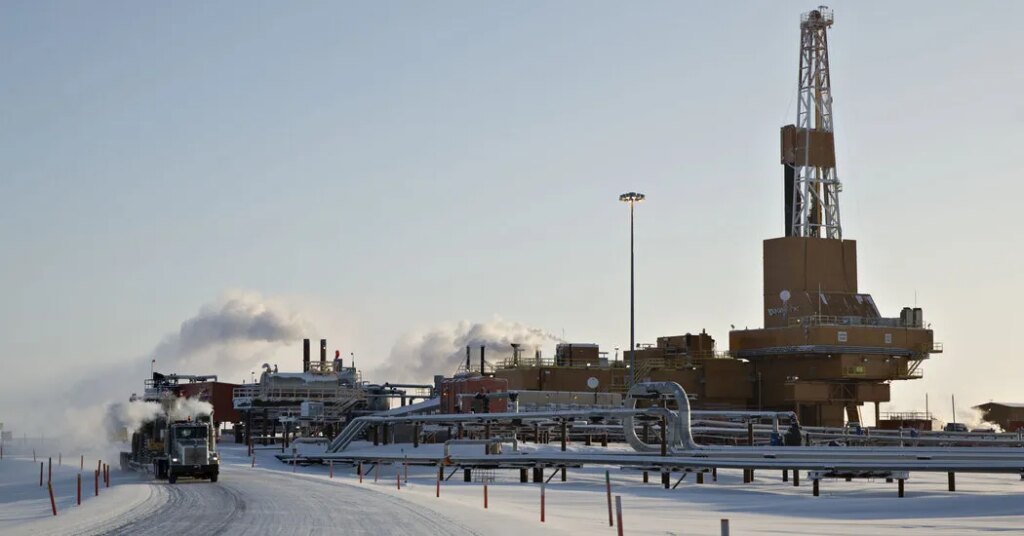
The Polar LNG plan called for the company to tap into the giant load of natural gas available in the northern reaches of Alaska, a byproduct of extensive oil extraction underway in the region.
Currently, there is no way to move most of the gas that is produced along with the oil, so energy companies inject it back into the earth.
Polar LNG’s proposal calls for it to buy a giant, 640,000-ton concrete-and-steel device from Novatek called a gravity-based structure that would be placed on the seabed just above the northern coast of Alaska, in an area known as Milne Point.
On top of that platform, equipment will be installed that would refrigerate gas supplied by an area oil producer, transforming it into a liquid that can then be loaded onto ships that travel through icy waters and deliver it to customers in Asia.
Novatek uses a similar approach to export natural gas from the Russian Arctic in a project called Arctic LNG 2. Mr. Putin said publicly last year that “we are discussing with our American partners” the possibility of using Novatek technology to produce liquefied natural gas in Alaska.
Korean-made ships with a special ice-breaking design that Polar LNG plans to use were initially built for Novatek, but delivery was stopped by the manufacturer after the United States imposed sanctions on the Arctic LNG 2 project.
From the start, Novatek was slated to supply the gas liquefaction station. But financing for the project was not supposed to come from Russia, according to executives involved in the effort.
Emphasizing the point, Polar LNG features images of the American flag and a bald eagle on its website, boasting that “Polar LNG helps ensure the United States leads,” adding that the project is “America’s Arctic Advantage.”
The company hired lobbyists in Washington and in Alaska to help push the project, according to federal and state records. In Washington alone, the company is spending $380,000 a quarter on lobbying, hiring a former Trump-era Interior Department acting assistant secretary, Adam Suess.
Novatek is already under U.S. sanctions that would require the Treasury Department to issue a license for its equipment to be used in Alaska. Recently passed sanctions legislation named after deceased Senator Lindsey Graham, Republican of South Carolina, makes things even harder: the bill specifically targets Novatek, as well as its Arctic LNG 2 project, because of Novatek’s ties to Mr. Putin.
However, Mr. Trump temporarily waived the law’s Russia sanctions last week, presenting the move as necessary to keep peace talks going.
During a meeting held at the Four Seasons Hotel in late August in Abu Dhabi between executives of Polar LNG and its parent company, Tech Wave Industrial Projects Management, top executives from Novatek were present. That was when Mr. Riddle began to appreciate that Novatek was directly involved in approving funding to keep the effort going, text messages reviewed by The Times indicate.
Tech Wave is an Abu Dhabi-based company that specializes in managing manage oil, gas and construction projects. Its chief operating officer is Bjorn Gundersen, who a decade ago was listed in oil industry trade publications as a senior executive at Novatek supervising LNG projects.
A second Tech Wave executive, Ahmed Farghaly, also worked for Novatek until recently. According to his LinkedIn profile, he left around the time the United States first imposed sanctions on one of Novatek’s LNG projects. Mr. Gundersen, Mr. Farghaly and Tech Wave did not respond to requests for comment.
Denis Solovyov, Novatek’s deputy chairman, as well as Leonid Mikhelson, the company’s chief executive, discussed his company providing as much as $15 million to Tech Wave to bankroll Polar LNG, the messages say. Asked about the messages and the Abu Dhabi meeting, Novatek said it could not comment on private correspondence, but that the company and Polar LNG had agreed to “provide each other with open communication.”
“All the necessary decisions were made at the meeting in Abu Dhabi,” Mr. Solovyov wrote in one message to Mr. Riddle sent in early September. “The first 5 million were supposed to arrive by today.”
It was several weeks after this exchange that Mr. Riddle resigned. Two other top Polar LNG executives, Dan Chandra, the company’s chief financial officer, and Jim Smith, a former Exxon Mobil executive who served as Polar LNG’s executive vice president, also have left in recent weeks.
Polar LNG, in a statement Friday, said “Riddle was recently terminated from the company for cause,” adding: “The company is investigating claims concerning Riddle that may result in litigation.”
But Mr. Riddle resigned six days before the company issued him a letter saying it would terminate his employment immediately, in part because he had raised concerns that some of the company’s actions could be “subject to sanctions,” documents obtained by The Times show.
Questions about the potential ties to Novatek had by late this summer already reached Trump administration officials, according to a memo prepared by an outside law firm for Polar LNG, Baker Botts.
“Concerns regarding a perceived connection to Novatek will likely affect licensing or other regulatory approvals,” Baker Botts wrote in a memo to company executives that was shared with The Times.
In addition, the letter said that federal officials had already made clear in communications with the company that they were concerned that an investor in Polar LNG “has ties to Novatek and may be acting on Novatek’s behalf with respect to the project.”
Paul Luther, a Baker Botts lawyer who worked on the matter, declined on Friday to discuss it further.
Polar LNG would need a series of approvals from the federal government before the deal could move ahead, including a sign-off from the Treasury Department authorizing it to acquire the Novatek seabed platform, given that parts of the company are under sanctions. It would also require a permit from the Federal Energy Regulatory Commission to build a gas export facility.
Questions have already emerged about whether the Novatek device will function at the planned Milne Point location because of shallow waters there and the “potential disruption to traditional whaling and local opposition, particularly from the local native Alaskan population,” a lawyer for Polar LNG wrote in an internal company memo.
Certain Trump administration officials had already expressed skepticism about the Polar LNG plan, according to internal company documents seen by The Times and interviews with some of the people involved.
Part of the concern is that the Polar LNG project would be pitted against an even more ambitious plan to build a $50 billion, 800-mile natural gas pipeline to move natural gas from the northern slope to the southern coast of Alaska, where it could be more easily shipped out from existing ports there. That plan would also potentially supply Asian markets.
Both the Biden and Trump administrations enthusiastically embraced the gas pipeline project, which Japan and Korea may help finance to increase their reliable supply of natural gas.
“The pipeline makes far more sense,” said Matthew McManus, who until April 2025 served as a deputy director at the State Department’s Bureau of Energy Resources and is now at the National Center for Energy Analytics. “The Polar LNG project would face years of permitting and concerns about ties to Russia.”
Mr. Talkington, Polar LNG’s acting chief executive, said his company sought to seize “a generational opportunity to advance U.S. energy dominance, unlock profound benefits for the state of Alaska, and strengthen American Arctic navigation.”
The fact that discussions are even going on about using Russian equipment — and potentially a Russian-financed company — to move American natural gas to international markets is a further insult to Ukraine, and should not be a part of talks over a possible end to the war, said Ilya Zaslavskiy, a gas industry consultant who previously worked in Moscow and New York who now does research on Russian sanctions and energy issues out of Washington.
“Any approach by Novatek to transfer technology should be seen as a Kremlin attempt to co-opt U.S. policymakers in order to undermine U.S. foreign policy toward Ukraine and our allies,” Mr. Zaslavskiy said.
Rebecca F. Elliott contributed reporting.
The post In U.S. Gas Talks With Kremlin, Hidden Financing for Alaska Project Emerges appeared first on New York Times.