Electricity costs around 50 percent more in Ohio than it did six years ago. Gas station fill-ups have gone up even more. And where corn and soybeans once grew, banks of computers now sift through data in hulking gray warehouses that glow against the night sky.
The pressures of soaring energy costs and the data center boom have handed Democrats a unique opportunity to make inroads in a state that Republicans have dominated for many years. But persuading voters to connect those issues to races for U.S. Senate and governor has proved difficult.
In more than two dozen interviews with The New York Times, Ohio residents described data centers as threats to their communities and expressed frustration with higher fuel and electricity bills. But few said they had been convinced to cross party lines — or show up to the polls if they usually did not.
Becky Loel, a retired secretary, expects high gasoline and diesel prices to be fleeting. Doyle Bross, a horse trainer with an easy laugh, considers the Republican Party part of his identity. Todd Leonard recently swapped his diesel truck for a gasoline model, and he waited over an hour at a community meeting this month to testify against a data center that had been proposed for a farm near his home.
But Mr. Leonard, a 45-year-old general contractor, has not voted recently and didn’t plan to in November. “It just doesn’t directly impact me,” he said of the midterm elections.
That voting habits are so sticky partly reflects the power of party affiliation and inertia about the act of voting, even at a time of broad discontent with the economy and President Trump’s handling of it.
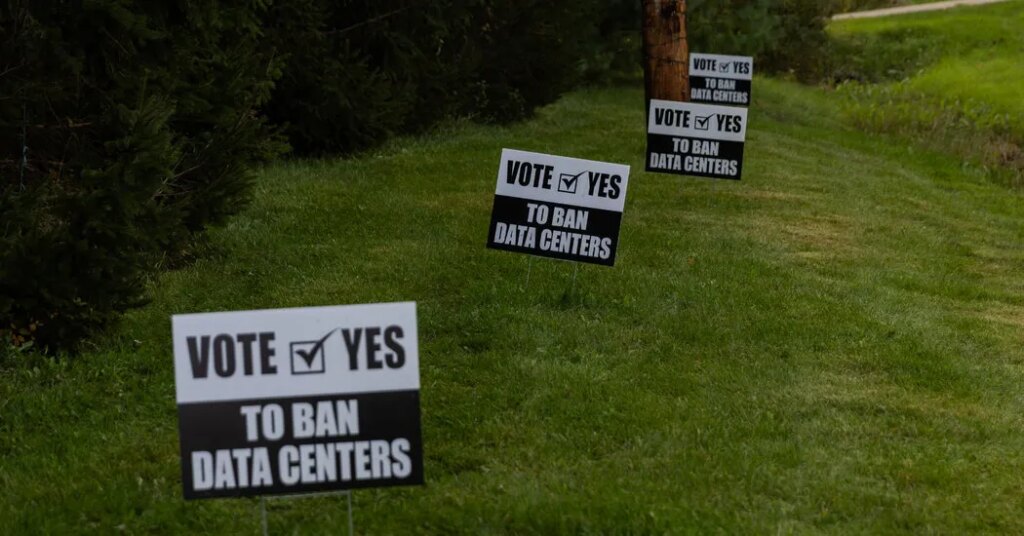
It also suggests that the data center backlash, which is so fierce that more than a dozen Ohio communities will vote on measures to restrict the facilities locally, is not consistently swaying statewide races, even as Democratic candidates like Sherrod Brown have made it central to their campaigns. Mr. Brown, a former senator, is seeking to beat Senator Jon Husted, a Republican.
Just 3 percent of likely Ohio voters said data centers and artificial intelligence were the most important issue in determining their vote for Congress, according to a recent New York Times/Siena poll. Concerns such as the cost of living and foreign policy were more important.
Ohio also has an open governor’s race, in which Amy Acton is trying to become the first Democrat to win since 2006, running against Vivek Ramaswamy, a Republican. But even though the governor has far more influence than Congress over state policies on energy and data centers, those issues have featured less prominently in that race.
“We have local communities in full-on revolt over data centers,” said David Niven, a political science professor at the University of Cincinnati. “It hasn’t necessarily translated one to one to the rest of state politics, though.”
There are, of course, those who care deeply about stemming the spread of computing facilities, which have grown ninefold in Ohio since 2020 and played a part in rising electricity costs. The Columbus area has turned into the country’s second-fastest-growing data center market, according to Cleanview, a research firm.
Sue Barton, an 87-year-old retired real estate agent, counts herself among them. A Republican who voted for Mr. Trump in 2024, Ms. Barton went door to door this summer collecting signatures for a charter amendment that would ban large data centers in her village of Granville, a dozen miles from the state’s biggest cluster of data centers.
But as of late October, other issues were top of mind as Ms. Barton considered statewide races. Mr. Brown had served in the Senate for too long, she thought. She was willing to give Mr. Husted the benefit of the doubt on data centers despite his support for tax breaks for those facilities when he was Ohio’s lieutenant governor, a position he left in 2025.
“When all this started happening, the public did not know and I don’t know that he knew how bad it really was going to be,” Ms. Barton said.
However, she was leaning toward voting for Dr. Acton for governor after Mr. Ramaswamy’s campaign released an attack ad featuring his opponent’s estranged mother. It was, she said, “just beyond what people should do.”
A week earlier, Mike Bellish was driving through his community farther south, where a data center developer had planned to build on a longtime farm. Mr. Bellish, a 63-year-old information technology manager, is a registered Republican who generally voted for Democrats in recent years. But he was unsatisfied by what he had heard from all of the candidates.
“No data centers near neighborhoods,” he said, describing what he wished politicians would commit to. Plus, Mr. Bellish said, tech companies “should be paying for their electrical needs.”
The candidates for Senate and governor have expressed support for those broad principles but refrained from making concrete commitments. They appear to not want to seem too supportive of data centers or oppose them so adamantly as to forgo their potential economic benefits.
Mr. Husted has said that data centers “should only be located where communities want them,” and Mr. Brown said that Ohioans “should get to decide if data centers are built in their community.”
Dr. Acton has backed a conditional moratorium on new data centers, which she said “must” be built on previously developed sites, often called brownfields.
“If data centers can’t follow our strict protocols, they cannot do business in our state,” her campaign said in a statement.
Mr. Ramaswamy said he would “emphasize” brownfields for new data centers and seek to provide free electricity for those living nearby.
“A year from now, if we’re still talking about data centers in Ohio as a problem, then that means I will have failed my job,” said Mr. Ramaswamy, the only one of the four to do an interview with The Times for this article.
Translating broad promises into effective policy will be anything but straightforward.
Electricity prices are lagging, meaning today’s bills reflect regulatory decisions made years ago and recent commodity prices. The same is true of data centers, which typically take several years to permit and build. Even if the next governor and legislature move quickly to change policy, the results may not become evident to voters before the next election. What’s more, Ohio is part of a regional grid and wholesale electricity market known as PJM, which effectively determines a big portion of monthly electric bills.
“You could have data centers in Virginia increasing costs for customers in Ohio,” said Ryan Hledik, a principal at the Brattle Group, a Boston research firm.
Voters are also contending with much more expensive gasoline and diesel.
Ms. Loel, the retired secretary, has been helping some of her grandchildren with gas money, and she left her family’s diesel truck behind on a recent trip to the county fair, taking their gas-powered Honda Pilot instead.
But she said high fuel costs were not a major factor in her voting decisions because she doubted they would last. The 76-year-old registered Republican was leaning toward voting for Mr. Ramaswamy and Mr. Husted.
She did have a request for Mr. Husted, though: “Stop the data centers from coming in.”
Mr. Bross, the horse trainer, planned to vote the same way. “I haven’t voted for a Democrat for a long time,” the 72-year-old said.
A big question for Democrats in the final stretch is whether their efforts to tie Republicans to data centers will sway enough people who are concerned about the issue, said Christopher Nichols, a history professor at Ohio State University. For Republicans, the question is whether they have tacked enough to the center to satisfy voters.
“They aren’t in a position to win on data centers,” Mr. Nichols said of Mr. Husted and Mr. Ramaswamy. “But they are in a position to lose.”
The recent Times/Siena poll found that 48 percent of likely Ohio voters thought Mr. Brown would do a better job on data centers, compared with 38 percent for Mr. Husted.
With less than two weeks until Election Day, Mr. Bellish, the I.T. manager, said he was gravitating toward Mr. Brown and Dr. Acton.
“I feel like Husted has brought in a lot of these data centers. It just seems out of control,” Mr. Bellish said. As for Mr. Ramaswamy, he added, “It doesn’t seem like he would put a throttle on it.”
The post Why Anger About Data Centers and Energy Prices May Not Swing Votes appeared first on New York Times.