The two combatant politicians shook hands on a stage at a hotel in Caracas after signing an accord. It was a sign that they were willing, for now at least, to keep talking about finding common ground for Venezuela.
Their aides and supporters surrounding them clapped, encouraging the notion that the authoritarian state might move toward democracy — in months or years from now, and under the watch of the country’s new chief authority, the United States.
No one addressed the central questions looming over the talks: Are President Trump and Secretary of State Marco Rubio, and the leaders in Caracas who now answer to them, ready to commit to a timeline that would result in elections?
And when should they take place?
One of the politicians on the stage, Jorge Rodríguez, in glasses and a gray sports jacket, serves as a top official in the government formerly led by Nicolás Maduro, who was seized in January in a U.S. military assault that killed scores of people.
Mr. Trump now supports that government, lavishing praise on its new leader, Delcy Rodríguez, long a commanding figure in the apparatus of repression under Mr. Maduro, who is imprisoned in New York.
The other politician onstage, Dinorah Figuera, standing next to the Venezuelan flag in an electric-blue suit, returned from exile in Spain to represent opposition groups in the negotiations over what American officials call a gradual political transition. She and Mr. Rodríguez had just spent a week doing their third round of talks, ending with the signing ceremony and news conference on Wednesday.
The next day, in a small group interview, Ms. Figuera made it clear who wielded much of the power in the process.
“I recognize Marco Rubio as a democratic figure for the United States and for Venezuela,” she said. “I recognize how he has supported a path toward free elections, transparent elections, freedom of expression and respect for human rights.”
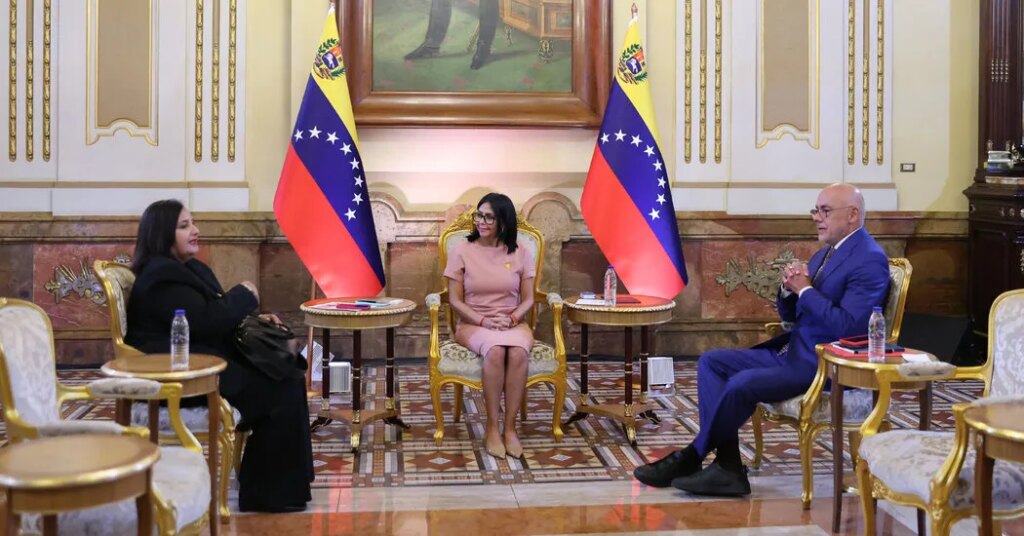
After the interview, Ms. Figuera went to the Miraflores presidential palace to meet with Ms. Rodríguez, a signal of reconciliation. After the meeting, Ms. Rodríguez acknowledged “the effort of the parties seated at this dialogue table to make progress regarding political guarantees for all.”
She also criticized dissent.
“There are still very, very small groups that resist and believe that by setting fires — or attempting to set the country on fire — and blocking streets, they can help Venezuela move forward,” she said.
If the talks move too slowly, that could work to the advantage of Ms. Rodríguez. Over two days this week, Ms. Figuera told reporters from Washington there had been steady progress, but declined to give a notional timeline for elections.
State Department officials had encouraged the reporters to fly down to observe the end of this round of talks.
For Mr. Rubio, the eventual outcome in Venezuela has an important personal and domestic political dimension — he is an ambitious Cuban American politician from Florida, home to many Venezuelans who fled the country over the decades and long for a new government there. Any suggestion that Mr. Rubio is not working toward democratic change ignites criticism from them.
Mr. Trump has repeatedly asserted that the country is not prepared to vote. “I don’t think they’re ready yet. You know, it’s very new,” he said last month. At the same time, he boasts that he is taking Venezuelan oil and its revenues for the benefit of Americans.
“The president expresses himself colloquially,” Ms. Figuera said. “Of course, it leaves us uncertain. But when I see his tangible policies in the process of investing in Venezuela in the oil sector, and alongside that, he’s in the process of democratization, I value what he has done more than his words.”
In a follow-up conversation, Juan Miguel Matheus, a member of Ms. Figuera’s negotiating team, said he hoped that by the end of the year, the country could finalize plans to set up a new Supreme Court — a key step in building an election framework.
On Thursday, Venezuela’s legislature approved a committee that would help select new justices.
Decades ago, Venezuela was a working democracy. After Ms. Rodríguez’s party took power in 1999, leaders ravaged that system.
For its part, the United States has been criticized for poor outcomes after orchestrating some foreign democratic elections, notably in Iraq during the American occupation and civil war.
Mr. Rubio has emphasized that the United States has a three-stage plan for change in Venezuela: stabilization, economic recovery and political reconciliation leading to a democratic transition.
“To have a peaceful transition — which is what we desire, a peaceful transition to a permanent and enduring democracy — will require a lot of hard work, a little bit of patience, free and fair elections,” Mr. Rubio told reporters when he met with Ms. Figuera in Washington on Oct. 9.
Mr. Rubio was an outspoken champion of democracy in his former role as a U.S. senator, but has avoided putting any deadlines on the process. Mr. Trump rarely talks about democracy or human rights, and openly admires authoritarian leaders.
Absent from the talks is María Corina Machado, Venezuela’s most popular opposition leader and the recipient of the Nobel Peace Prize last year. Ms. Machado, who lives in exile in Panama after leaving Venezuela to receive the prize, would be Ms. Rodríguez’s most competitive electoral challenger if she were to return.
Ms. Machado has called for elections by July 2027. She has said she is trying to get back into the country, but has been blocked on at least seven occasions by authorities she has declined to name.
The Trump administration has not expressed enthusiasm for her return.
“The United States does not facilitate the return of opposition figures,” the State Department said in a statement when asked why the United States had not helped Ms. Machado travel back to Venezuela.
In an interview with The New York Times in Panama last week, Ms. Machado said the United States left her out of the dialogue. The State Department has said her party was invited to participate.
In the Thursday round-table discussion with reporters, Ms. Figuera said she had no interest in running in a future election and continued to see Ms. Machado as the leader of the opposition.
Ms. Figuera, a doctor by training, is a relatively little-known figure in Venezuela. She assumed the role of dialogue leader because she was a lawmaker in what the United States recognizes as Venezuela’s last democratically enshrined legislature, elected in 2015.
“I have no interest — to use a Venezuelan expression — in ‘barking in María Corina’s cave,’” Ms. Figuera told reporters. “Rather, as I told her, my goal is to help pave the way. And to me, it is inconceivable to be the one who establishes the institutions while simultaneously being a candidate.”
At one point, Ms. Figuera wept softly when she spoke about the isolation from her family while she was in exile and having to return to sit across a table from Mr. Rodríguez, a leader in a government that she said had tortured and killed political prisoners.
Some tangible results have emerged from the talks and other negotiations.
In recent months, the government has released hundreds of political prisoners, restored access to blocked media websites and proposed changes to the country’s repressive anti-hate law, used to imprison those deemed to have incited hate. Human rights groups say the law has been applied to punish government critics.
Still, the moves are incremental. More than 320 political prisoners remain behind bars, according to the human rights group Foro Penal. And other repressive laws remain on the books.
One goal of the talks is to confirm new justices to the Supreme Court, which validates election results. The next step in establishing the election framework would be the legislature under Mr. Rodríguez selecting members of a new National Electoral Council, which administers elections.
Both parties have also agreed to work together to try to recover Venezuelan gold stored in the Bank of England.
American diplomats and Ms. Figuera say the U.S. government is the “facilitator” of the talks. It has drawn up a road map for the negotiations. And it helps pay for hotels and other travel expenses for some members of the opposition, a senior State Department official said.
Most of the people on the opposition’s side still live in exile and have been flying to Caracas for the talks.
A fourth round of negotiations is scheduled for November.
All parties face pressure from Venezuelans, who are increasingly taking to the streets to demand better living conditions. A Bloomberg poll released this month showed that 65 percent of respondents disapproved of Ms. Rodríguez.
Although talks in recent years have not resulted in democratic change, Mr. Matheus, the ally of Ms. Figuera, said he thought this round would be different — because the reputations of several Republican politicians, including Mr. Rubio, were now closely tied to Venezuela.
They have to make it work, he said, adding, “I think this process is irreversible.”
Sheyla Urdaneta contributed reporting.
The post Under U.S. Watch, Venezuela Grapples With Tensions Over Democracy appeared first on New York Times.