In Lackawanna, a small Rust Belt city in western New York, generations of families have passed through a mobile home community since it opened in the 1950s to house mill and oven workers from Bethlehem Steel.
Working-class tentacles still touch the rows of mobile homes and RVs, but there are signs of discord. Among the widespread totems of Buffalo Bills loyalty, a Confederate flag hang from one window. Well-manicured lawns outside newer homes contrast with rundown double-wides and dilapidated cars.
Kathy Hochul’s origin story begins here, just outside Buffalo, at a trailer where her parents lived right before she was born.
There is no marker or plaque noting the governor’s ties to the community, and the co-owner of the mobile home park, seated atop a riding lawn mower, offered only a tepid welcome. She noted that she planned to vote for Ms. Hochul’s Republican opponent, Bruce Blakeman, in November.
The frustrations of voters from corners of the state like this one animate Ms. Hochul. She has paid particularly close attention to places like western New York, far from the state’s hubs of power and wealth, and filled with people who feel forgotten.
Ms. Hochul asserts that she understands this sentiment better than most.
Her father, Jack Courtney, once worked in the furnaces at Bethlehem Steel, which employed 20,000 people at its peak. He eventually moved to the white-collar side of the company as a computer programmer and systems analyst.
As his career advanced, so did the family’s fortunes. The Courtneys left their mobile home, first for a nearby apartment and later for Hamburg, a fast-growing town about seven miles to the south.
The family’s rise amid a steep manufacturing decline — punctuated by the steel mill’s closing in 1983 — has served as something of a guiding light for Ms. Hochul’s worldview and economic vision for New York.
Her zeal to keep or create jobs in the state has led some government watchdogs, as well as Mr. Blakeman, to question whether the governor has been overly generous in offering state subsidies or other incentive packages to the private sector. Ms. Hochul rejects those assertions, often tying her policy to the economic struggles that she witnessed growing up.
She retells the trailer park story when she introduces public housing investments, and invokes the Bethlehem Steel shutdown as she heralds the opening of a bus plant in Plattsburgh or a technology center in Rochester.
“I have the memory of being a child who watched Bethlehem Steel close down, the place my grandpa worked, my dad worked, my uncles worked,” she said this summer at an event commemorating a construction milestone at Micron’s $100 billion semiconductor manufacturing campus in central New York.
“All of a sudden, because of foreign competition and decisions made back in the ’70s, all that was gone,” she added later. “My memories were of people saying, ‘Last one here, turn out the lights.’”
Ms. Hochul was thrust into the political limelight in August 2021, when she suddenly found herself in the governor’s mansion after the shocking resignation of Andrew M. Cuomo. She has since won attention for resisting some of President Trump’s agenda and has won over New York City’s powerful real estate titans while achieving a surprising political partnership with Mayor Zohran Mamdani.
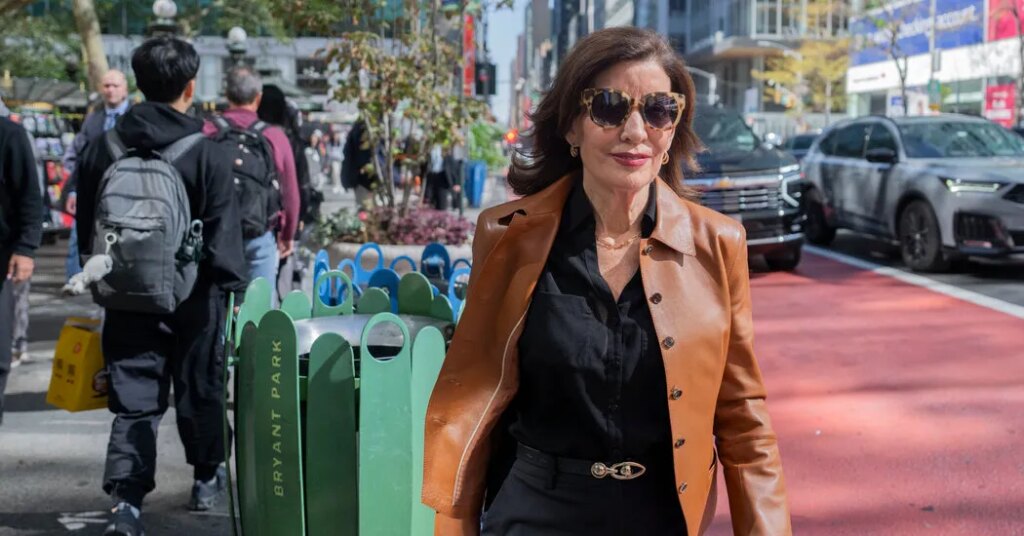
Despite her prominence, Ms. Hochul remains a diner-counter populist, and she says her upbringing is at the root of it all.
The Courtneys of Hamburg, N.Y.
Jack Courtney met his future wife, Patricia, in church when they were in the eighth grade. They married when she was 19 and he was 20, working in the furnaces of Bethlehem Steel while attending Canisius College in Buffalo.
They made their home in the trailer park, briefly raising the first of six children, Dennis, there. Their daughter Kathleen followed in 1958, her imminent arrival prompting the family to move to an apartment in nearby Woodlawn.
After about a decade at Bethlehem Steel, Mr. Courtney left what appeared to be a secure job in 1968 to join Computer Task Group, which had just been founded by several former IBM employees. By 1973, the firm named him marketing chief.
Mr. Courtney was known for tracking new technological trends that could be taught to the firm’s employees, positioning the company to win lucrative contracts to help others build systems that incorporated these innovations.
By 1980, the company employed roughly 600 people and made $20 million in revenue, and Mr. Courtney shared in that success. In 1979, The Buffalo News reported that he was the 20th highest-paid executive in western New York, earning roughly $127,000 at the time, the equivalent of $626,000 after adjusting for inflation.
David Campbell, a former colleague who ran the company when Mr. Courtney was its president, characterized Mr. Courtney’s ascent as “an amazing American success story.”
“Having the boldness to leave Bethlehem and take a chance on a new company that ended up being a tremendous success,” he added. “Obviously, his daughter saw that whole path.”
As Computer Task Group prospered, western New York declined.
Facing increased foreign competition, Bethlehem Steel, then the nation’s second largest steel producer, lost close to $500 million in the third quarter of 1977. At the time, it was the largest quarterly loss for any American company ever.
That same year, one of the worst blizzards in western New York’s history killed 23 people. The following year, the local N.B.A. team, the Buffalo Braves, relocated to California.
“To understand Hochul, you need to understand Buffalo of the 1970s and 1980s,” said Sean Ryan, the mayor of Buffalo who has known Ms. Hochul for decades. “The deindustrialization of Buffalo and western New York stuck in everyone’s head.”
In public appearances across New York, Ms. Hochul frequently describes how the economic downturn of this period morphed into a psychological malaise as well.
“When those big employers left, it meant you had no value in people’s minds,” she said in an interview.
“That was hurtful, and it gives us a chip on our shoulder — one that I still have today,” she added. “People look down on us. You’re the Rust Belt. Your team loses four Super Bowls. You have the Blizzard of ‘77, which was on Johnny Carson late-night jokes. People mocked us all the time. So that’s been our psyche. And I just thought, ‘But we’re not losers.’”
As her father climbed the corporate ladder, Ms. Hochul also observed the social activism of her parents, who were the children of Irish immigrants and were Democrats.
In 1971, Ms. Hochul, her brother and her parents participated in a daylong fast protesting the Vietnam War. The event was a “gesture of personal penance for supporting it through your taxes,” according to a local newspaper ad.
In Hamburg, the family delivered turkeys to needy Puerto Rican families on Thanksgiving and took leadership positions at their church. News accounts from that time also show that the Courtneys sought to integrate the town, which had no Black residents in 1965. To accomplish this, Mr. Courtney coordinated a survey gauging local sentiment on “racial attitudes.”
Ms. Hochul said in an interview that her parents were “social justice Catholics.”
“You were taught that you were put on this earth to make profound change in the lives of others,” Ms. Hochul said. “They found different vehicles to do that. I follow that same philosophy today.”
Syracuse to the statehouse
She began working in local politics in high school and, at Syracuse University, immersed herself in student government and activism. Syracuse was not her clear-cut first choice. A small women’s college was also in the running, and Ms. Hochul sought her father’s opinion.
He told her that one of those schools was where a congressman’s wife goes, she recalled. The other — Syracuse — was where a congressman enrolls.
After interning for a state legislator and working on local campaigns in New York, Ms. Hochul found her way to Washington, D.C., to attend American University Law School, moving there with her future husband, William Hochul, another Erie County native. She landed jobs with John J. LaFalce, a former 14-term congressman from western New York, then with Senator Daniel P. Moynihan.
She married Mr. Hochul, a lawyer, in 1984, and the couple returned to Hamburg in 1991 to raise their two children. She joined the Hamburg Town Board where she served 13 years before becoming deputy clerk and then clerk of Erie County. After winning and then losing a seat in Congress, she was elected lieutenant governor in 2014, when Mr. Cuomo won his second term.
In her many references to her father, who died in 2023, she rarely details the extent of his financial success story, but it played a concrete role in her electoral rise. He contributed hundreds of thousands of dollars to causes benefiting her political career. The donations included a $110,000 loan to her campaign for county clerk, which he later forgave, and a $250,000 contribution to the House Majority PAC, which spent around $660,000 supporting her failed congressional re-election run in 2012.
Her early focus as an elected official trended toward the quotidian: efforts to rejuvenate Hamburg’s downtown business district; fights over the locations of cellular towers; and a yearslong battle to remove tolls from the State Thruway.
Ms. Hochul once appeared at a forum lugging a bag with $200 of coins to showcase “the average amount western New York residents pay every year in New York State Thruway tolls,” according to local news reports.
She also started a downtown neighborhood improvement association with her mother, who had opened a flower shop in Hamburg. And she led campaigns against big-box stores like Walmart coming to town and usurping customers from local businesses. (When Walmart did eventually arrive, Ms. Hochul proudly trumpeted the concessions she wrangled regarding aesthetics.)
“They knew that it would be sucked dry if Wal-Mart came in,” said Sheila Courtney, Ms. Hochul’s only sister. “They were worried about all the villages, all the little towns closing out, particularly Hamburg.”
Friends and former colleagues of Ms. Hochul say that as much as she is shaped by her upbringing, her agenda also reflects her political environment.
When a resolution in support of same-sex marriage came up for a vote before the State Democratic Committee in 2003, she declined to take a position. In 2007, as the Erie County clerk, she promised to report undocumented immigrants who applied for driver’s licenses to federal immigration agents.
“Please understand the world I’m in,” she said in a recent interview at a Greek diner in Lackawanna, noting that Hamburg had been solidly Republican for more than a century. “I was trying to find a way to be a progressive Democrat in a town that is pretty hostile to them.”
Earlier in her term, Ms. Hochul delivered on a local crowd-pleaser: She secured a new stadium for her beloved Buffalo Bills, pushing through $600 million in state funds to build a facility that opened last month with heated seating decks and the largest snow-melting system in the world.
The fanfare greeting the Bills’ home opener did not dampen questions about spending tax dollars on such a project, but Ms. Hochul was undaunted.
“I think there were some other cities that were pursuing the Bills and promising stadiums,” she said in September, just before the Bills played their home opener in the new stadium. “I was a brand-new governor five years ago this month, and I said, ‘No, that’s not happening on my watch.’”
Ms. Hochul is also keen to take credit for Micron’s investment of $100 billion over the next 20 years in the Syracuse region, where it plans to build a huge computer chip factory. The company’s decision was personal for the governor, who expended great energy wooing its leaders with $5.5 billion in state incentives — the largest such package in state history.
The company and the state have committed a combined $500 million for work force training in the region as well.
Over the years, some of the state’s subsidized development projects — like Global Foundries in Malta, just south of Saratoga Springs — have proved successful. At others, like Solar City in Buffalo, Mr. Cuomo’s heady estimates of job growth and economic activity have failed to materialize.
Since the Micron deal was first announced in 2022, the plant’s construction has been delayed, and now it will not open until 2030.
“It’s notable that four years later, we are still several years away from the site producing anything,” said Ken Girardin, a fellow at the Manhattan Institute, who added that cumbersome environmental review processes were part of a reason the project has been delayed.
Ms. Hochul’s enthusiasm has not been dampened. The Micron deal, she says, helps fulfill her goal to create jobs and the kind of hope that seemed to dissipate from upstate communities as the economy sank decades ago.
As a Hamburg Town Board member, Ms. Hochul was asked in 2001 about the local economic mood. She noted that her children — then 11 and 13 — had “already announced they are not staying since western New York has no future and no good jobs.”
Neither of Ms. Hochul’s children — who now have children of their own — live in upstate or western New York, and all five of the governor’s siblings left as well.
She jokes that she is the “only one out of a big Irish Catholic family still left in this area,” directly blaming government for being unprepared for the steep job losses.
“It was painful,” she said in August. “Those scars are still with me today.”
Jeff Ernst and Mark Sommer contributed reporting.
The post The Education of Kathy Hochul: A Family’s Rise, a Hometown’s Fall appeared first on New York Times.