Midterm candidates, both parties and their allied super PACs are spending enormous amounts of money in the final two weeks to try to win whatever votes are left for the taking before Election Day.
New financial reports released on Thursday from every federal political committee reveal a deluge of spending over the first 14 days of October. Over $1 billion was poured into television and digital ads, paid field canvassers and expensive events, all motivated by a belief that on Nov. 3, the future of the Trump administration will be determined.
Democrats are racing to take advantage of a favorable political environment, Republicans are straining to defend full control of Congress, and voting has already started in many states — shrinking the pool of Americans left to reach.
Over the final two weeks alone, $1.4 billion worth of political advertisements are scheduled to air, according to the media tracking firm AdImpact, part of an estimated $11.6 billion expected to be spent on ads throughout the 2026 campaign. Just on Wednesday, $147 million worth of ads aired on all media platforms, according to AdImpact, the most of any single day in the campaign.
The largest spender in the first 14 days of October was the main super PAC for Senate Democrats, which doled out nearly $109 million, according to the new Federal Election Commission filings. President Trump’s three main super PACs combined to spend about $103 million over those two weeks. They were followed by the main super PAC for Republican Senate candidates, which spent about $86 million.
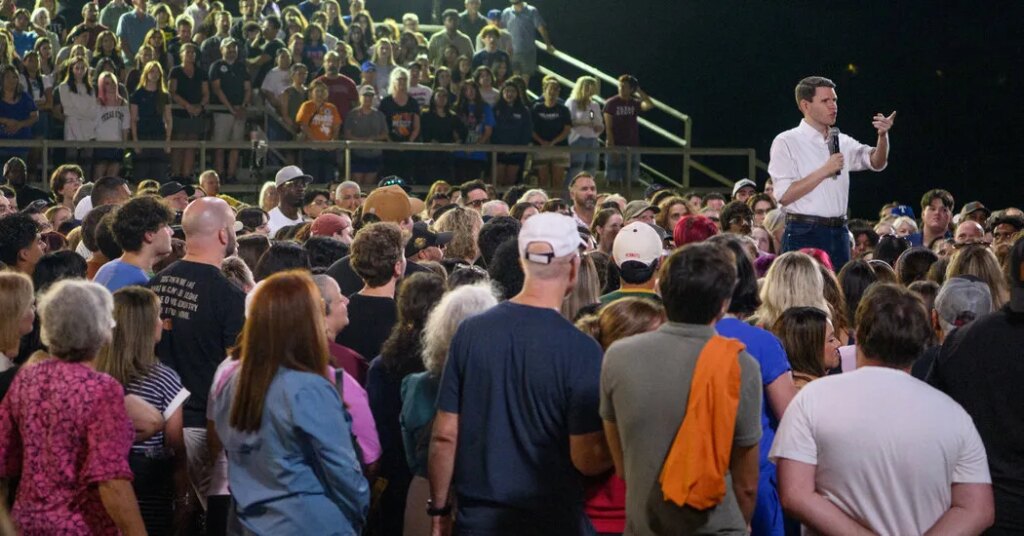
Over those two weeks, James Talarico, the Democrat running for Senate in Texas against Ken Paxton, a Republican, spent more than $22 million from his campaign account, the most of any candidate in a competitive race.
Here’s where the parties stand financially in the homestretch of the midterms:
Republicans hope their big-money edge pays off.
The reports laid bare the phenomenon that has defined the midterm money competition: Democratic candidates are dominating in fund-raising. But when you include super PACs and other outside groups, Republicans have a huge financial advantage, particularly in the battle for the Senate.
The Times assessed the five Republican and five Democratic super PACs that have raised the most money this cycle and found that the G.O.P. groups raised roughly $732 million more than their Democratic counterparts between January 2025 and mid-October of this year.
The five right-leaning groups have collected $1.6 billion. They were led by the main Senate Republican super PAC, the Senate Leadership Fund, which raised roughly a third of that. By comparison, the five left-leaning ones raised $877 million, led by S.L.F.’s Democratic rival, Senate Majority PAC.
Republicans also held an edge among official party committees, in large part because the Republican National Committee drastically out-raised the Democratic National Committee and has transferred about $44 million to party committees.
The good news for Democrats — besides many of the other political factors working in their favor — is that their nominees have raised far more than their Republican rivals this cycle in almost every competitive Senate and House race. Democratic candidates have been able to use this money to buy ads at cheaper rates than Republican super PACs.
In some contests, the gap was strikingly large: In Texas, Mr. Talarico raised roughly $123 million more than Mr. Paxton did.
In Wisconsin, Rebecca Cooke, a Democrat running in a battleground House race, hauled in about $12.5 million this cycle — more than any other candidate in competitive House contests and more than double what some Republican contenders for Senate brought in.
Elon Musk and other megadonors are powering the G.O.P.
Elon Musk crossed a new threshold of political influence on Thursday: He became the first donor to disclose more than $400 million of midterm giving.
Mr. Musk, the world’s richest person, donated another $77 million or so to his super PAC, America PAC, in the first two weeks of October. That puts his total disclosed midterm giving to federal committees at nearly $420 million, according to a review of records filed with the F.E.C. and the Internal Revenue Service. About $178 million of that went to America PAC, which is running a sprawling field campaign across the country.
Mr. Musk’s financial footprint is significantly greater than the $290 million or so he spent on the 2024 presidential cycle.
Other conservative megadonors are spending big, too. This month, Dick Uihlein, a Midwest-based billionaire industrialist, put $12.3 million more into his super PAC, which sends its money to a wide range of Republican groups and runs ads for the party’s candidates. Mr. Uihlein has now given nearly $143 million in federal donations, according to F.E.C. and I.R.S. records, placing him among the biggest donors in the country.
On the Democratic side, Michael R. Bloomberg, the billionaire former mayor of New York City, donated about $66 million to federal committees between Sept. 1 and Oct. 14, according to F.E.C. and I.R.S. records. The New York Times reported that Mr. Bloomberg was in the process of parting with about $80 million over the final two months, aiming to help Democrats in House races in particular.
The final weeks are full of subterfuge.
This is the high season for campaign-finance shenanigans.
As an election draws closer, outside groups and candidates sometimes make sneaky moves that are hard to catch on filings before voting is over. Such maneuvers are legal, but they leave voters in the dark about the true sources of money behind candidates.
And much of the money flowing to super PACs at the end of the midterms is from shadowy nonprofit groups that do not disclose their donors.
A new super PAC called Government That Works PAC is a prime example of Democrats’ rising use of dark money. The group raised about $28 million in the first 14 days of October, mostly from a coterie of Democratic nonprofit groups and partly from the liberal billionaire Reid Hoffman. During the same period, the super PAC then flipped close to that amount to other liberal super PACs, including about $4 million to VoteVets, a left-leaning veterans group that is spending big for Josh Turek, the Democratic nominee for Senate in Iowa.
Republicans also rely on murky funding sources. Substantial dark money flowed into the super PAC supporting Mr. Turek’s opponent, Representative Ashley Hinson, as well as the main ones backing Senator Susan Collins of Maine and former Representative Mike Rogers, the Republican nominee for Senate in Michigan.
In Ohio, a new super PAC that is promoting a third-party socialist candidate for Senate was revealed on Thursday to be entirely funded by a Republican-linked outfit. The group, called Enough Promises Ohio, received $2.5 million this month from Conservative Americans PAC, a Republican group that has been meddling in races to try to hamper Democrats and that gave $13 million to super PACs this month. The socialist candidate could pull left-wing votes away from the Democratic nominee, former Senator Sherrod Brown, in a tight race.
Beware: Any activity on or after Oct. 15 will not be public until after Election Day, meaning that it will be easier than ever to pull off surreptitious tricks.
About the data
For the fund-raising graphic, The Times included candidates in House and Senate races that the Cook Political Report rates as tossups, leaning toward Democrats or leaning toward Republicans. Those figures calculate total contributions to each candidate’s main campaign committee (including transfers from other committees) minus refunded contributions and contributions that candidates made to themselves.
The “major party committee” fund-raising figures include each party’s main committee, their Senate committee and their House committee. The “top super PACs” are the five for each party that have raised the most money this election cycle.
Super PAC and party fund-raising figures in the graphic include total contributions to the committees, minus refunded contributions, as well as transfers from other committees and receipts reported on line 17 of federal filings: “other federal receipts.” To avoid double counting, The Times subtracted transfers within the network (for example, transfers from the Democratic Senatorial Campaign Committee to the Democratic National Committee or internal transfers among a committee’s various accounts).
The post In Final Surge of Vast Midterm Spending, Parties Make Last-Ditch Appeals appeared first on New York Times.