I always get the same question when I return from reporting in Russia: When will Russians finally be fed up with the war?
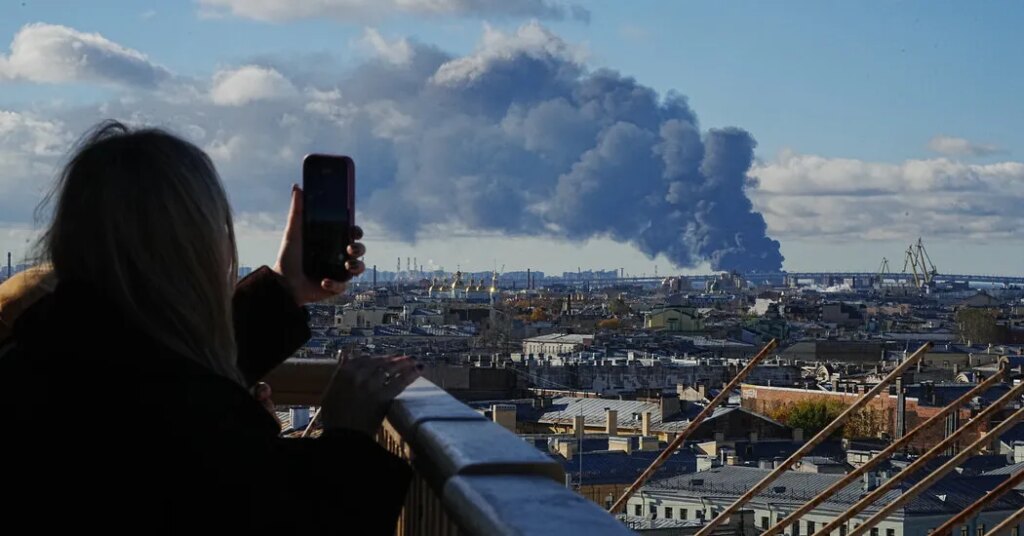
They might seem to have good reason now. The war, for years mostly background noise among many Russians, feels more present. The economy is limping. Drivers have to wait in line for gas. Warehouses and data centers are going up in flames. Even Moscow at times comes under heavy attack, as it did on Thursday, when Ukraine launched 630 drones into the region.
One recent morning, I set out to ask Russians what they thought about all this. I went to Sofino, a town about an hour from Moscow, where Ukrainian drones a few days before had struck an industrial area, igniting a fire, and a residential complex, killing two people.
On the way, I pulled over at a Rosneft gas station where waiting cars snaked well past the exit lane. It had no diesel, but gasoline was available for about $3.25 a gallon — a steep price in Russia. A young man named Danya told me he had waited 30 minutes for gas.
He shrugged it off, repeating a refrain I hear all the time from Russians. “Everything is fine,” said Danya, who, like others I spoke with, asked that his last name not be used to avoid trouble with the authorities. He added that fuel shortages were overblown.
The war, he insisted, “doesn’t affect my life at all.”
“Everything is fine,” he said again.
Russians shrug for several reasons. They are silenced by the fear and conformity bred by a repressive government. They feel they have as much influence over their country’s politics as they do the weather. They are used to deprivation from centuries of political and economic crises. They keep their focus, as a coping mechanism, on what hasn’t changed. And they are flooded with anti-Ukraine propaganda from the state.
There is also a more fundamental explanation. Ukraine’s strategy, as it holds Russia to a near deadlock on the front lines, is to make Russians feel the war and demand an end. That includes the strikes on oil refineries that President Trump has pressured Ukraine to stop in recent days as he has openly favored President Vladimir V. Putin of Russia.
Although the Ukrainian campaign has significantly cut Russian oil production, causing clear economic damage, it has not been enough yet to drastically change life in Russia. Kyiv lacks the ballistic missiles and jet-powered drones that Russia fires at Ukrainian cities every day. And Ukraine’s strikes, focused mostly on economic and military targets, do not instill the same fear as Russia’s systematic assaults on Ukrainian civilian targets.
Ukraine’s attacks have politicized some Russians who before now had tried to ignore the war. People have rallied around the flag. In Sofino, outside an apartment building with a gaping hole in the third and fourth floors after the Ukrainian strike, I asked three warehouse workers if they felt angry at the Russian state for starting the war and letting it drag on for nearly five years.
“Quite the opposite, the attacks make people hate them even more, because their homes have been damaged,” one young man said, referring to Ukrainians and their Western backers. He asked that his name be withheld.
Inside the building, a woman named Lusya was dragging a trash bag down the rubble-strewn stairs. She said it was surreal watching television that evening because there was no mention of the attack that had suddenly rendered her homeless. Still, she said she trusted Russia’s leaders.
“I support my president, even more so after all this, because you realize you just have to support the man and consolidate around him,” she said.
“I believe we are very lucky to have Putin,” she added.
Enduring adversity is a source of national pride for Russians. Successive generations have heard tales of the sacrifices of World War II. Waiting in line for basic goods was common during the Soviet era. The war in Ukraine, for many, is just another hardship to bear.
“People get used to a ‘new normal’ again and again,” said Elena Stein of the Berlin-based Center for Independent Social Research, which supports research inside Russia.
Many Russians are just tuning out the war. In a poll last month by the independent Levada Center, nearly 60 percent of respondents said they paid little or no attention to the fighting, the highest level ever recorded. Six in 10 said the country was on the right track, up 10 percentage points from the level in June, just after an earlier drone attack on Moscow.
The reliability of polling data is limited in autocratic Russia. But such numbers indicate that Mr. Putin’s yearslong effort to insulate Russians enough from the war that he can conduct it unimpeded is still largely working, despite mounting challenges.
“The pressure and the problems that are there are, in my view, not intense enough for him to reconsider at this point,” said Janis Kluge, a Russia analyst at the German Institute for International and Security Affairs.
Other analysts have said that the Trump administration’s recent decisions to engage in business deals with the Kremlin while demanding no concessions will only harden Mr. Putin’s resolve to continue fighting until he achieves his objectives in Ukraine.
While polls show that growing numbers of Russians want the war to be over, the vast majority say it should end only on Russia’s terms. Many appear ready to continue deferring to Mr. Putin.
Kirill, 36, a choreographer with a small hoop earring, said that aside from the price of gas, “I don’t feel it at all.”
“I’m not going to complain, because I know that this is my country, I’m going to support it no matter what,” he said. “I know that the people at the top can clearly see the bigger picture.”
As I spoke with Kirill and others at the Rosneft station, the store’s manager, Irina, came to admonish me for interviewing her customers. But soon she was sharing her own story.
Unlike the people in line, Irina did not deny the war’s role in her life.
She said she had told her 11-year-old daughter that if a drone or missile struck the gas station, she risked dying on the spot. Her mother-in-law works as a security guard at a warehouse complex that has been struck. And her brother has been fighting on the front since 2022. She said it was a miracle that he remained alive, adding that he had survived nights when up to 40 people were killed. He told her that he expected the war to continue until 2030.
She voiced the trademark sense of fatalism in Russia. “We’ll just have to endure it,” she said. “If we die, we die. I’ve already made peace with it.”
Irina was not as inclined as others to defer to the government’s approach on the war. She said she felt that officials were not telling the truth about casualties on the battlefield and in long-range strikes on Russian cities.
Eventually, this sort of mistrust, coupled with a worsening economic outlook, could set off more expressions of dissatisfaction, said Jeremy Morris, a sociologist at the University of Aarhus in Denmark who conducts fieldwork in Russia.
While it might not happen soon, he said, most Russians are not apathetic and apolitical, as they are sometimes portrayed. They just lack outlets for action as the government has grown more repressive.
During parliamentary elections last month, I visited the headquarters of Yabloko, Russia’s main antiwar party. I spoke with Maria, 24, one of the approximately 20 percent of Russians who tell pollsters they oppose the war.
She expressed indignation as she described reading English-language posts on social media describing Russians as a “slave nation.” She pointed to comments like one recently by a European Union spokeswoman, who said that “if Russian citizens face the consequences of this war, they have a chance domestically to take action against it.”
Maria described the costs of speaking up in Russia, where 1,856 people are currently incarcerated as political prisoners, according to the banned human rights group Memorial.
“None of you have gone through the experience of the average person living under totalitarianism, repression, total fear and the absence of free speech,” she said. “You can’t demand that we go on strike or turn out for protests, because all we’ll achieve is ending up in prison — or getting killed.”
The post How Long Will Russians Put Up With War? Here’s What They Told Us. appeared first on New York Times.