The title of Pawel Pawlikowski’s extraordinary, compact drama Fatherland has a double meaning. In this somewhat fictionalized story of Thomas Mann’s brief 1949 visit to Germany, the Nobel Prize-winning author, after having lived in exile in California for 16 years, is challenged with finding his mooring in a country he can no longer call home; if it’s his fatherland, it long ago turned its back on him and his ideals. But fatherland can also be a state of mind where fathers live, a state both more specific and more elusive than fatherhood. In Pawlikowski’s telling of this portion of Mann’s story, it’s during this trip that Mann learns of the death of his son, Klaus—also a writer, though not as successful as his father—by suicide. If the elder Mann feels any emotion when he hears this news, it’s frozen inside him, a bubble of feeling isolated on its own ice floe. Fatherland, so secure in its rigid borders, is a cold, cold place.
Mann’s freedom from this interior island prison happens in the film’s last five minutes, a wordless reckoning that’s as quietly moving as anything you’ll see at the movies this year. But that moment wouldn’t hold so much power if Pawlikowski—with the help of his cowriter, Hendrik Handloegten—weren’t so skilled at sketching in the feathery details leading up to it. Pawlikowski is also the director of the 2013 Ida, as well 2018’s Cold War, pictures that, like this one, deftly balance postwar Eastern Bloc realities with the truth that all humans strive for connection and belonging. These aren’t dour movies, but serious, lustrous ones, less “political” pictures than movies about people trying to sort out what living really means.
At the beginning of Fatherland, no one—not even the aged Mann, played here in a quietly extraordinary performance by Hanns Zischler—has figured that out. The movie opens with a long-distance phone call: Mann’s semi-estranged son Klaus (August Diehl), living in Cannes and clearly in emotional distress, has reached out to his sister Erika—we’ll later realize it’s Sandra Hüller’s voice we hear on the other end of the line. Erika, an actress, writer, and onetime race-car driver, has become her father’s assistant, and she now urges Klaus to join her and their father on the trip they’re about to undertake, from California to the “new” barely postwar Germany. In the year of Goethe’s 200th birthday, Mann will be accepting two awards, one in Frankfurt, in the West, the other in the East, in Weimar: his justification is that his literary idol was born in one city and died in the other, though it’s obvious that Goethe couldn’t have imagined that chasm that would open between the two within 200 years’ time.
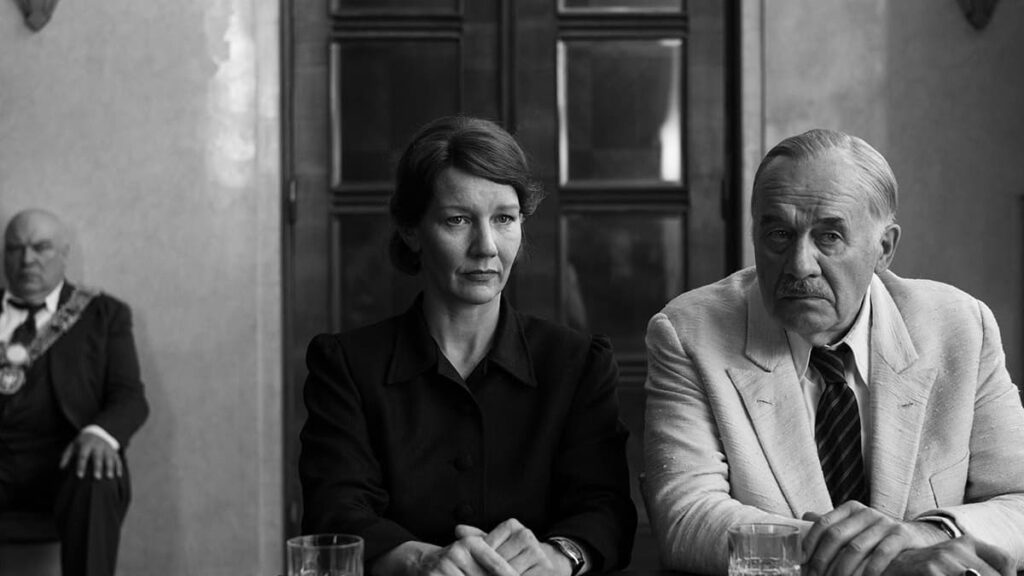
Both cities are in transition, and in crisis, though neither wants to admit as much. In Frankfurt, a gray city crumbling at the corners and still finding its footing after the war, though somehow doing its best to pretend all is well, Mann and Erika are greeted by the mayor and hustled off to a press conference. There, the esteemed man himself answers the respectful but probing questions of journalists. Once they learn that he’ll also be traveling to the East, it’s not lost on them that doing so could make him a target at home in the States, where anti-Communist storm clouds have long been gathering. And there are other, more spiritual questions for him to consider. An American journalist, a woman who, it turns out, is an old friend of Erika’s and possibly a former lover (she’s played by Anna Madeley), asks him where he feels his true home is, now that he’s an American citizen. His answer is courtly but honest. He may live in the United States, he says, “but where my Heimat is, my home, is a much more difficult question.” He’s a man between states, both literally and figuratively.
In Weimar, the chief way to welcome a returning hero is apparently to greet him with a somber folk song sung by a choir dressed in dark clothing; at one point, he’s serenaded by a group of children singing the then-newly pened East German national anthem. Mann accepts it all gracefully, but there’s also something a bit quizzical and lost in his expression. He’s jarred by one alarming moment: a wild-eyed man appears at the hotel suite where he and Erika are staying, begging him to reveal in his speech that the nearby former concentration camp Buchenwald is now being used as a detention center for political prisoners. The man is whisked way by officials before he can finish his spiel, though it’s doubtful any of it has swayed Mann at all. In both the East and West, when it’s time to address the audiences who have eagerly gathered to hear his thoughts, he gives heartfelt speeches, anchored in the legacy of Goethe, about the power of art to transform and sustain not just individuals, but whole nations. He seems to truly believe, as he says at one point, that art doesn’t recognize borders—or at least, he truly wants to believe it.
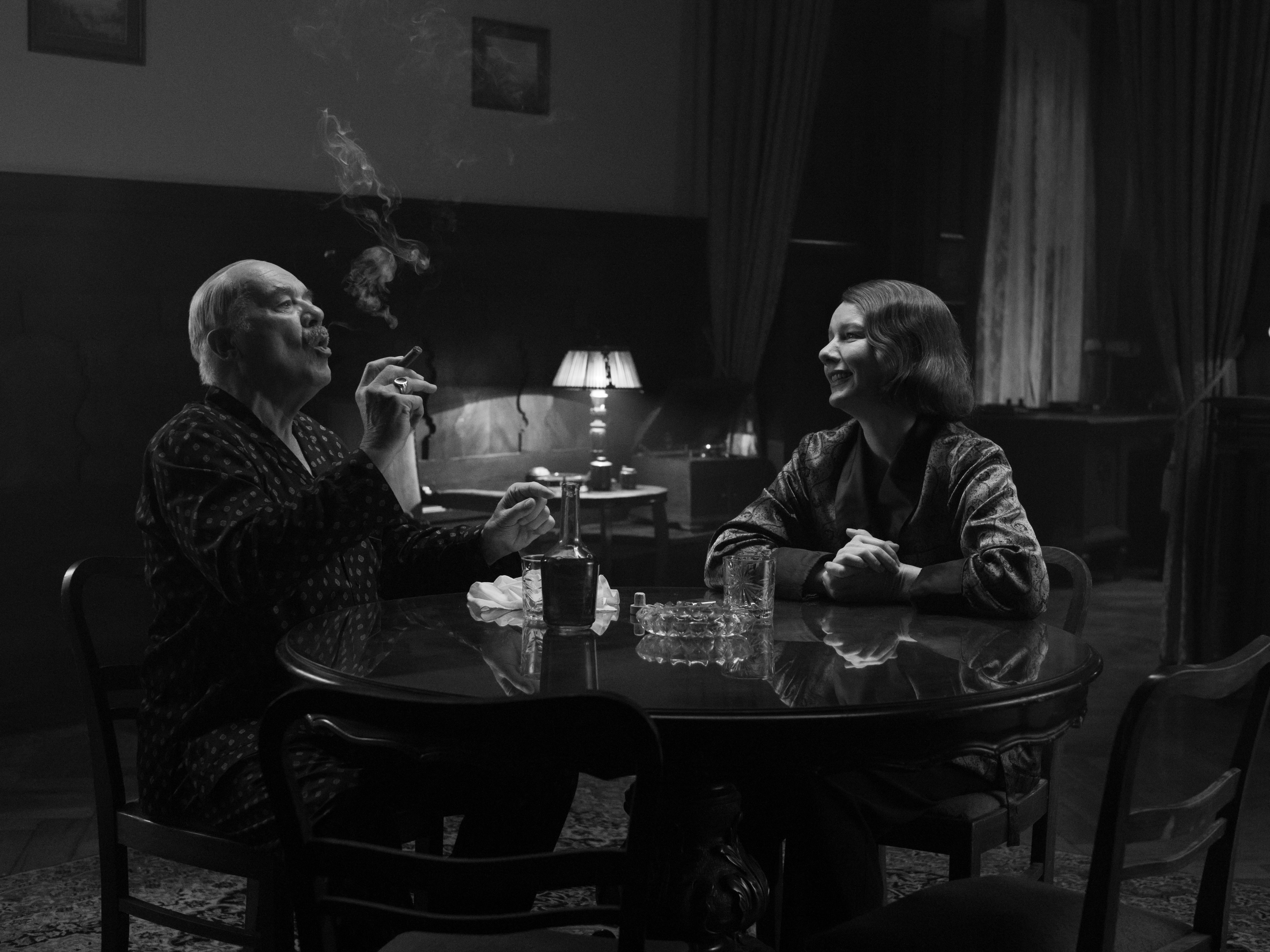
Through all of this, Hüller’s Erika serves her father dutifully. When necessary, she translates his responses to journalists into fluid French; she attends cocktail parties in his honor, even when it means suffering the indignity of running into an oily, traitorous, Nazi-loving ex-husband she’d rather forget forever; she drives her father through the countryside, and though we can’t see her face as she does so, we wonder if this particular task gives her some joy, given her car-racing past. But through it all, because Hüller is such a subtly expressive actor, almost gossamer in the ways she shifts moods, we see the ways in which her resentments toward her father can’t help simmering to the surface. When she learns of her beloved brother’s death, her composure doesn’t crumple visibly—only somehow we know her emotional reserves are folding in and flattening like a house of cards. And when she sees how little this event seems to trouble her father, she can barely go through the motions of helping him on his mission, which, as he seems to envision it, is to save his homeland with his lofty views on art.
How these two find their way back to one another, and to a place of acknowledged and shared grief, is a kind of unspoken miracle that unfolds in last 15 minutes or so of this elegant, remarkably economical movie. Artistically and emotionally, Fatherland accomplishes more in its 82-minute runtime than any two-hour-plus movie released this year. Cinematographer Lukasz Zal, who also shot Ida and Cold War, renders Fatherland in the same satiny black and white, as well as the same serenely squarish, or Academy, aspect ratio. Every frame is spare, elegant, intimate, and the film moves along so gracefully that you’re barely prepared for how exhilarating, and how quietly devastating, its final moment is. At one point, Hüller’s Erika tells her father that Klaus had once said he felt Bach made him feel life was worth living. Her father shrugs that information off, but the final moments of Fatherland—incorporating a serendipitous conjuring, like a specter, of “Jesu, Joy of Man’s Desiring”—bring it back to him. Can a person have more than one Heimat? Or can that place of spiritual belonging shift over time? Perhaps Bach had the answer. Perhaps he put it in a piece of music, for us to find when we most need it, in a church or even in a movie.
The post Fatherland Is One of the Most Quietly Surprising Films of the Year appeared first on TIME.