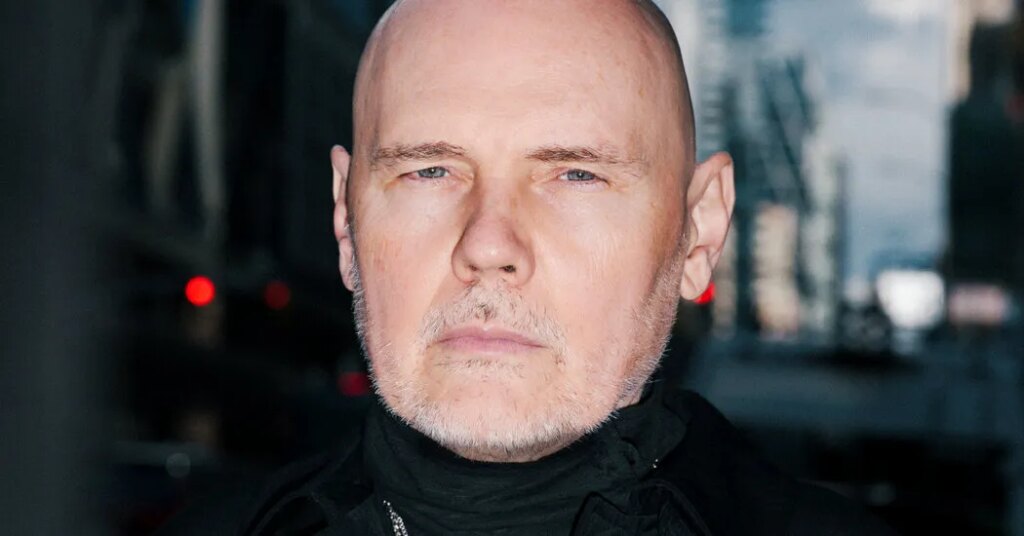
When Billy Corgan was on top of the world, as the frontman and creative engine of the 1990s alt-rockers the Smashing Pumpkins, some of the voices he heard the loudest were those calling him uncool. Years later, when Corgan was far from those heights, he saw a generation of younger critics and consumers write off his era’s core sensibilities as relics to be buried.
Whether these were wholly accurate assessments or the obsessions of a combative, platinum-selling musician convinced of his own greatness, the perceived disrespect took a toll on Corgan, who has long had a prickly relationship with his peers, the music press, Pumpkins detractors and even the band’s biggest fans.
“There was a moment in my life where I was being rewarded for being completely anarchic as an artist, not as an MTV guy, OK? And at some point that all goes away. And then you’ve got people younger than you holding you up as a vision of mockery: here’s what not to do. Mocking, bullying, laughing,” Corgan, 59, said recently on Popcast, The New York Times pop culture chat show. “And you’re supposed to go along with this world while they’re holding up pop people as if they’re Jesus walking on water.”
“I’m a guy with crooked teeth,” Corgan added. “What the [expletive] do you want me to do? By the way, I’m still one of the best songwriters in the world.”
In years both lean and lush, Corgan still managed to forge a path forward.
In addition to his extracurriculars — including as a wrestling impresario, teahouse owner and now a disarmingly thoughtful podcast host — Corgan reunited most of the original Pumpkins in 2018, following a 2000 breakup. However stubbornly, he has continued to assume that the band’s legacy will catch up to his estimation of it if he holds firm.
There have been some concessions along the way. Corgan, now the father of young children, claims he’s retiring his legendary heel persona — “that guy’s dead” — and has embraced a new generation of artists, appearing in concert alongside alt-adjacent pop stars like Sombr and Olivia Rodrigo.
Young fans are discovering him, too. At a recent stop on the Smashing Pumpkins’ Rats in a Cage arena tour, celebrating 30 years of the band’s double album “Mellon Collie And The Infinite Sadness,” which released in 1995, the crowd was a mix of aging true believers and fresh-faced TikTok gaggles.
In a frisky conversation with the Popcast hosts Jon Caramanica and Joe Coscarelli, Corgan spoke about his personal and professional rebirth, including his passion for the emotional intensity of guitar rock; the passion with which his critics dismiss him; and his passion for rubbing his recent re-ascendance in their faces. “I’m going to shock you by not playing a contrarian today,” he said.
JOE COSCARELLI Before seeing you in concert last night, I’d heard tell of the Gen-Z fans of the Smashing Pumpkins and ’90s alt-rock in general. We’ve seen the shoegaze revival happen on TikTok, Spotify, Bandcamp and SoundCloud — this broad umbrella of rock sounds where now people think the Pumpkins and Beach House are from the same scene or something.
BILLY CORGAN Yeah, which is nice if you think about it.
COSCARELLI When did you notice that this was happening and how have you either embraced it or rejected it?
CORGAN I feel like 15 years ago, people kept telling me, ‘oh, guitar’s coming back.’ And then two years would go by and they’d be like, ‘guitar’s coming back.’ So after I heard it so many times, I just thought, OK, it’s never coming back — the pop hegemonic thing is never going to go away, Taylor [Swift] is going to rule over all of us until the end of time. And then about five years ago, suddenly it’s like it was about the guitar again.
JON CARAMANICA What were the triggering events?
CORGAN I would be in L.A. and listen to KROQ, which is the classic alt station. There were years I would listen to seven songs in a row and not hear a single guitar line. It was all synthy, and then all of a sudden it’s just like, here come the guitars. Or you’re watching an N.F.L. game and they’re playing our music, playing Nirvana. Suddenly it was just back in the air.
CARAMANICA Do you think, generationally, younger folks who were being offered less of that started seeking something out in opposition to what they were being offered?
CORGAN It got so inorganic for so long that you just need the sound of something that feels commensurate to the way you’re feeling as a kid. I’m 59 years old, so I can only imagine what it’s like for a teenager to feel the classic disassociative aspects of being a teenager, and then add to that social media and all that additional pressure. What in the cosmology of music represents that angst? And I think our generation, for whatever reason, is the closest thing that they can kind of dial in.
COSCARELLI But not everything gets rescued from the dustbins of history. Why the Pumpkins in particular?
CORGAN You want a politically correct answer?
COSCARELLI No, I want the real answer.
CORGAN Because we wrote great [expletive] songs, and we were told at some point in the early 2000s that those types of songs with those types of themes were no longer relevant, and off they went. That it was too complicated. The Cure had the same problem. I’ve been friends with Robert [Smith] for many years, and we would sit there somewhere in the early 2000s over a Chinese meal and lament, like, what the hell happened? This emotionally resonant music just seems like it’s been shoved aside by sociopathic influencers with kind of one-note music.
COSCARELLI You’re talking about pop at that time?
CORGAN All of it, because look, and I’ve been very critical of, let’s call it the Pitchfork generation. When they sold out alternative ethos for pop domination — in essence, celebrating Rihanna as an alternative star and wiping Siouxsie [Sioux] off the map — that to me was the great betrayal of the alternative ethos. So suddenly all the things that make alternative music so beautiful — the messiness, the dissonance, the out-of-tune guitars — it was like, nah, that’s just too messy. We don’t have time for that anymore. I started literally comparing the guitar in interviews to the saxophone.
CARAMANICA As you go from the ’90s and the 2000s, and the cultural primacy of hip-hop and “TRL” pop supplant the centrality of rock, were you on high skepticism? Were you like, this is not simply a rejection of rock, but it’s a rejection of some value system?
CORGAN My first rationalization was, OK, music is cyclical. When I talked to top executives in the labels, late ’90s, early 2000s, they were literally like, rock bands are too expensive to record, we’re making so much money on hip-hop — it’s cheaper, we know they’re not going to last in the business, we’re literally exploiting them. I mean, they would just tell me this outright.
COSCARELLI And they still are.
CORGAN Sure, not my fight to fight. So it was kind of being sold to me as, look, the business is on a downturn, we’re making more money on these people, you guys are too complicated. But then when this pop dominance thing came over, my opinion is it totally dovetailed with social media. A pop star is genetically made to take advantage of every fashion, perfume endorsement. They’re a vehicle for many things. Your general kid who comes out of a basement, like Kurt Cobain, is not socially engineered to be thinking about the perfume cross-endorsement.
You would have been hung up on a cross as a sellout. The number one word of the ’90s was authenticity. My favorite word, because who was defining it? Usually upper-middle-class white people from the East Coast, telling me, who grew up in a [expletive] basement, what authenticity was.
COSCARELLI So you broke up in the year 2000, and a lot of people, when writing the obituary of the band, said, they’re giving up trying to fight with “TRL,” essentially, the teeny-bopper pop of the time.
CORGAN By the way, that was a joke. I went on KROQ on May 23, 2000 and I said the band’s going to break up at the end of the year, and I jokingly said, ’cause I’m tired of fighting Britney Spears. The meta-joke I was making was, I see where this is going, and you all are idiots. If you’re going to throw your lot in with the pop people, you’re going to learn.
COSCARELLI This brings me to my question, which is that here you are onstage with Olivia Rodrigo, onstage with Yungblud, someone doing cosplay of your youth. I’ve got to say, that’s the one to me where I’m like, Billy Corgan’s not supposed to like Yungblud. I wonder if you can talk not only about how you’ve come to ally with those artists, but also just your general softening, if you want to call it that.
CORGAN I don’t see it as a softening.
COSCARELLI So tell me how you see it.
CORGAN Surprisingly, there’s something happening in pop now that I couldn’t have anticipated, which is that as they’re reaching around the ether to try to evolve pop for their time — which they should — they reach for us. And I’m talking about the collective alt voice. There’s something about what we have that they go, ‘you know what, there is something fresh here.’
I used to joke, you know, it was me versus Janet Jackson. Until I met Janet Jackson — the loveliest, most beautiful woman, right? So I couldn’t personalize it anymore. And I just interviewed Jimmy Jam the other day. It was amazing.
COSCARELLI I mean, those are geniuses.
CORGAN Now I get it. But at the time, in ’88, I’m watching MTV, I’m like, I want to shove all you people out of the way. And we did it, you know what I mean? But pop music, historically, it was always a celebration of an amalgam. And suddenly pop music became this kind of royal class, and they were being held up by the Pitchforks of the world.
COSCARELLI So this brings us back to Olivia Rodrigo.
CORGAN She’s so smart. She’s super savvy. I don’t know her much, but she’s figured out that the way to break free is to be free. She’s like, bring me all these influences. She’s not afraid to make an imperfect song. She’s not afraid to have one vocal slightly out of tune. She’s broken free, and she’s being rewarded, because pop stars should be as authentic in their game as rock stars are authentic in their game.
COSCARELLI Is there something about the new class of young people getting into the band who are coming at it without the historical baggage of knowing, ‘oh, I’m supposed to like Nirvana and Sonic Youth more than the Pumpkins because Billy was too pop and cared too much and wore funny outfits?’
CORGAN Now you’re vibing on what I’m saying. It’s the decline of the gatekeeper class. And I’m laughing over their bodies as they float by in the river, because they did it to themselves.
CARAMANICA Did any of the critiques affect what you believed about yourself artistically?
CORGAN No.
CARAMANICA You never felt of lesser value?
CORGAN No. No. Let me say something, which will sound a bit touchy-feely, but I mean it for the sake of the conversation: Do you feel my work in the aggregate has ever been properly understood?
CARAMANICA By who? The media?
COSCARELLI Do you mean by fans? I think by fans, certainly. I think the media and critics, the top layer of your work. Do you have a lot of music that no one, day-to-day, gives a [expletive] about except your superfans? A thousand percent. Do you think that music is as good as the music that is recognized?
CORGAN I think in time it will be viewed not with the same commercial value, but in the same artistic value.
CARAMANICA I hear a lot of Kanye in you.
CORGAN Isn’t it the other way around?
CARAMANICA Well, sure.
CORGAN When we were making “Mellon Collie,” Kanye was literally working one block down the street at the Gap.
CARAMANICA When you saw him moving through the world in the mid- to late 2000s into the 2010s, did you look at him and say, ‘that’s an artist navigating his fame and his creativity similar to how I do’?
CORGAN I’ll personalize it even more. I’ve only ever had one conversation with Kanye. He called me on the phone once, and we had a nice 15-minute chat. Didn’t know him back then. I heard him blowing up in Chicago first. When I first saw his game, I thought, was he influenced by the way I did this [expletive]? Because it was the same game. Pick fights, do crazy [expletive]. I call it the cognitive dissonance game.
But by creating the cognitive dissonance conversation, you have to choose. So when I ask you a question like, ‘has my work been fairly assessed by your critical class?’, it forced you to make a decision of my value. As an artist, that’s what I saw Kanye doing. It was like, I’m going to pick the fight and make you decide whether or not I’m a genius or not, whether I’m an idiot or not. And I wonder if he got that game from me, but maybe it was just in the water.
COSCARELLI You told me that you’re the second greatest heel in rock ’n’ roll history after Lou Reed.
CORGAN I was — past tense.
COSCARELLI What happened to that version of you?
CORGAN It got boring.
COSCARELLI And what about personally? You’re the father of young children, you have a family now. Was there anything that was happening outside of the Smashing Pumpkins universe that allowed you to say, ‘I don’t want to play the heel anymore’?
CORGAN I’m glad you brought that up, because I had a unique thing happen when my son was born. I remember looking at him and thinking, am I going to do the same thing to him that my father did to me and talk about what used to be and what happened and who I was, puff myself up, like, you know, Daddy used to be this guy? And I was like, I’ve got to reanimate myself so that when he looks, he sees me on the biggest stages of the world and he’s proud of me, not for who I was, but for who I am. So that clarified for me in a way that I did not anticipate.
CARAMANICA The feedback that you would get at home from your father and then the feedback you were getting in the world later on — did you see common themes between those two things?
CORGAN I’ll tell you a story. When I gave my father the “Gish” album, which was our first album, he said something really snide about it that really hurt me. So when we were finished making “Siamese Dream,” he called me at home and said, ‘can you send me the CD?’ And I was like, I just don’t want to deal with this. So I waited like three weeks or something. And he called again and said, ‘did you send it?’ And I thought, OK, I sent it to him. And about a week later, he called me, and it was one of those, like, oh God, here we go. Because I just knew I was going to get it. I was like, OK, so what did you think? There’s this really long pause, and he goes, ‘I don’t know the person who made this record.’ And I said, ‘Daddy, I’ve been here the whole time.’
I feel I’ve been here the whole time. I feel like truly I am a significant artist who’s contributed a lot. I’m all over the map. I know I’m unusual in that. I’m definitely an outlier. I maybe had one of the most unusual careers in the history of pop and rock, and I don’t think that’s an oversell. So it feels good to be back, it feels good to be rolling, but the journey has been very, very rough.
CARAMANICA Would the criticism not have hit as hard if you had received more embrace from your father about what you were doing musically?
CORGAN See, I think this is the key to why I’m having success now, because I think having a family finally gave me that sense that I could fail in public and I was going to be OK. If your whole life is predicated on winning or losing, and it’s all out there, well, what does that turn you into? It turns you into a weirdo.
Credits
Popcast is hosted by Jon Caramanica and Joe Coscarelli and produced by Sophie Erickson, Kate LoPresti and Felice Leon. This episode was filmed by Luke Piotrowski, Lauren Pruitt and Thomas Trudeau. It was edited by Mark Zemel, Eddie Costas and Pat Gunther with help from Rebecca Blandon. Our theme music is by Elisheba Ittoop. Nick Pitman is our audio engineer and Amanda Webster is our photo editor. Brooke Minters is our executive producer. Header video cinematography is by Avery Munson Clark.
Special thanks to Hannah Erickson, Sarah Bonn, Dahlia Haddad, Mike Cordero, Nicole Huber, Aaron Byrd, Carl Mazurek, Zach Caldwell, Maddy Masiello, Brad Kimbrough, Andrew Wilcox, David Malitz, Elena Bergeron, Sia Michel, Nina Lassam and Sam Dolnick.
The post Billy Corgan Unloads After a Lifetime of ‘Mocking, Bullying, Laughing’ appeared first on New York Times.