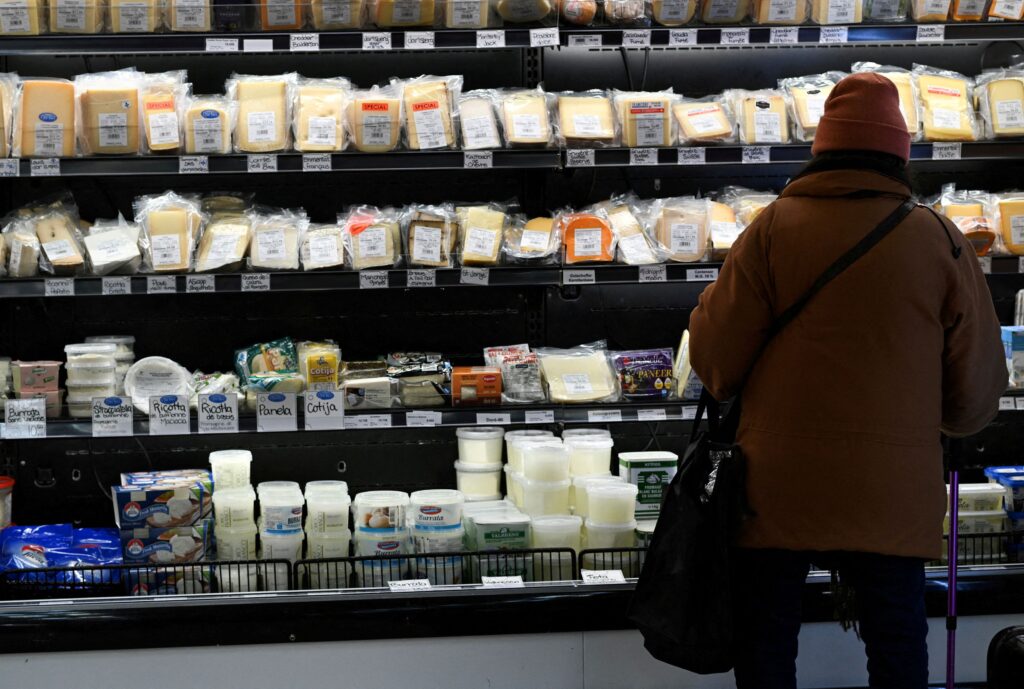
One of the latest victims of U.S. tariffs is a third-generation family business in New Jersey. The Gellert Global Group imports Canadian cheeses, and the food supplier says it’s facing $40 million in additional annual costs after President Donald Trump slapped a 50 percent import tax on dairy products this summer as part of his feud with Canadian Prime Minister Mark Carney.
The company’s lawsuit this week challenging the legal basis for the tariffs tees up another showdown over free trade. In February, the Supreme Court decided 6-3 that Trump lacked authority under a 1977 emergency powers law to impose his “Liberation Day” tariffs. Almost immediately, Trump imposed similar duties under Section 122 of the 1974 Trade Act. The U.S. Court of International Trade struck those down.
After that, administration officials apparently dug through dusty filing cabinets in search of new justifications. In July, Trump invoked a 96-year-old provision buried inside one of the more atrocious pieces of legislation in American history: the Smoot-Hawley Tariff Act. That 1930 law deepened the Great Depression and has become synonymous with the folly of protectionism. Raising tariffs to help domestic producers prompted other countries to retaliate, causing a collapse in U.S. exports.
The laws of economics are unchanged. A tariff is a tax on importing something, and American buyers pay it. Tariffs protect politically favored producers by forcing everyone else to pay more: manufacturers buying inputs, retailers stocking shelves and families shopping for groceries.
Section 338 of Smoot-Hawley has never before been expressly invoked to impose tariffs. Nor has it been tested in court. The archaic provision allows a president to impose duties on countries that “discriminate” against goods from the United States. Trump used it to put a 50 percent tariff on a hodgepodge of Canadian goods, including alcohol, hockey sticks and, yes, cheese.
The family-run business argues that the law doesn’t give Trump such broad authority. The cheese importer is represented by the Liberty Justice Center, a legal nonprofit that helped defeat Trump’s first round of tariffs in court. They have a strong case this time, too.
Consider the delicious product at the center of this case. Some of the Gellert group’s suppliers buy milk from dairy farmers in Upstate New York, send it to Canada to be turned into cheese and sell the finished product back in the U.S. Where, exactly, does the “foreign” part of this supply chain begin? The tariff punishes an American importer, threatens an American farmer’s customer and raises the eventual price for American shoppers.
This is the reality of an integrated economy. The market discovered an efficient way to turn New York milk into tasty Canadian cheese. But Trump has made it 50 percent more expensive.
Under Section 338, the president can respond when another country “discriminates” against U.S. goods, putting them “at a disadvantage” in its market. But, as evidence of discrimination, Trump cites Canada’s responses to his own tariffs, as well as dairy quotas established under the U.S.-Mexico-Canada Agreement, a deal that he negotiated during his first term.
The Smoot-Hawley law says the duties should “offset” the discrimination, but Trump instead slapped the statute’s maximum rate of 50 percent on the covered goods. The law also requires a 30-day waiting period, but the administration waited only seven days before it started milking the Gellert family business for tariffs.
If Trump wants to levy new, sweeping tariffs, he can ask the legislative branch to pass a bill. The Constitution grants Congress, not the president, the power to “lay and collect Taxes” and “Duties.” Under the Supreme Court’s major questions doctrine, if Congress seeks to delegate this authority on a question of “vast economic and political significance,” it must do so explicitly. Instead, the president seeks to claim broad authority from a narrow statute that clearly was not intended to be used in such an extreme way.
There is evidence that Trump understands his tariffs are badly hurting Republicans in the Nov. 3 midterms. The president may soon exempt some agricultural and forestry products from his import taxes in a bid to help Sen. Susan Collins (R-Maine), the Wall Street Journal reported Friday. The U.S. importers affected should hold the applause, given that the tariffs could return on Nov. 4. Such whipsawing underscores why the Gellerts are right to litigate.
Free markets require stable rules, voluntary exchange and confidence that politicians will not arbitrarily rewrite the terms of commerce after businesses make investments. A company contemplating whether to build a factory, sign a supplier or enter a foreign market cannot reliably calculate its returns if the president can unilaterally add 10, 25 or 50 percent to its costs on a whim.
The post A stinky cheese tariff appeared first on Washington Post.