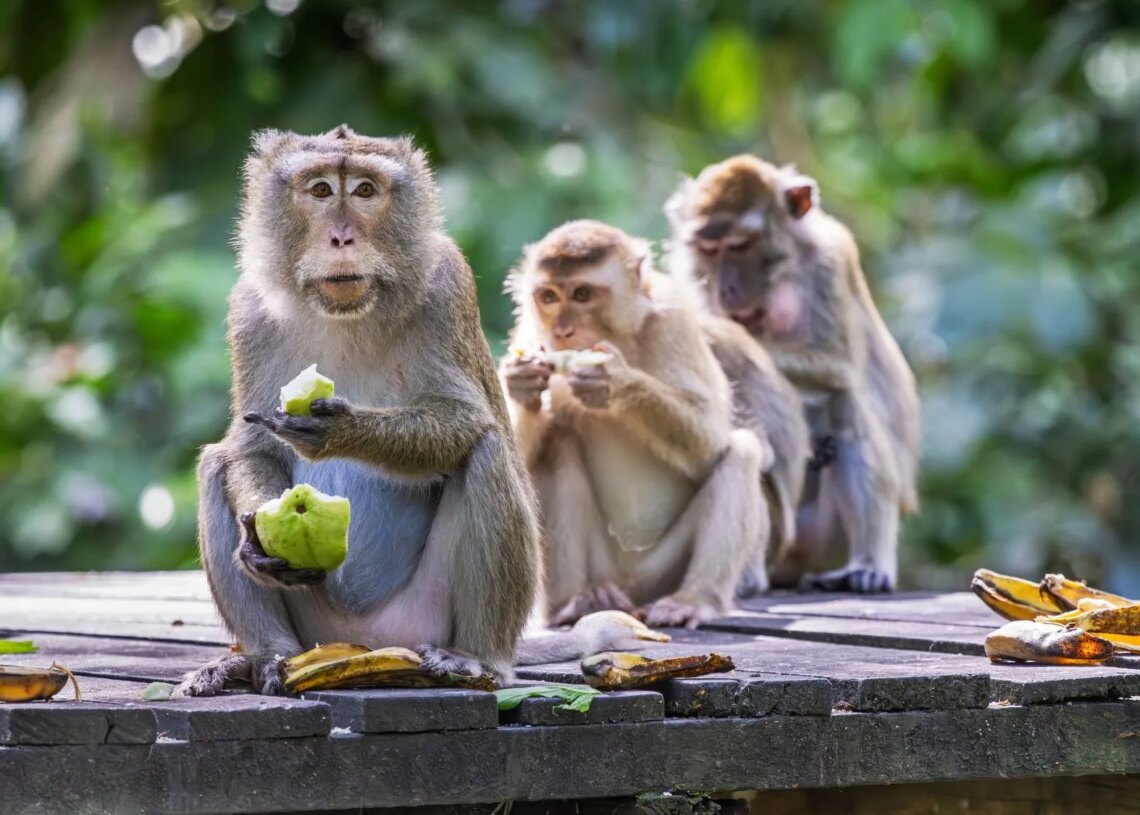
Monkeys, they’re just like us! Yes, we share a ton of genes, but socially, researchers recently found monkeys from groups that lived through a deadly outbreak became much more wary of tainted food afterward. Now you’re starting to see why Taco Bell is still trying to recover from that tainted lettuce scare.
As The New York Times described them, they’re basically “germaphobe monkeys,” an apt nickname for the Japanese macaques observed in a study published in Royal Society Open Science.
When a virus tore through a South Texas macaque sanctuary, three out of four monkey groups watched their neighbors suffer and die from a disease spread through bites and scratches. Once the epidemic faded, cognitive scientists from the University of California, San Diego set up an experiment, the results of which they detailed in a press release.
Offered they macaques two food choices, food on a clean surface versus food on a board covered in feces.
Scientists Discovered That Monkeys Become Germaphobes After Surviving a Deadly Outbreak
That’s an easy choice for you, but for the macaques, a little s—t on their food isn’t usually a deal breaker. Monkeys that hadn’t been exposed to the virus happily eat the poop-covered food 79 percent of the time. But macaques from groups that survived the outbreak and witnessed its horrors only ate the poop-covered food 47 percent of the time.
Sure, if you knew someone who ate poop-covered food 47 percent of the time, you would think they were deranged. But again, these are monkeys, and 47 percent is crazy low.
What’s so fascinating here, and what’s so weirdly human about this phenomenon, is that the initial virus that wiped out so many of the monkeys wasn’t transmitted through food at all, and yet, like so many of us in the early days of the COVID-19 pandemic who were furiously scrubbing down groceries in hopes of eliminating all traces of what would ultimately turn out to be an airborne virus, the monkeys that survived the outbreak turned into hypochondriac neat freaks, and justifiably so. They had undergone a severe trauma, and they were mitigating potential vectors of infection.
The researchers say that the psychological defense mechanism stems from something called the “behavioral immune system,” which triggers disgust in the brain to ward off perceived threats. When we went through a global pandemic that shut down the world, we went apes—t with the hand sanitizer. After the macaques went through their own tiny version of a pandemic, their sense of security was on high alert based on past trauma.
Strongly suggesting that avoidance of potentially disease-ridden stuff is a learned social behavior, potentially handed down from mother to baby, the researchers found that former pets and lab-reared monkeys were more willing to eat the dirty food. Poor things. They never had a mama to teach them not to eat food covered in poop.
The post These Monkeys Survived a Deadly Outbreak, Then Started Acting a Lot Like Humans appeared first on VICE.