On the surface, President Donald Trump’s friend and envoy Steve Witkoff left Moscow on Wednesday with a handful of winning talking points: a U.S. citizen released and on his way home; Russia’s agreement to resume trilateral talks with Ukrainian representatives; and a Russian ship carrying diesel set to depart for the United States this week.
But in the tangled mess that is the war in Ukraine, all of those gestures benefit Russia most — leaving a ceasefire, let alone peace, a distant prospect for besieged Ukrainians, and the Trump administration and U.S. Republicans still grappling with high diesel and gasoline prices ahead of the midterm elections.
To win effusive praise from Witkoff and announce a resumption in negotiations, Russian President Vladimir Putin had to do very little: release Stephen Hubbard, a detainee of little value, and then overcome an obstacle of Russia’s own making: professed grievances over Ukraine’s stepped-up drone and missile strikes that coincided with Russia’s parliamentary elections in September.
Ukrainian President Volodymyr Zelensky did not disguise his dismay — or his cynicism about the diplomatic developments — as he used the latest Russian strikes on Kyiv to throw shade at Witkoff for praising Putin as a “humanitarian.”
“Three waves of ballistic strikes were launched by Russian ‘humanitarians’ against Kyiv from the evening,” Zelensky said. “They used 21 missiles. Unfortunately, there is a significant number of hits and damages in the city: ordinary houses, energy facilities, infrastructure of one of the stations and the metro, shopping centers, and enterprises. Among the damaged objects is even a monastery.”
“Twelve of our regions were under Russian strikes this night,” he continued. “In Kyiv and the regions, 34 people were injured, including five children. As of now, two deaths are known.”
Zelensky added: “Essentially immediately after the latest negotiations, Russia delivered a demonstrative strike. This means that there are no real changes in its attitude towards everything that is happening. It is important to continue trying to find the right solutions to end this war.”
As Kyiv and Moscow maneuvered for Washington’s favor Wednesday, Zelensky reiterated his willingness to freeze the fighting along current battle lines — a proposal that Trump had made just over a year ago and that Russia rejected, insisting that Ukraine surrender the entirety of its eastern Donetsk region, including the so-called “fortress” cities that Russia has tried and failed to capture for years.
Following Witkoff’s visit to St. Petersburg on Wednesday, high-ranking Kremlin aide Yuri Ushakov said the U.S. envoy’s points were so convincing that Moscow reconsidered its opposition to meeting a Ukrainian delegation and was willing to send delegates to Abu Dhabi in mid-November for technical talks, the first since February.
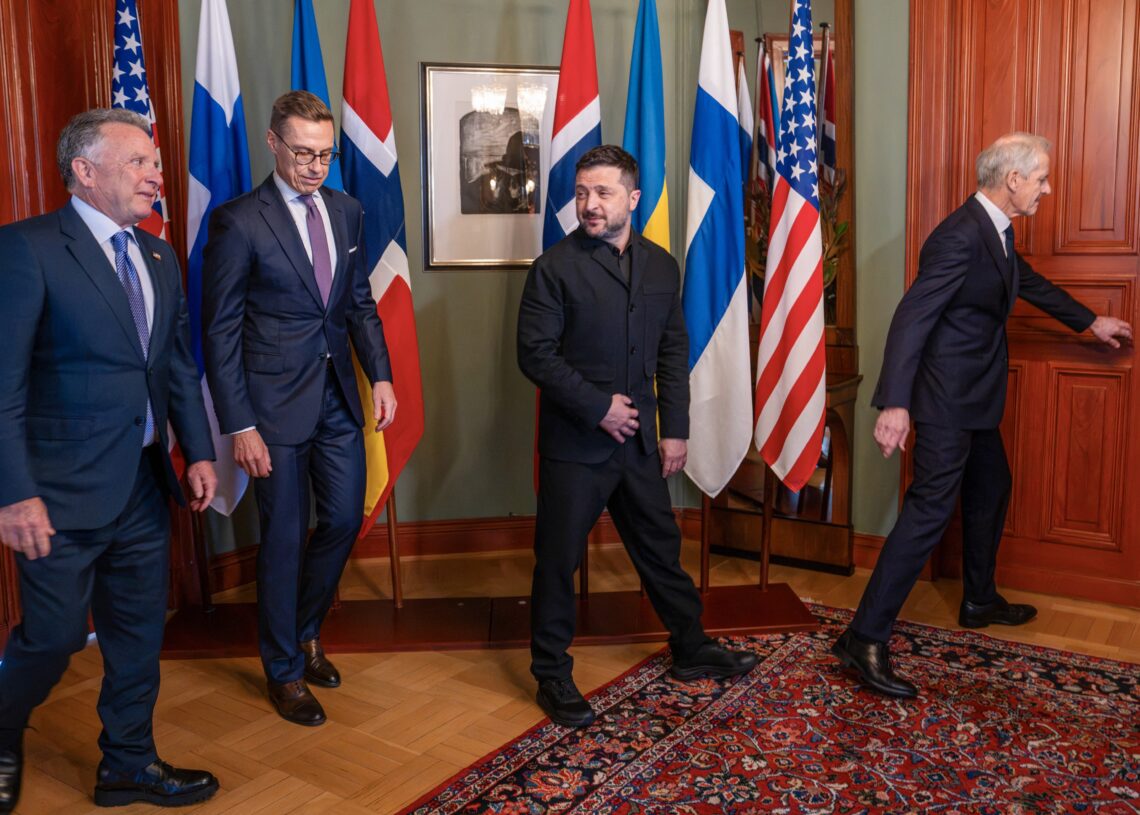
Ushakov said that Witkoff had informed Putin of the results of his talks with Zelensky in Oslo, adding there was little “substance” to the “new elements” of Ukrainian and European proposals. Ushakov said that he did not know how close the war was to ending but that “it is heading that way.”
Experts and analysts, especially in Ukraine, were less convinced.
“As experience shows, the mere fact that negotiations are taking place does not mean that a peace agreement is likely to be reached anytime soon,” Ukrainian political scientist Volodymyr Fesenko said in an interview. “It is more likely that the war will escalate at the same time, particularly the air war against Ukraine.”
“Russia’s attacks on Kyiv and Ukraine will be used as a tool to exert pressure on the negotiations,” he continued. “This is Putin’s preferred method. That is why I say that negotiations and an escalation of the war will take place simultaneously.”
Meanwhile, Oleksandr Merezhko, a Ukrainian member of parliament and chair of the committee on foreign policy and interparliamentary relations, described the talks as “a charade.”
“Russia is using the negotiations as a propaganda tool — that’s all — while we are trying to work with the Europeans and have some discussions and so on,” he said. “But there are no results anymore, and there won’t be any, unfortunately.”
Tatiana Stanovaya, a political scientist and fellow at the Carnegie Russia Eurasia Center, wrote on X that while Witkoff’s readout generated little enthusiasm in Moscow, recent sanctions relief and Trump’s latest shift toward Russia “have given Putin sufficient grounds to agree to resume negotiations, particularly as doing so comes at little cost to Moscow.”
“It is prepared to engage in discussions for tactical gains, calculating that these, combined with the further deterioration of the Ukrainian state, may eventually produce a strategic shift in Russia’s favour,” Stanovaya wrote.
Other Russian officials have called the latest meeting with Trump’s envoys a sign that “Washington shares the assessment” about the lack of substance in what Kyiv and its European backers have proposed.
Russia has long sought Trump’s support for a negotiated end to the war that would delivery victory to Putin by allowing him to seize all of Ukraine’s eastern Donbas region.
“The talks … are undoubtedly a prelude to a potential diplomatic breakthrough,” Russian lawmaker Leonid Slutsky said. “The latest meeting has, in effect, brought the issue of a settlement in Ukraine back onto the negotiating track.”
The talks are set to include military officers and Putin aide Vladimir Medinsky, a former culture minister now known for his revisionist history books about Ukraine. Putin, meanwhile, will head to China, where he is working to set up a joint meeting with Trump and Chinese President Xi Jinping on the sidelines of the Asia-Pacific Economic Cooperation summit.
That’s a format that the Russian leader has long seemed to prefer, in which he can push to end the war on his terms while bypassing Ukraine and Europe.
The idea of such a big-power summit has alarmed Ukrainian officials, with Foreign Minister Andrii Sybiha writing on X: “A trilateral meeting between the leaders of Ukraine, the US, and Russia could help end the war sooner. A trilateral meeting between the leaders of Russia, China, and the US would do only the opposite: encourage Putin to continue this war.”
During his meeting with Putin, Witkoff hailed the diesel deal Trump struck with the Russian leader as “another example of what we can achieve by working together.”
The deal, which removes sanctions from Russia in a reversal of long-standing U.S. policy, is intended to lower fuel prices ahead of the midterm elections.
Putin has claimed that it lowered global diesel prices by 5 percent to 6 percent, a figure energy experts dispute. The amount of diesel Russia is releasing is marginal compared with overall U.S. usage and hardly enough to address the global energy crisis set off by the U.S. war with Iran.
Russian Deputy Prime Minister Alexander Novak said the first tanker with diesel bound for the U.S. was set to depart Thursday, even though the contract for the supplies has yet to be signed.
“This tanker will have a capacity of 40,000 tons,” Novak said. “And, certainly, further shipments will follow.”
To ship diesel to the U.S., Russia had to lift its own export embargo, imposed after systematic Ukrainian drone strikes knocked out some of the country’s largest oil refineries, creating shortages and price spikes for Russians.
Those strikes forced Russia to prioritize its domestic market, ration fuel at home and even temporarily permit the sale of lower-grade fuels to stabilize domestic availability.
Novak hinted that production limits were still in place and that the destination for diesel shipments will depend on “what volumes we can supply — over and above the needs of the United States.”
Details aside, the deal has given Putin a basis to push one of his mainstay talking points: that the West is hurting itself by imposing economic sanctions on Russia and ultimately won’t be able to meet its own needs without resuming purchases of Russian fossil fuels.
For Putin, who is also aware that Trump may flip positions again after the midterm elections, the current thaw with Washington creates an opportunity to improve ties with the U.S. while pushing ahead with a plan to make winter the most miserable yet for Ukraine in the nearly five-year-long invasion.
The Kremlin seems to hope that will break Ukraine’s resolve and European support for Kyiv will collapse.
But for Russia, there is also a risk of overplaying its hand, said Vladimir Pastukhov, a Russian political scientist.
“The Putin regime will never have a more favorable opportunity to extricate itself from this war than it does right now,” Pastukhov said. “The frantic, restless way Putin is acting suggests he may, in part, grasp this. But hubris — the eternal nemesis of Russian emperors — stands in the way.”
Pastukhov said Trump appears to have moved away from a belief that freezing the fighting would be the best way to end the war quickly and is instead mulling a solution “in the manner of a gangland showdown.”
“In any case, I believe that this is no ordinary moment in the history of this war … but a true point of no return, a juncture where an intense struggle is underway over the terms of peace,” Pastukhov said.
“In all likelihood, this round of ping-pong will prove inconclusive; what happens next will depend on whether Trump is capable of moving from hints to action — that is, whether he will risk openly siding with Putin in this war, thereby forcing Europe — and, along with it, Zelensky — to capitulate.”
Natalia Abbakumova contributed to this report.
The post Russia agreed to restart trilateral talks. Peace in Ukraine is far off. appeared first on Washington Post.