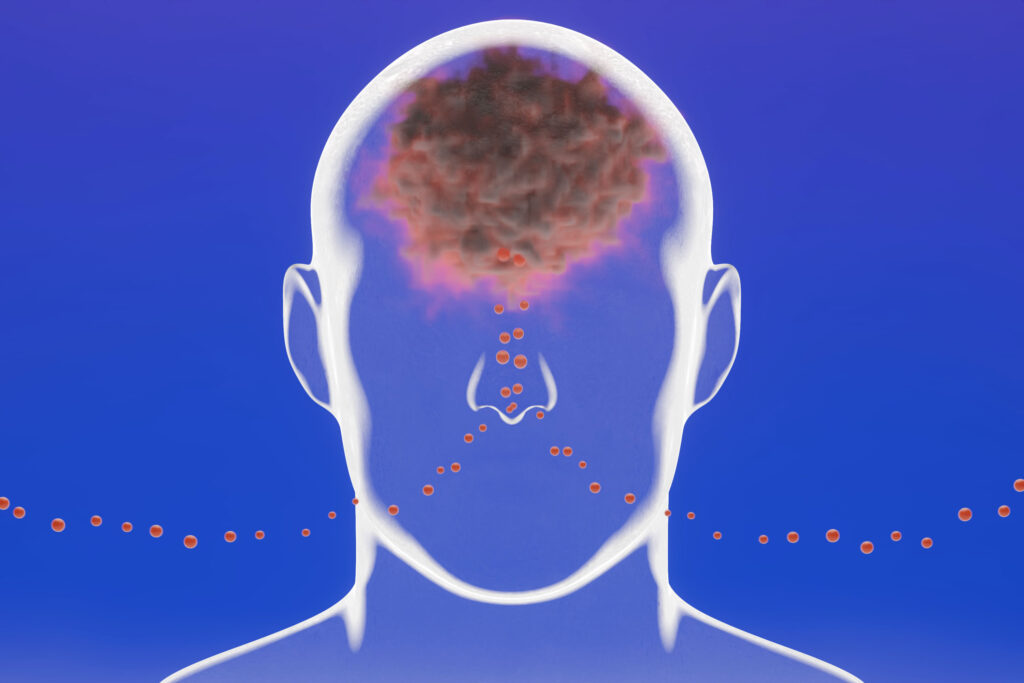
Last year, startled scientists reported that the average human brain they studied contained roughly the weight of a plastic spoon in microplastics and nanoplastics. Now, a deeper look suggests a much broader assortment of material from the outside world — silica, metals, soot and other debris — is getting through.
Researchers from the Rush Alzheimer’s Disease Center and other institutions examined, in extraordinary detail, brain tissue from 11 people who died at ages 80 to 91. They discovered that some particles had penetrated deep into the brain, reaching the amygdala, a region that helps shape emotion and memory.
The finding is part of a broad shift in how scientists are thinking about the link between air pollution and conditions that impact the brain such as dementia, Parkinson’s and autism.
For years, a leading explanation has been that pollution harms the brain indirectly, by triggering inflammation and other changes throughout the body. That idea hasn’t gone away. But scientists are now exploring whether that pollution may also act more directly.
Exactly how the particles get there remains unsettled.
They are tracing how particles may travel into the brain and what happens once they arrive, while other studies are revealing potential changes in brain structure, proteins and metabolism associated with pollution exposure. The work could help connect what people breathe today with diseases that may emerge years or decades later.
Caleb Finch, a professor emeritus at the University of Southern California’s Leonard Davis School of Gerontology, said there is growing evidence exposures may begin in pregnancy and accumulate across a lifetime.
“There’s a lot we don’t understand yet, but we do know that the risk of dementia increases in proportion to the amount of air pollution,” he said.
The questions are becoming more urgent as climate change alters the air around us. Hotter, drier conditions are fueling larger and more intense wildfires in many places, while drought and land degradation can increase the risk of dust storms — sending enormous clouds of smoke, soil, minerals and other microscopic debris across cities, states and even continents.
Here are three recent discoveries helping to fill in the picture.
A shrinking brain
Several studies published this year using the UK Biobank, a vast repository of health data on people in Britain, offer clues about how breathing polluted air might translate into physical changes in the brain.
One, published in April in the Journal of Nutrition, Health & Aging, followed more than 400,000 people over nearly 14 years exposed to varying levels of air pollution and ultimately recorded nearly 9,000 cases of dementia. Those with the highest exposure to PM2.5 — particles one-thirtieth the width of a human hair, which can enter the bloodstream and lungs when inhaled — had a 14 percent greater risk of developing dementia than those with the lowest exposure. They also showed signs that their bodies were aging faster biologically.
More surprising was what showed up on the brain scans: People exposed to more polluted air had what researchers described as a “reduction in global and several regional brain volumes.”
The findings suggested a possible progression from pollution to accelerated aging to brain atrophy and, ultimately, dementia.
A second study, published in May in Environmental Pollution, looked more closely at what might be happening inside the brain. Among nearly 270,000 people followed for about 14 years, greater exposure to PM2.5 was associated with structural changes in the hippocampus, a region essential to learning and memory.
The researchers also found clues about what might be driving the damage. Inflammation and changes in the way the body processes fats appeared to account for a small portion of the link between pollution and dementia, offering another possible path from the air people breathe to changes in the aging brain.
Neither study can prove cause and effect, and exposure was estimated from pollution levels near participants’ homes rather than measured individually, so the estimates may not reflect each person’s actual exposure. But the studies have started filling in the possible missing steps between exposure and disease.
Which particles are most dangerous?
One of the biggest questions is which parts of polluted air are most dangerous. What we breathe is not one thing but a shifting mixture of particles, metals, gases and chemicals — and scientists are beginning to tease apart which components may matter most to the brain.
In a study published in September, researchers compared the effects of three very different pollutants: diesel exhaust, dust collected from the World Trade Center site and wood smoke. Mice breathed each for five hours, after which researchers examined what had changed in their brains.
The surprise was how much diesel exhaust and World Trade Center dust had in common. Despite coming from very different sources, they altered more than 1,200 of the same genes, including ones involved in triggering inflammation, damaging to fats in cells and processing amyloid, the protein that accumulates in the brains of people with Alzheimer’s. Wood smoke, in contrast, did not produce several of the Alzheimer’s-related changes.
Diesel exhaust and World Trade Center dust were rich in metals, while wood smoke was not, leading researchers to suspect that metals may make some forms of pollution particularly damaging to the brain.
Mouse studies do not always translate to humans, and a five-hour exposure is very different from the complicated pollution people encounter over a lifetime. But the experiment points to a possibility with important implications: When it comes to the brain, the amount of dirty air may be only part of the story. What makes up that pollution may matter, too.
Toxic clumps
In one of the largest studies yet to examine the connection between air pollution and Lewy body dementia, the second most common type of dementia after Alzheimer’s, researchers analyzed hospital records from 56.5 million Americans from 2000 through 2014. They found that people living in areas with higher levels of PM2.5 were more likely to be hospitalized with two diseases marked by toxic clumps known as Lewy bodies: dementia with Lewy bodies and Parkinson’s disease dementia.
Then the researchers went looking for what might explain the connection.
In experiments in mice, exposure to pollution triggered the abnormal folding and buildup of alpha-synuclein, a protein that forms Lewy bodies.
“This is something we were so surprised to see,” said author Xiaobo Mao, a professor of neurology at Johns Hopkins and who will begin a new job in January as the director of the Houston Methodist Center for Translational Precision Dementia Research.
The exposed mice also developed brain shrinkage, nerve-cell death and cognitive decline. But when researchers exposed mice genetically engineered without alpha-synuclein to the same pollution, most of that damage largely disappeared, suggesting the abnormal protein played a key role. That makes the pathway a potential target for future therapies.
The findings, published in 2025 in Science, could also help solve a longstanding mystery about Lewy body dementia. Most people who develop the disease have no family history of it, leading scientists to suspect that environmental exposures may play an important role.
How a pollution scientist protects himself
Mao’s interest in air pollution began around the 2008 Beijing Olympics, when the city’s notoriously dirty air had become an international concern. Chinese officials were counting “blue-sky days,” restricting driving based on license-plate numbers and temporarily shutting factories in an effort to clear the haze.
Mao was studying nanoparticles at the time — particles so tiny they are measured in billionths of a meter — and began wondering what all that material in the air might be doing inside the body.
He now lives in the United States, but decades of studying pollution have shaped how he thinks about the air he breathes every day. His precautions are mostly ordinary ones.
He pays attention to indoor air as much as outdoor pollution. Cooking, especially without adequate ventilation, can generate surprisingly high concentrations of particles. “Indoor cooking may sometimes be worse than anything else,” he said.
He would avoid living directly on a major road, where traffic-related pollution tends to be higher. At home, he changes his HVAC filters regularly. Then there are the basics: He eats a balanced diet, exercises and gets outside in the sunshine.
Mao said can’t control everything that enters the air around us. But he works to control what he can. “That kind of prevention can go a long way,” he said.
The post A remarkable new picture is emerging of how the air around us could harm the brain appeared first on Washington Post.