The bluntness of the words, when Billy Crystal speaks them, fits the scale of the tragedies he suffered so recently.
“2025 was the worst year of our lives,” he says.
The horrors began that January, when the Palisades fire consumed the Southern California house where he and his family had lived since 1979. They intensified in December with the murder of Rob Reiner, his best friend, whom he had known even longer.
A mere blink of time has passed since then, and here is Crystal, on Broadway with “860,” a warm and very funny memoir of a solo play, named for the address of his beloved home turned to ashes.
Making comedy is what Crystal does with loss. It’s what he did with “700 Sundays,” his 2004 Broadway reminiscence about his childhood on Long Island, which opened three years after his mother died. With “860,” he proves that he has only grown more skilled at deploying laughter to assuage the pain of grief. Crystal may be heartbroken, but he is absolutely at home revisiting his past onstage.
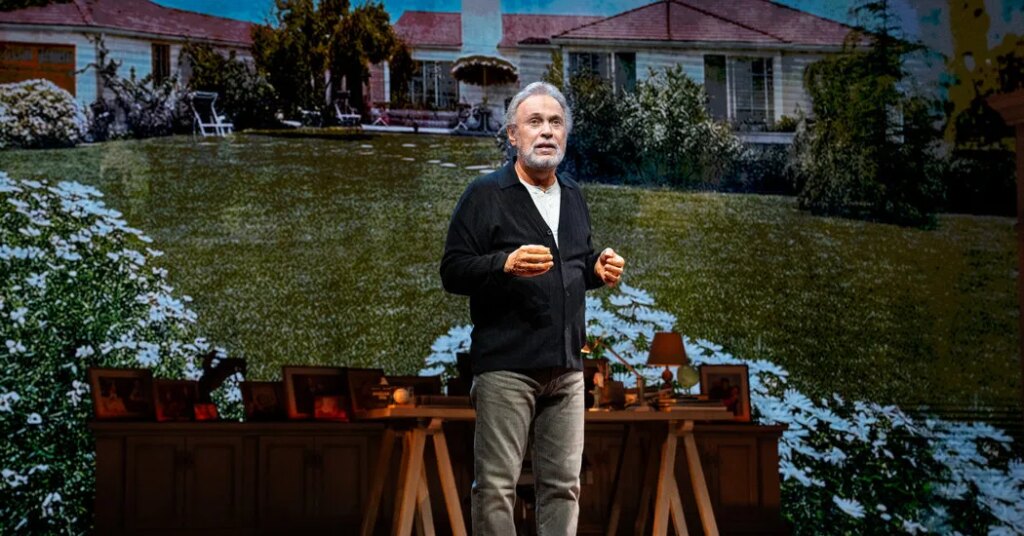
Directed by Scott Ellis at the Imperial Theater — a 1,445-seat house that Crystal makes, somehow, feel intimate — this is a wisely judged show, suffused with nostalgia yet never overwhelmed by it. The set, by Scott Pask, recreates a room that the flames ate: Crystal’s memorabilia-filled home office, with picture-covered walls, a small flock of award statuettes and, off to one side, an old seat from Yankee Stadium. Much of the play is an entertainingly comic tour through Crystal’s adult life — the years that “700 Sundays” didn’t get to — and his objects are portals to memory.
Crisis comes first, though. The play starts with Crystal and his wife, Janice, preparing to leave their home in Pacific Palisades as the fire gets closer, not knowing which vital belongings to take with them and suddenly having no time to do anything but flee — maddeningly slowly, in traffic backed up on Sunset Boulevard. Projected video of the flames and billowing smoke, along with firefighter audio, plunges us right into that panic-filled time. (Video design is by Hana S. Kim and Kylee Loera. Sound design is by Dan Moses Schreier. Both are top-notch.)
To help us feel the weight of his family’s loss, Crystal rewinds to 1979 — when he and Janice bought the house as young parents, while he was starring on the TV comedy “Soap” — and then back even further, to when he was studying film directing at New York University’s School of the Arts.
“It had not yet been Tisched,” he says — an extremely New York joke that got a huge laugh at the performance I saw. (The name has been the Tisch School of the Arts since 1982.) Then again, loads of his jokes did the same, including a reference to the 1970s-80s series “Fantasy Island,” whose title he doesn’t even mention. “The plane! The plane!” he says, repeating its most famous line. The audience cracked right up.
Crystal, who is 78, has been a pop culture figure for nearly a half-century. Many, many people feel a lot of fondness for him. Part of the interest in this show is the desire to know how he’s holding up, if he’s OK. You can feel that the crowd has his back.
“860” is a story about how Billy Crystal became Billy Crystal, and it is crucial in its telling to make clear that this is a guy who didn’t have money starting out, and who for a while was a daytime stay-at-home dad and a nighttime nascent comic, honing his act. When he and Janice buy the house, which comes with an amphitheater, he makes sure to note that they got a deal. Lack of pretentiousness — despite the wealth and fame he found — is intrinsic to his appeal.
There is real charm, consequently, to his recollections of boldface-name friends he has had, particularly Muhammad Ali, who was already a mega-celebrity by the time they met, and whom the then-unknown Crystal initially regarded with awe. A master of impressions, he does a stellar old bit playing both Ali and the sportscaster Howard Cosell.
He also re-enacts a phone conversation he had with Robin Williams, with Williams in character as Ronald Reagan, calling from hell. It’s brilliantly funny — a reminder of Williams’s singular comic genius. At the performance I saw, Crystal then crossed his arms tightly, put his hands on his elbows and said there was “nobody, nobody like him.”
The one segment of the show that feels too slick is about his repeat gig hosting the Oscars, and his rapport with Jack Nicholson. Otherwise, “860” is more genuine than that. It’s also peppered with little bits of political commentary, both verbal and visual. Crystal does an excellent Kash Patel face.
He approaches discussing his friendship with Reiner in a roundabout way: by recalling how Norman Lear cast him in a 1976 episode of “All in the Family,” to play the best friend of Reiner’s character. “It went so well, we decided just to stay best friends,” he says.
He doesn’t get deeply personal there; reminiscing about their work together, he is even a bit of a showboat, pointing out famous elements of “When Harry Met Sally …” that he says were his doing. Later in the play, when he talks about Reiner’s death, he is oblique. “The unimaginable became reality,” he says, “and the reality will always be unimaginable.” It is enough that he acknowledges the loss while he is still freshly grieving it. He does not owe anyone more.
Crystal has threaded themes of love, loss and luck through his smartly constructed script. Toward the end, he returns to the fire, which destroyed so much of Pacific Palisades, and recounts the shock and the aftermath. Marc Shaiman’s music underscores the poignancy. Jen Schriever’s lighting evokes the flames’ terrible beauty. Brutally stark projected images show us the devastation.
But Billy Crystal is not here to bum you out. He wishes, he really does, that he still had his house and his stuff. Yet he seems acutely aware of which parts of his life remain worth cherishing. Evidently they include being onstage in a room full of strangers, telling stories and making people laugh.
860 Through Jan. 3 at the Imperial Theater, Manhattan; billycrystal860.com. Running time: 1 hour 35 minutes.
The post ‘860’ Review: Billy Crystal, After the Fire appeared first on New York Times.