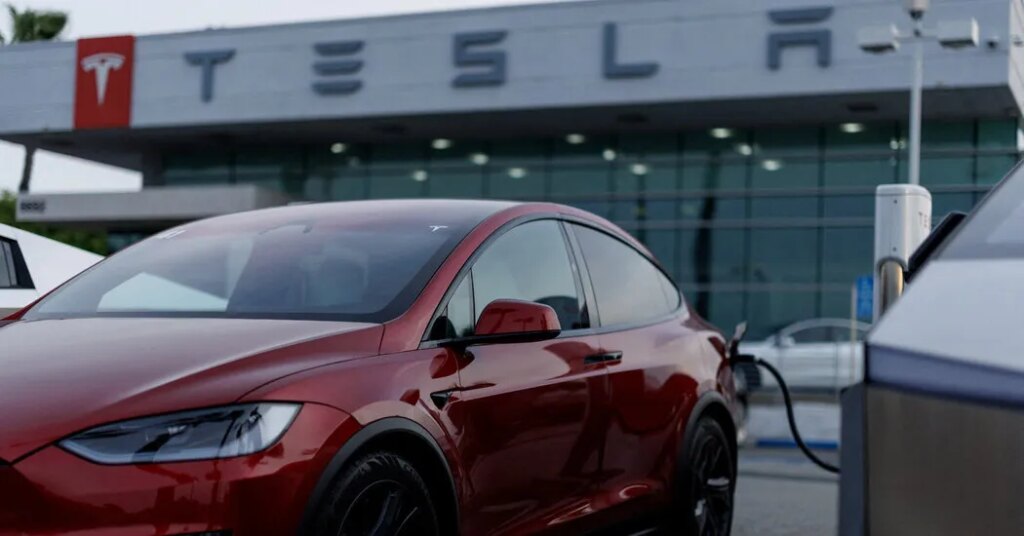
Tesla on Wednesday reported a second consecutive quarterly decline in profit as the company poured resources into self-driving cars, humanoid robots and other new technologies.
Net profit fell to $787 million in the third quarter from $1.4 billion a year earlier, the company said. Sales were $28 billion, little changed from a year earlier. Wall Street analysts had expected net profit of $815 million and sales of $28.3 billion, according to the average of estimates compiled by Tesla.
The company released its earnings report a day after its chief executive, Elon Musk, said that Tesla and SpaceX, another company Mr. Musk controls, were exploring a merger that would create a supersized conglomerate that was deeply involved in cars, robots, rockets, satellite internet service and artificial intelligence.
The prospect of a merger comes at a critical moment for Tesla. Mr. Musk had warned that profit would suffer at the automaker as it devoted resources to autonomous driving technology and humanoid robots that are being developed with A.I. The company brings in very little revenue from those new lines of business.
Tesla this year began producing the Semi, an electric heavy duty truck, and the Cybercab, a car that drives itself and does not have a steering wheel. But Tesla is only beginning to deliver the Semi in significant numbers and is not yet selling the Cybercab.
This month Tesla also unveiled the Roadster, a sports car. An edition of the vehicle will be capable of flying for short distances. But the Roadster will not go into production until 2028 and, with a price tag in the hundreds of thousands of dollars even for a version that cannot leave the ground, it is unlikely to sell in large numbers.
“In its current form, it’s a distraction — not a meaningful contribution to the Tesla product portfolio,” Paul Miller, a principal analyst at Forrester, a research firm, said in a statement.
Tesla remains dependent on the Model Y sport utility vehicle and Model 3 sedan for much of its revenue. Both are older designs. Still, their advanced driver-assistance software appears to be fueling sales, analysts said, allowing Tesla to sell more electric vehicles in Europe and the United States.
Tesla had 54 percent of the U.S. market for new electric vehicles in the third quarter, according to Cox Automotive. It had slipped below 50 percent in 2024 as established car companies like Hyundai and General Motors began selling more electric vehicles.
It is not clear how much importance a combined SpaceX and Tesla will place on the business of selling cars relative to other areas like A.I, robots and self-driving taxis that Mr. Musk has described as central to the company’s future.
Many established U.S. automakers, including G.M. and Ford Motor, have dialed back their push into electric vehicles, which has been a drain on profits for them.
G.M., the largest auto manufacturer in the United States, said Monday that it earned $3.3 billion in the third quarter, more than double its profit a year earlier, as it finished recording more than $11 billion in losses from electric vehicle investments.
The company attributed the increase to sales of large pickups and sport utility vehicles with internal combustion engines. But those vehicles could be vulnerable to high prices for gasoline and diesel.
At an event in New York on Wednesday, G.M. executives made the case that the company remains committed to electric vehicles. They announced a plan to make G.M. more competitive with fast-moving Chinese companies, in part by producing electric vehicles equipped with batteries that are significantly less expensive to make than the ones commonly in use.
The post Tesla Profit Slumps as Musk Pours Money Into A.I. and Robots appeared first on New York Times.