The ongoing youth protests rocking India caught Prime Minister Narendra Modi by surprise when they first broke out in the summer.
His deployment of police batons and tear gas, plus social media videos seeking to connect with Gen Z in their style, did little to contain them. A rare political climb-down, by sacrificing his education minister, got the protesters to go home for the time being, but it also emboldened his opponents.
So when the protesters announced another demonstration in the capital earlier this month, this time angry over changes to the nation’s voter roll, many leaders of the strongman’s own governing coalition were alarmed, as Mr. Modi maintained his trademark silence on anything negative.
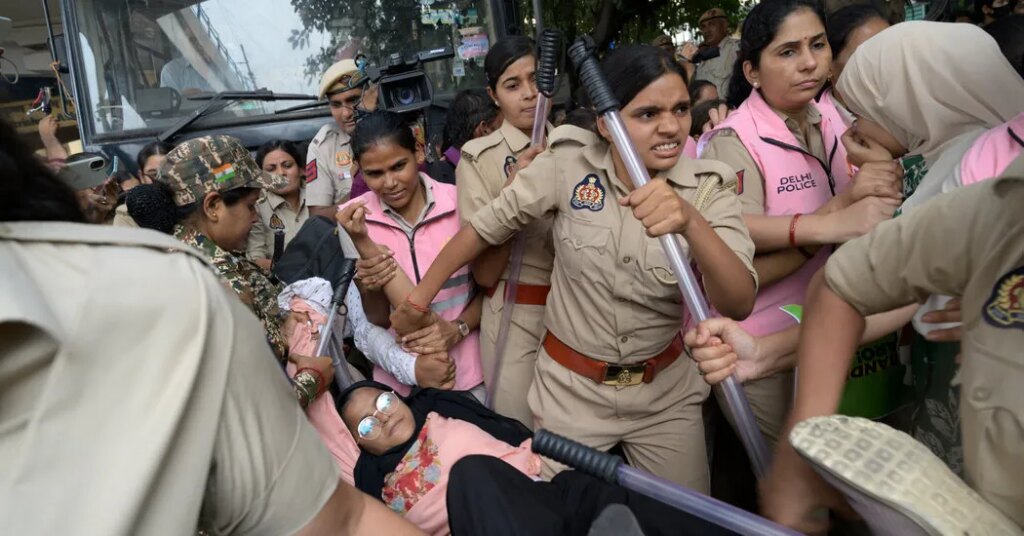
But how Mr. Modi has dealt with the unrest in recent days — locking down the heart of New Delhi, detaining protest leaders and rounding up protesters by the thousands — signaled a better prepared strategy that has reassured some of his backers that he can stall the momentum of the protest movement, according to interviews with more than half a dozen senior members of the governing coalition. Most of them asked not be identified as they are not authorized to publicly discuss internal strategy.
The government’s approach is two-pronged, they said.
-
First: Quash any mobilizing effort that suggests that public anger is the continuation of the organic Gen Z eruption over the summer that, by all accounts, unsettled Mr. Modi’s grip on power.
-
Second: Allow the gatherings of the traditional opposition parties to go ahead, framing the fight squarely against a traditional foe that Mr. Modi has repeatedly beaten at elections and is confident of vanquishing again.
For now, the approach appears to be working.
The “cockroach” youth movement — which began this summer over the failings of the education system and was revived this autumn over accusations that Mr. Modi is manipulating India’s election system — has become bogged down by the enormous powers of the state thrown at them.
Their momentum has deflated as their leaders move in and out of detention, and get tangled up in legal cases that could follow them for years. Security forces have met protest calls by putting locations under lockdown and flooding the area with uniformed officers. Organizers and supporters are stopped at the city gates, pulled out of trains and buses, and in many cases held in their homes or barricaded inside their university campuses.
Broadcast media seen as friendly to the government has then declared the low turnout a flop.
The organized political opposition, on the other hand, has received a boost from the rare public challenge to Mr. Modi. But the anti-Modi coalition has long been a fragile one, its unity frequently tested by internal competition on local turf across the country.
Mr. Modi’s Bharatiya Janata Party has long portrayed the strongman as less of a prime minister of a coalition government, and more of an executive ruler. It is framing the current agitation as an effort by Rahul Gandhi, the leader of the opposition bloc, to topple Mr. Modi through violent means.
“Their intention is pure and simple regime change,” Smriti Irani, a senior B.J.P. leader and former cabinet minister who defeated Mr. Gandhi in his constituency in 2019, said in TV appearances last week. “An unelectable prince, who hopes to be emperor one day, is now throwing a political tantrum.”
Still, Mr. Modi has found himself in troubled waters that he has not experienced in his 12 years at the national helm, many of the governing coalition leaders said. A nonpartisan civil society is managing to break through and question government failures in ways that the B.J.P. cannot easily dismiss as old-school partisan politics.
Internal Discord
There was already some discontent within Mr. Modi’s camp before the protest movement. Some figures within the B.J.P. and other parties in his coalition had become disgruntled by how much power has become centralized.
“The opposition is not a problem for them,” said Durga Nand Jha, an academic who leads a think tank affiliated with the B.J.P.’s parent organization. “The problem is, why is the public and their own supporters not defending them? They are struggling to consolidate their own supporters in this moment — some are opposing, some are silent, some are just sitting at home.”
The B.J.P. has become overly dependent on state levers and electoral machinations at the cost of political dynamism, according to party leaders and analysts. In several states, supporters have been disheartened over what they see as a heavily top-down approach to local elections and issues.
Party leaders, however, expressed confidence that they would still be better placed than the opposition Congress Party, which is struggling to translate the growing popularity of its leader, Mr. Gandhi, to an actual revival of its cadres at the local and state levels.
“A few thousand protesters here and there — students, farmers, businessmen — don’t make a dent in our winnibility,” said Krishna Kant Shukla, a B.J.P. leader in Uttar Pradesh, India’s largest state of 240 million people, which will hold an election next year.
The summer youth protests had drawn large crowds, including many youth from families not associated with the opposition, according to one B.J.P. leader and two leaders of parties in the ruling coalition. The youth were irreverent in how they poked fun at Mr. Modi with their placards and memes. Many, on camera, suggested they came from families who supported the ruling party.
The task of handling political agitation falls to Amit Shah, Mr. Modi’s powerful home minister, who is his effective No. 2 and has been at his side for over two decades.
Ahead of the protests this month in New Delhi, Mr. Shah deployed tens of thousands of security forces and barricaded a large swath of the city center to make sure crowds similar to those from the summer could not gather.
But even during the crackdown, there was an interesting let up: The police allowed a large gathering of the Congress Party and its opposition alliance partners to crowd into central Delhi. Mr. Modi’s supporters then cast the gathering as Mr. Gandhi attempting a power grab — choosing a preferred foe to address rather than acknowledging that it was facing a problem with youth anger.
A Shaky Alliance?
Behind the bravado, Mr. Modi’s party is facing the moment on shakier ground.
After losing his party’s parliamentary majority in 2024, Mr. Modi has been dependent on several coalition partners.
How he holds together his alliance will be key, particularly if the youth movement grows and his partners see their ties with the ruling party as a liability.
Leaders from two parties that have brought support to Mr. Modi complained that Mr. Modi and Mr. Shah rarely consult leaders of their own B.J.P., let alone those from coalition partners. A leader from one of the allied parties likened Mr. Modi to Indira Gandhi, the prime minister who suspended democracy for two years in the 1970s. Neither could take criticism, the party leader said.
As the youth movement has faced the brunt of the state’s suppression, its leaders have been questioned for not coordinating more closely with the organized opposition to find safety in numbers.
But Anish Gawande, a spokesman for an opposition party who also maintains close ties to leaders of the youth movement, said that such merging would play right into Mr. Modi’s designs.
“It’s only if the third space opens up that the opposition can revive itself,” Mr. Gawande said.
He said the youth movement needed to reinvent itself in the face of government suppression, but the harsh crackdown was helping with the movement’s broader mission for accountability: by exposing the repressive measures of Mr. Modi’s government. Its heavy-handedness, particularly the repeated detention of youth leaders for nonviolent marches, may backfire with a younger generation.
“You have to realize that you cannot constantly do this, that these security forces cannot sit in Delhi for the next year,” Mr. Gawande said. “So just as the state tires us out, we also tire the state out.”
The post Modi Seeks to Calm Allies by Shackling Gen Z Protests appeared first on New York Times.