The rules of the road when it comes to President Trump’s relations with foreign leaders are clear: He may trash you. But woe unto you if you whack back.
No one knows that better than President Volodymyr Zelensky of Ukraine, who has been through this particular diplomatic wringer more than once. But he got a pointed reminder during a closed-door meeting in Oslo this week with Mr. Trump’s negotiators.
Steve Witkoff, the president’s special envoy, and Jared Kushner, the president’s son-in-law, reproached Mr. Zelensky on Tuesday for his sharp comments responding to Mr. Trump’s sharp comments about him, telling the Ukrainian leader that the way he had conducted himself had infuriated the president, according to a person informed about the exchange.
Mr. Zelensky pushed back at times during the discussion as the Americans complained about certain remarks. “I never said that,” Mr. Zelensky insisted at one point, according to the person, who shared details on the condition of anonymity because it was a private conversation. But he clearly got the message. When he addressed journalists afterward, a subdued Mr. Zelensky strained to offer a positive assessment while sidestepping his recent criticisms of Mr. Trump.
“We are thankful to the American side,” Mr. Zelensky said, citing the resumption of U.S. intelligence help. He noted that he had spoken with Secretary of State Marco Rubio on his way to Oslo, which produced “positive signals from the American side” and that he had a “very constructive dialogue” with Mr. Witkoff and Mr. Kushner. “But,” he added, “it was very constructive between us because all of us want peace: Ukraine, Europe, United States.”
The one-way-street school of diplomacy has worked for Mr. Trump in the sense that his belligerence leaves many world leaders reluctant to cross him for fear of blowback or even, depending on his mood, a fresh round of tariffs. Mr. Trump demands deference while rarely giving any, except to those who accede to his wishes or to those he courts, notably autocrats like President Vladimir V. Putin of Russia, President Xi Jinping of China and Kim Jong-un of North Korea.
The contrast between Mr. Trump’s attitude toward autocrats versus democrats was made all the sharper a day after the Oslo meeting, when Mr. Witkoff landed in St. Petersburg for peace talks. Upon securing the release of an American held prisoner in Russia, Mr. Witkoff called Mr. Putin, who faces an international arrest warrant for war crimes, “a humanitarian.”
Mr. Zelensky has been one of the exceptions in openly challenging Mr. Trump at times. But he has to calibrate how far he can push that because his country remains dependent on the United States for its survival as it defends itself against Russia’s invasion.
The Oslo meeting was intended to smooth over the latest rift. Mr. Witkoff stopped in the Norwegian capital before heading to St. Petersburg. Mr. Kushner, who was ill, did not accompany Mr. Witkoff, but joined the conversation via video link.
Mr. Trump’s recent shift further toward Moscow has prompted much speculation that it may be related to the upcoming midterm elections. But Mr. Witkoff and Mr. Kushner went on at length during their conversation with Mr. Zelensky to deny any connection to domestic politics, according to the person informed about the session.
Mr. Zelensky had two friends with him for the encounter: his host, Prime Minister Jonas Gahr Store of Norway, and the visiting President Alexander Stubb of Finland. Both of them have been strong backers of Ukraine and like most European leaders do not share Mr. Trump’s tilt toward Russia, but at the same time labor not to rile him unnecessarily.
“I’m happy that we were able to get together today to straighten out a few things and to agree that what matters now is to look ahead,” Mr. Store said. “There’s nothing to gain from digging into what was said yesterday or a week ago. We now really have to be focused on what lies ahead.”
Mr. Stubb expressed hope that the back-and-forth with Washington would now end. “Today was a success and tomorrow is a new day and hopefully we don’t do any backtracking,” he said.
Mr. Store and Mr. Stubb organized the meeting in Oslo in hopes of getting peace negotiations back on track. The notion that Mr. Witkoff would have gone to Russia to meet with Mr. Putin without seeing Mr. Zelensky first would have resulted in terrible optics, two European officials said. The meeting in Oslo would not fully resolve the fundamental issues, they added, but there is no real alternative to American leadership.
The White House did not immediately comment on the Oslo meeting. An American close to the talks said that the participants had a frank but respectful exchange that allowed them “to clear the air” and move forward. Mr. Zelensky’s public criticism of Mr. Trump may serve his own short-term political objectives, the American warned, but is ultimately counterproductive to Ukraine’s longer-term goals of ending the war.
This has been the calculation that many world leaders have had to make, particularly in Mr. Trump’s second term — when to respond in kind when the American president lashes out and when to swallow pride in the interest of not poking the bear.
For years, presidents and prime ministers of allied nations went out of their way to avoid angering Mr. Trump, who prefers escalation over conciliation. But in recent months, especially since his threats to take over Greenland last winter, leaders have shown less submissiveness and more willingness to stand firm.
Prime Minister Mark Carney of Canada has led the way with his defiance of Mr. Trump’s attempts to strong-arm America’s northern neighbor into making trade concessions. Rather than back down, as leaders often did in Mr. Trump’s first term, Mr. Carney decided “to hit back” and slapped on dollar-for-dollar tariffs in retaliation.
Mr. Zelensky’s situation, however, is more complicated. Mr. Trump has been predisposed against Ukraine since his first term, convinced by advisers that Kyiv meddled in the 2016 election against him, an unfounded assertion that intelligence agencies have called Russian disinformation. His effort in 2019 to pressure Mr. Zelensky into opening an investigation into his Democratic rival, Joseph R. Biden Jr., led to Mr. Trump’s first impeachment for abuse of power.
The tone for the second term was set shortly after Mr. Trump returned to power last year and berated Mr. Zelensky in an explosive Oval Office meeting. Mr. Zelensky demonstrated at the time that he was unafraid to stand up to the president. But under coaching from European leaders and congressional allies, Mr. Zelensky has since mostly sought to avoid direct confrontations.
The past two weeks made that more difficult as Mr. Trump, who has long had a convivial relationship with Mr. Putin, pivoted even more dramatically in Moscow’s direction. Among other things, Mr. Trump and his team have struck a deal to buy Russian diesel fuel, lifted some sanctions and exempted Russia from others included in legislation that he just signed, curbed some intelligence and satellite assistance for Kyiv, delayed the delivery of interceptors and worked to broker an agreement to sell lucrative Russian oil assets to people with ties to Mr. Trump’s circle.
Mr. Trump has lashed out repeatedly against Mr. Zelensky in recent days, calling it “disgraceful” for Ukraine to strike Russian oil refineries and insisting that it “damn well stop.” He once again blamed Mr. Zelensky for the war that Mr. Putin started and said that “Russia has been fine” even as intensifying Russian missile and drone barrages are killing more civilians in Ukraine than at any time since the beginning of the full-scale invasion.
Mr. Trump went so far as to demand that Ukraine “get a new president” instead of Mr. Zelensky. By contrast, he has had no tough words for Mr. Putin, saying that he did not want to “do anything that will drive, foolishly, Russia away from the bargaining table.”
It goes well beyond diplomatic protocol to explicitly push for the ouster of the leader of a fellow democracy. But when Mr. Zelensky responded by calling the diesel move a “weak decision,” suggesting that he felt “betrayed” and indicating that it seemed that Washington was trying “to convince Ukraine to capitulate,” Mr. Trump adopted the role of the aggrieved party.
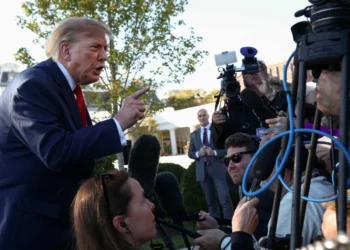
Just hours before the Oslo meeting, he again lay the responsibility for making peace on Ukraine rather than Mr. Putin, who could end the war tomorrow by stopping his attacks on his neighbor. “Zelensky has to want to settle this war,” Mr. Trump told reporters in Washington. “And if he doesn’t, I think it’s going to be a very bad thing.”
Mr. Trump’s assertion that Mr. Zelensky, rather than Mr. Putin, is the obstacle to peace offends Ukrainians and Europeans alike. Mr. Zelensky emphasized in Oslo that, after all, his people are the ones under bombardment.
“We are losing people, and because Russia attacks, we’re losing people and time, and it’s a pity because our children don’t have real life, childhood, and all the people, to be honest,” he said. “That’s why we need to end this war as quick as possible. I hope that our partners, Americans and Europeans, will help us.”
The post In Trump’s World of International Diplomacy, Insults Are a One-Way Street appeared first on New York Times.