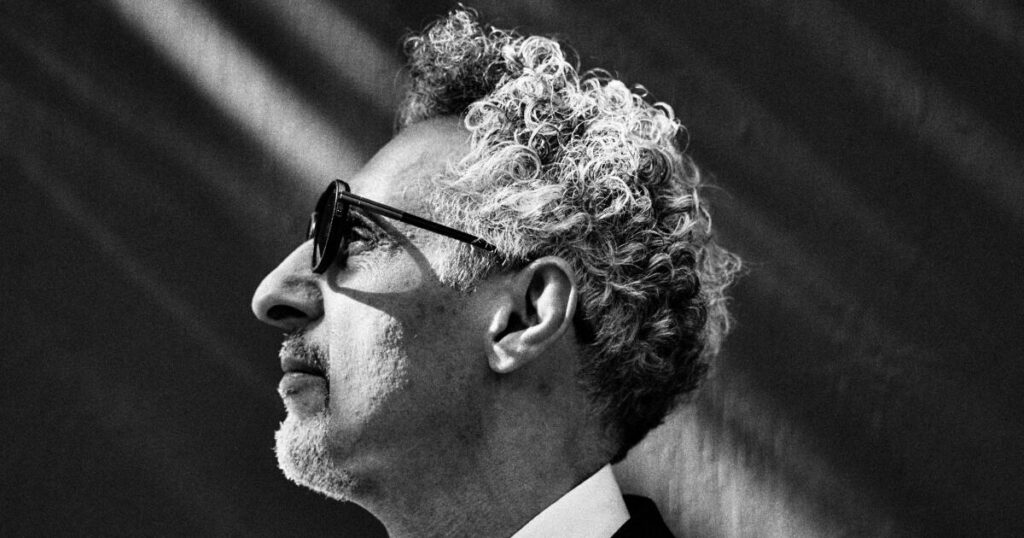
John Turturro has appeared in some classic L.A. movies during his 40-plus-year career, from the showbiz fever dream “Barton Fink” to the shaggy stoner noir “The Big Lebowski.” But he’s never been what you’d call a Hollywood guy.
It’s a blazingly hot October afternoon at the Sunset Marquis in West Hollywood, the storied rock-star haunt where suntanned guests are lounging around the pool and being seen. Turturro, 69, has been staying at the hotel for decades and is on familiar terms with the waiters. Over a Cobb salad, he remembers how the staff used to give him a hard time about his car in the early 1990s, when he was breaking through with roles like the racist pizzeria worker in Spike Lee’s “Do the Right Thing.”
“They were like, ‘You should be seen in a better car,’ ” Turturro recalls, still seemingly baffled by the suggestion. “I was like, ‘What are you talking about? It gets me where I’ve got to go. It’s a Toyota. What’s the big deal?’ ”
Turturro often visits L.A., where his younger brother, actor Nicholas Turturro, lives and his daughter Arianna works as an editor at DC Comics. But New York has always been home. Raised in Queens, the son of a builder and a dressmaker, he lives in Brooklyn with his wife of 41 years, Katherine, and still takes the subway to watch his beloved Knicks.
“I love being around the people who keep the city humming,” he says. “I don’t want to live in a bubble. I don’t think it’s healthy.”
His latest film, “The Only Living Pickpocket in New York,” in theaters Friday, brings Turturro back to the streets he knows so well and offers him something surprisingly rare in his long career: a movie built entirely around him. And with the performance drawing some of the strongest reviews of his career, it could finally earn him the Oscar nomination that has somehow thus far eluded him.
“If you had asked me when we were first starting to put together the movie, ‘Who would you like in this movie?’ I would tell you, John Turturro,” writer-director Noah Segan says. “Who realistically is going to be in this movie? I don’t know. A guy who might be a little bit like John Turturro, if I’m lucky.”
A fourth-generation New Yorker, Segan grew up on the films of Spike Lee and the Coens and wanted to make something in that gritty, character-driven tradition. He wrote the script with Turturro in mind, though he knew the actor, enjoying renewed attention for his role on Apple TV’s “Severance,” had no shortage of offers. But within days of sending the screenplay, Segan got word that Turturro wanted to have lunch. “I freaked out,” Segan says.
Turturro plays Harry Lehman, a dapper, old-school pickpocket with an elegant overcoat and a practiced touch, struggling to make ends meet in a city where nobody carries cash anymore, all the while caring for his disabled, unresponsive wife (Karina Arroyave) and trying to reconnect with his estranged daughter (Tatiana Maslany). After stealing a valuable USB drive from a crime family’s son and passing it along, Harry must track it down before the young man’s associates make good on their threats against his wife. Along the way, Harry crosses paths with a sympathetic detective played by Giancarlo Esposito, his “Do the Right Thing” co-star, as well as an old friend who runs a pawnshop, played by fellow Coen brothers regular Steve Buscemi. Seeing Turturro back on the streets of New York alongside longtime collaborators adds to the film’s throwback charm.
Turturro admires Harry’s old-school pride in his craft, but the character’s devotion to his ailing wife struck a deeper chord. He had helped care for his own mother and his older brother Ralph, who had schizophrenia.
“It’s got all this tension, but it’s also got tenderness and regret,” he says of the script. “My job is to mine all that, to go to the sub-basement.”
With his angular features, wiry intensity and gift for playing men on the verge of coming unglued, Turturro was one of the most arresting presences to emerge from the New York-based indie film boom of the early 1990s, a time when low-budget movies could launch the careers of actors who didn’t fit the traditional mold. With that corner of the movie business increasingly squeezed, he calls a film like “Pickpocket,” shot in just 25 days, “kind of a little miracle.”
Hollywood never quite figured out how to make Turturro a conventional leading man and he wasn’t especially interested. Instead, he has carved out a career as one of the most distinctive character actors of his generation, moving between film, theater and television, with occasional detours into blockbusters such as the “Transformers” movies and the rebooted Robert Pattinson-starring “The Batman.”
“I don’t know what a ‘John Turturro type’ is,” he says, bristling slightly at the suggestion. “I like to surprise people. I think if you want to have longevity, it’s helpful that you can do all different things and fit in different ways. Sometimes someone is the lead and it lasts for so long — and then the milk expires. And then what do you do?”
At the peak of his early success, Turturro could have made a comfortable living playing neurotic oddballs and angry loose cannons in big studio movies. Instead, he decided to direct an intimate, deeply personal film inspired by his father. Set in 1950s Queens, “Mac” follows three Italian American brothers whose construction business strains under the oldest brother’s uncompromising standards. Turturro also co-wrote and starred in the film, which won the Camera d’Or for best first feature at the 1992 Cannes Film Festival.
Though “Mac” made little impact commercially, the Cannes prize was a welcome vote of confidence for Turturro as a filmmaker — and came with roughly $65,000 toward his next film. “That award meant so much to me,” he says. “Even Quentin Tarantino said to me, ‘That was the greatest award.’ He was pissed off that he didn’t win for ‘Reservoir Dogs.’ I said, ‘Quentin, you’ve done very well for yourself.’ ”
In 1998, Turturro was offered a part in “Mystery Men,” a big-budget superhero comedy starring Ben Stiller. He gave the script to his then-8-year-old daughter to read. “She said it was terrible,” he says. At the time, he was considering an off-Broadway production of Samuel Beckett’s “Waiting for Godot,” which the two read together. This time, Arianna was impressed. “She said, ‘This is good, Dad,’ ” he recalls with a laugh. “I said, ‘Yeah, but I’m going to get $300 a week!’ ”
Still, Turturro chose Beckett, appearing alongside Tony Shalhoub and Christopher Lloyd, while “Mystery Men” went on to flop at the box office. “I wouldn’t trade that experience for anything,” he says. “Sometimes five people see something but they love it. And sometimes 100 people see it — and does that make it better? I don’t know. I think about that a lot.”
Turturro has always been a physical actor, whether strutting across the bowling alley as Jesus in “The Big Lebowski” or practically bursting out of his skin as the twitchy Herb Stempel in Robert Redford’s acclaimed 1994 drama “Quiz Show.” But as he approaches 70, demanding roles take a greater toll.
“If I have to run down the street really fast, that’s much harder,” he says. He recently tested himself playing a heavy-drinking everyman in Eugène Ionesco’s absurdist drama “Rhinoceros” in Cambridge, Mass., a production he will bring to Broadway next spring. He even gave up his customary glass of wine with dinner to keep his memory sharp. “I don’t know how long I could do things like that,” he says. “I do take care of myself. But I’m not 35.”
Watching his old work, as he did recently when putting together a reel of his performances, Turturro sometimes catches himself trying too hard. “I’m making three moves where I could have made one move,” he says. He remembers Paul Newman telling him on the set of Martin Scorsese’s “The Color of Money” that it had taken him 25 years to truly relax in front of the camera. “I said, ‘Wow, you could have fooled me,’ ” Turturro recalls.
Turturro believes the years have made him a better actor in many ways. “I have way more experience as a husband, as a father, as a son,” he says. “Lots of loss, great times, really dark times. You don’t realize that you’re carrying your life with you. You can distill things and be simpler and fuller as you get older. You actually can get better.”
Turturro won the acting prize at Cannes for “Barton Fink” and earned an Emmy for a guest role on “Monk” but has never managed to make the cut with Oscar voters. He thought he might have had a shot for “Quiz Show,” though he didn’t put in the effort to campaign. “I would watch [the Academy Awards] when I was a kid and go, ‘Wouldn’t it be cool to be invited to that?’” he says. “But I didn’t understand the whole publicity machine thing. I didn’t have a publicist.”
A nomination for “Pickpocket” would be gratifying, he admits, particularly for the attention it could bring to a small independent film. “Would it be nice? Yes, of course it would be nice,” he says. But an Oscar would be, as he puts it, “the cherry on top of the cake” — not the cake itself. “I’ve seen people be overlooked and I’ve seen things that have been rewarded that maybe you go, well, that’s not my taste.”
Turturro shows little sign of slowing down. He’s directing a documentary about former Yankees manager Joe Torre and has no shortage of other ideas, including an adaptation of Philip Roth’s 1995 novel “Sabbath’s Theater” he is developing. Even a visit to the doctor can get his imagination going. “I have all these doctors that I love and they’re all eccentric,” he says. “I told my wife, ‘I should do a one-man show about all my doctors because they’re so funny.’ That’s just the way my brain works.”
Christopher Walken, his longtime friend and “Severance” co-star, once told him: Actors don’t retire. They get retired.
“I’m a worker — I like to work,” Turturro says. “I understand balancing your life but I don’t get retirement. I found something that I fell in love with. And I still love it.”
The post Hollywood never quite knew what to do with John Turturro. That suited him fine appeared first on Los Angeles Times.