In the final weeks of Michigan’s closely watched Senate race, Dr. Abdul El-Sayed’s ethnicity, religion and family have come under renewed attacks and scrutiny.
His Republican opponent, former Representative Mike Rogers, invoked Dr. El-Sayed’s mother during their first debate, trying to draw a connection between her and Al Qaeda. President Trump has mocked the pronunciation of Dr. El-Sayed’s name and has started referring to him by his middle name, Mohamed. And Republican ads have suggested that Dr. El-Sayed has ties to terrorist groups or to the Muslim Brotherhood, the Islamist political movement.
Dr. El-Sayed has forcefully responded to the questions about his identity. Over the weekend, a nearly five-minute exchange at a town-hall event with a man who asked him to “disavow the Muslim Brotherhood” went viral on social media. This week, in a brief, testy interaction with a reporter from Newsmax, he said, “I clearly disavow” the movement. And in a new video, Dr. El-Sayed says that he prays daily and calls himself a “man of faith.”
Now Dr. El-Sayed, who would be the first Muslim senator if he wins, finds himself confronting both ugly attacks and pointed questions about family members — particularly his mother and a half sister — and their past comments and personal histories. Republicans have pushed to make those questions a main story line in the final days of a Senate race that could determine control of the chamber.
The focus on Dr. El-Sayed’s identity, religion and family comes at the end of a campaign defined by its emotional and bitter clashes over Israel and the United States’ role in the Middle East. Dr. El-Sayed has cast himself as a leader of the Democratic Party’s march away from support for Israel, arguing that the longtime U.S. ally should not exist as an explicitly Jewish state and calling for an end to its American military support.
As he approaches a second and final televised debate with Mr. Rogers on Wednesday, Dr. El-Sayed is appealing to voters who are not Muslim to see him as a person of faith whose experience reflects America’s history of religious pluralism.
“A lot of people question whether or not I can win this race because of my name,” he said during a speech this month in Cadillac, Mich. “I’ve been a guy named Abdul Mohamed El-Sayed in Michigan almost my entire life. I would say I’m pretty good at being named Abdul in Michigan.”
An Open Letter and Family Scrutiny
The questions that Mr. Rogers is pushing about Dr. El-Sayed’s ties to the Muslim Brotherhood relate in part to an open letter he signed in 2012.
That letter, which Dr. El-Sayed signed while he was in medical school, asked Mohamed Morsi, who was then the new Egyptian president from a party that represented the political wing of the Muslim Brotherhood, to “purge the media and police” of supporters of the dictatorship that had been toppled during the Arab Spring. (Mr. Morsi, Egypt’s first democratically elected president, established good working relations with the United States.)
Dr. El-Sayed’s campaign denied that he had any connection to the Muslim Brotherhood. When asked recently by reporters, he has disavowed the group. His campaign aides declined to answer questions about the 2012 letter.
Many of the Republican attacks on Dr. El-Sayed focus on his mother, Fatten Elkomy, an Egyptian immigrant.
Dr. El-Sayed’s parents separated when he was 3 years old. He was raised in Missouri, Florida and Michigan by his father and stepmother, a Michigan-born descendant of Abigail Adams. He has featured his grandparents in advertisements, including one that began airing on Tuesday in which they declared, “We’re Presbyterians.”
After the separation, Ms. Elkomy lived in Egypt at first and later in Missouri, where she worked for a charity that was designated by the U.S. government as a supporter of terrorist groups, including Al Qaeda.
The charity, the Islamic American Relief Agency, was founded in 1985, raised at least $20 million and funded social services for children in Africa and Asia, according to federal records. It closed in 2004 after the terrorism designation.
The group and several leaders ultimately pleaded guilty — not to supporting terrorism, but to a lesser charge of transferring more than $1 million to Iraq in violation of federal sanctions. Its executive director, Mubarak Hamed, was sentenced in 2012 to nearly five years in prison.
This month, five people involved in the case said in interviews that they did not remember Ms. Elkomy because she was a low-ranking employee and was never accused of wrongdoing.
“She didn’t have anything to do with anything,” said Charles Swift, a lawyer who represented the group.
Among the 945 exhibits cited by prosecutors in a court filing during the case were 13 that pertained to Ms. Elkomy, a detail Republicans have seized on. Most of the exhibits were letters she sent documenting financial transactions between 1999 and 2001. (Records do not include the letters themselves or any information about whether the transactions were illegal.)
Evan Kohlmann, a counterterrorism consultant who was an expert witness in the case, said the charity was so small that all of its employees most likely knew about its activities. He added that the group was part of a global network whose leaders had been found to have previously sent money to Osama bin Laden. “It was no secret that they were doing this,” he said.
The Missouri charity had 14 employees, according to its last tax filing in 2003.
Ms. Elkomy, who now works as a psychiatric nurse practitioner in Missouri, addressed the criminal case years ago in a newspaper interview. She said she had worked at the charity between 1999 and 2004 to serve orphans and had never seen any ties to terrorism.
An even older chapter of Ms. Elkomy’s life has also drawn scrutiny because of years-old posts on social media by her daughter from a marriage after her divorce from Dr. El-Sayed’s father. The daughter, Eman Abdelhadi, who is now a professor at the University of Chicago, posted in 2012: “Had an amazing talk with my mom about her activism in the Muslim Brotherhood during the early 70s while she was in college #respect.” Ms. Elkomy has said she graduated from medical school at Alexandria University in Egypt in 1983.
Dr. Abdelhadi has also made other posts suggesting that family members in Egypt were part of the Muslim Brotherhood. None have mentioned Dr. El-Sayed.
Dr. El-Sayed’s campaign pointed to his past remarks about his complex family dynamics. He wrote in one of his books that his father left Egypt to escape the country’s political oppression and that he had little relationship with his mother. His aides said that any suggestions that he had connections to overseas terrorist groups were racist and Islamophobic.
Dr. El-Sayed’s mother and half sister, with whom he also did not grow up, did not respond to requests for comment. His aides declined a request for an interview with him for this article, and declined to talk in detail about his family or religious practices.
“I was raised here in Michigan, went to the University of Michigan, rebuilt the health department in this city, led the health department in this county, and you want to ask me about what was happening in Egypt in the 1970s?” Dr. El-Sayed, a former public health official, said in a recent interview with NBC. “Are you serious?”
A Barrage of G.O.P. Attacks
When the general election began, Mr. Rogers accused Dr. El-Sayed of being too far left politically for Michigan. He made a play for disaffected Democrats and described the El-Sayed campaign as “filled with anger, divisiveness, calls for violence and views that are out of touch with your values.”
It was a predictable line of attack against a progressive Democrat who had campaigned with the provocative streamer Hasan Piker during the primary race.
Then came the debate this month.
Mr. Rogers attacked Dr. El-Sayed’s mother and suggested his rival had ties to terrorists. “Well, if you have someone in your family that might be on the, on the watch list —” Mr. Rogers said, before Dr. El-Sayed cut him off.
“You going after my mom?” he asked.
Mr. Rogers stopped, but his allies did not.
Mr. Trump began calling Dr. El-Sayed by his middle name, Mohamed, and mocked the number of syllables in his given name. Ads emerged on television saying that Dr. El-Sayed had “ties to the Islamist movement.” On CNN, Mr. Rogers said his rival had “a long history of supporting the Muslim Brotherhood.” Republican allies of Mr. Rogers stepped up efforts to scrutinize Dr. El-Sayed’s political allies and donors.
This push came to a head on Saturday night when, at a town hall in Caro, a small town in northeast Michigan, a man who was reportedly a Republican operative asked Dr. El-Sayed if he would disavow the Muslim Brotherhood.
Dr. El-Sayed’s campaign was so pleased with his response — “Sure, yes, absolutely,” followed by a colloquy about the Constitution and his loyalty to it — that it posted the exchange on social media, where it spread widely.
Republicans argued that Dr. El-Sayed had bullied the questioner, and kept pushing the discussion about the candidate’s faith.
On Monday, Dr. El-Sayed posted a video that showed images of churches and a menorah while portraying himself as another religiously observant person.
“I pray every day,” he said. “We need a few more people of faith in Washington. I’m Abdul El-Sayed, man of faith.”
‘We Kind of All Knew Where This Was Headed’
From the start, Dr. El-Sayed had few illusions about the role his faith and ethnicity would play in his Senate campaign. Many other Muslim candidates for lower-profile offices had faced baseless accusations of mixed allegiances or ties to terrorist groups.
“We kind of all knew where this was headed,” Dr. El-Sayed said in an interview after his campaign event this month in Cadillac.
Dr. El-Sayed wrote in his 2020 memoir, “Healing Politics,” that he was “raised in a conservative Muslim household.” He went to Sunday school, fasted during Ramadan and refrained from eating pork.
And in interviews, he has said he attends a mosque, prays five times a day and does not drink alcohol. At Michigan, he was president of the Muslim Students Association and married his wife while they were undergraduates.
“I believe in an Islam that emphasizes God and my responsibility in his creation,” he wrote. “The Islam I practice doesn’t judge people; it seeks to empathize with and empower them.”
For a while during his Senate race, Dr. El-Sayed ran advertisements stressing his guy-next-door bona fides. He was captain of his high school football team and gave a commencement speech upon graduating from the University of Michigan.
For other Muslim elected officials, Dr. El-Sayed’s experience in recent weeks is reminiscent of what they have gone through in their campaigns.
Sam Rasoul, a Palestinian American who has been in the Virginia House of Delegates since 2014, was asked during a televised debate when he ran for lieutenant governor in 2021 if campaign donations he received from Muslims meant he would be loyal to all of Virginia.
Four years later, a different Muslim candidate, Ghazala Hashmi, was elected as Virginia’s lieutenant governor after facing similar attacks. She said she had texted with Dr. El-Sayed during his Senate campaign to offer encouragement.
“There’s such a heightened level of anti-Muslim rhetoric that has grown over the past couple of decades,” said Ms. Hashmi, who is now one of two Muslims who hold statewide office in the United States. “Islamophobia is something that is a part of the political system here.”
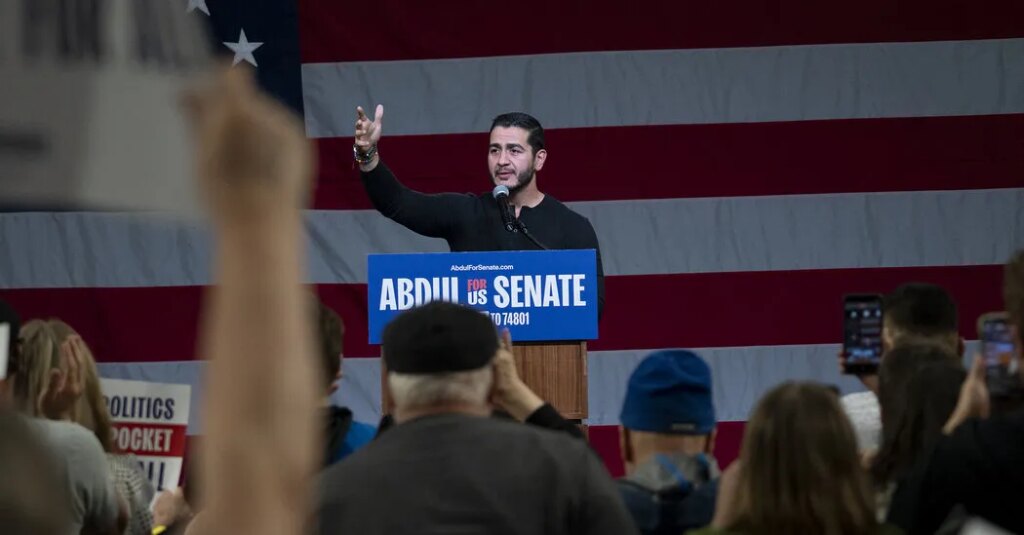
Onstage at campaign events, Dr. El-Sayed often stands not in front of signs with his campaign logo, as he frequently did during the primary, but in front of a giant American flag. He proactively talks about what Mr. Trump, Vice President JD Vance, Mr. Rogers and others are saying about him.
“They think my name and my faith are enough to get people to stop paying attention to the issues,” he said this month in Ionia. “My name is not the reason you can’t afford gas. My name’s not the reason you can’t afford your groceries.”
Susan C. Beachy contributed research.
The post Abdul El-Sayed Confronts Attacks on His Faith and Family Ties appeared first on New York Times.