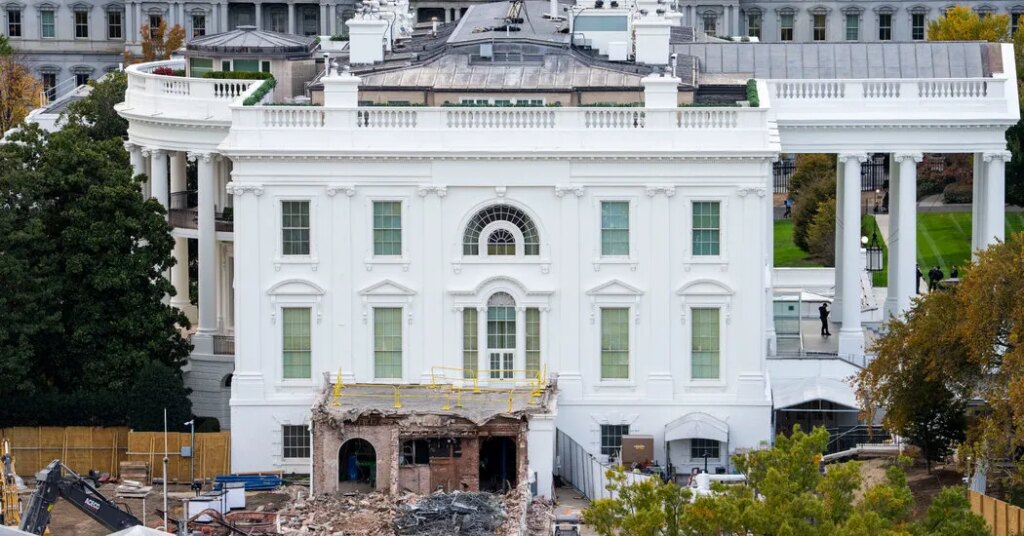
Almost a year has passed since excavators demolished the storied East Wing of the White House to make way for a new ballroom. The surprise destruction took just three days; most Americans heard about it only after a disbelieving onlooker sent a picture to The Washington Post. The paper verified the tip and published the news, which blazed through social media. Only then did the president inform the nation.
Since then, Americans, overwhelmingly aghast at President Trump’s ballroom project, have cycled through phases of shock, denial and grief. The press portrays the ballroom as a big frivolous party room, reveling in the new building’s tackiness — the oily gilt, the superfluous stairs to nowhere, its ungainly size. Even a former White House social secretary who supports the plan told me she fears it will resemble the Kremlin. But the Supreme Court’s decision in late August allowing construction to continue means that the president’s vision will proceed as a fait accompli, despite other legal challenges.
Democrats energized by the public’s sourness on the project compete for the most outré ideas for its post-2028 future: tearing it down on Day 1; selling off its contents and then tearing it down; converting it into a museum of authoritarian corruption; making it a soup kitchen. At the very least, one suggested, it should be renamed for former President Barack Obama.
Perhaps it is time that we looked at how, exactly, this particular bit of White House real estate has been deployed after it was built around the turn of the last century. Since the East Wing evolved as a base for the first lady’s staff in the era of Eleanor Roosevelt, its purpose had always been to advance diplomacy and soft power, especially that of the first lady.
And perhaps in that history lies its future. Yes, the entire historic structure is gone — and that was badly, injuriously done — but what will rise in its place will very much be part and parcel of the traditional East Wing. A party is never just a party in Washington, after all, and President Trump knows that. A grand, generous space for parties is essential, but so is the Office of the First Lady, and so far, there is little serious vision or thought devoted to this in his creation. It’s not too late.
Jackie Kennedy has rightfully been given the historical credit for turning White House state dinners into the most coveted invitation in Washington — and maybe the world. But John F. Kennedy himself was gloriously attuned to the power of setting the political tone through entertaining. He often called his social secretary, Tish Baldrige, to discuss household matters, and once pushed for French dishes on menus to be listed in English to avoid sounding too effetely European. Ms. Baldrige herself approached these dinners with ruthless political acumen. She asked the C.I.A. to prepare profiles of world leaders for Mrs. Kennedy, sent the agency thank-you notes and diarized how America had performed.
When a state dinner went badly, as it did on a disastrous 1961 evening with Prime Minister Jawaharlal Nehru of India and his sullen daughter, Indira, it could dangerously undermine America’s standing. At the time, Mr. Kennedy needed to cultivate nonaligned India as a buffer against China, and his aides had pinned great hope on the dinner. The evening was a flop. Mr. Nehru was bored and uninterested, devoting his attention to Mrs. Kennedy. Two days later, when asked at the National Press Club how he could stay “neutral between right and wrong,” Mr. Nehru responded flatly: “There are far too many grays in this world.”
Henry Kissinger, too, was an avid believer in the utility of parties as a stage on which to project the appearance of power during the tensest moments of the Cold War. He insisted on being seated next to only beautiful female guests at state dinners (the social office was asked to report on the “cleavage factor” of possible table mates), creating a conquest mythos of his own. He even made a joke about his rakish tendencies to the Soviet ambassador to Washington, with whom he brokered the most sensitive aspects of U.S.-Soviet relations.
George H.W. Bush understood that a successful dinner made tough negotiations the next day much easier. Many diplomatic crises erupted on his watch: the Soviet Union collapsed; Germany reunified. As both an extrovert and one of the last great American diplomats, Mr. Bush was dedicated to the party as an informal, intimate sphere where real decisions were made. His wife used to call him “Perle Mesta Bush,” after the great midcentury Washington political hostess and ambassador.
State dinner pageantry has also been a major lever in domestic politicking. Extending invites to a fantastically desirable party — any visit from a British royal, for instance, or Nelson Mandela’s first state dinner after his release from prison — has been a way for presidents to cultivate relationships with strategic members of Congress across the partisan divide. Demand was so high for these iconic evenings that it was not unheard-of for an aspiring guest to ring the social secretary, whose job was to oversee the guest lists, and declare his spouse was literally dying. Attending the dinner was her sincere last wish.
The end of the Cold War, the emergence of email and other modern shifts made entertaining seem increasingly like an obligation, rather than a tool. Ambassadors lost their social cachet and influence. Presidents held fewer state dinners, but to meet the growing demands of campaign fund-raising, the ones they did hold were colossal. Christmas parties swelled to several hundred guests — and then several hundred more herded through successive receptions. The White House is just too bijou in scale for such mass gatherings. The largest space, the East Room, can hold only 200 people for a seated dinner. So began the tent era.
Many eulogies have been written for the state dinner since the 1990s, some laced with snobbishness. Society doyennes mourned their proletarianization: the start of seating couples at the same table (the previous tradition of sitting apart, as it’s done across the Atlantic, was found intimidating); guest lists deadened by nobody staffers and blasé repeat donors; the finger bowl, also deemed intimidating, retired for good.
Despite all these dreary trends, political entertaining has remained essential. A state dinner retains a unique power to flatter an ally and create chemistry between a president and an important counterpart. In the late 2000s, Barack Obama and the German chancellor Angela Merkel circled each other coldly and warily. Ms. Merkel, who was not impressed with Mr. Obama’s fizzy celebrity status, clashed with him on how to handle the fallout from the 2008 financial crisis and refused to join the NATO intervention in Libya. Michelle Obama and the social secretary Jeremy Bernard set about planning a state dinner that would win Ms. Merkel over.
Mr. Obama presented the German scientist with the Presidential Medal of Freedom. Mrs. Obama sat next to Ms. Merkel’s reclusive husband, known in Germany as “the Phantom of the Opera” for usually being absent. Strudel was served for dessert. Warmth was kindled, and the two cerebral leaders went on to form a strong alliance.
Mr. Bernard organized that pivotal dinner in the Rose Garden. He gambled with moody weather, and won. What if it had rained? “We did have a backup plan, didn’t we?” Mrs. Obama asked him the next day. He did — the East Room with spillover — but it would not have been so grand, nor, perhaps, as effective.
Mr. Trump has made it clear for years that he views holding a state dinner in an outdoor tent to be supremely inelegant. About a year before the Merkel dinner, he called the Obama adviser David Axelrod to offer his help building a modular ballroom. “You have these state dinners, and you have them in these shitty little tents in the back. It’s not befitting,” Mr. Axelrod recalled him saying. No one ever got back to him.
Mr. Trump’s insistence that America needs a bigger ballroom fits his mode of politics — personal and driven by relationships and chemistry that outweigh old alliances and institutional policies. Entertaining is the domain of this personality-driven diplomacy. But while the president is keenly attuned to the importance of a true state dinner, he has hosted only two in his second term, both for figures — King Charles III and Queen Camilla, and President Xi Jinping of China and his wife — for whom no less formal an occasion would be appropriate.
The dearth of state dinners held thus far by the builder president — the president who dreams of America’s future parties — has not helped make the case for the ballroom’s urgency. Neither does the absent voice of the first lady on the matter, nor the absence of a social secretary in toto. Traditionally, the first lady and the social secretary play central roles in these dinners. Mr. Trump at times appears to wish to be both president and first lady. His dominant presence while hosting steals the limelight from Mrs. Trump, whose projects and advocacy work, much like those of the impressive but overlooked Pat Nixon, suffer from inadequate public and media attention. How widely is it known, for instance, that she was instrumental in getting the Take It Down Act, which criminalizes deepfake and revenge porn, passed in Congress? Or that her team helps push for the return of kidnapped Ukrainian children from Russia?
As much as the state dinner evolved as a tool of statecraft, it also provided a path for women to participate in the presidency and political life. The social secretary was the very first staff position on the federal payroll awarded to a first lady, and the first role in the White House for a woman above the grade of a maid, a clerk or a cook. In the 1950s and ’60s, becoming a diplomat, spy or civil servant was out of reach for most women. But a lucky few could work for the first lady. They could pour their intellect and dedication into the state dinner, because entertaining was their opportunity for participating in political life. The antique but much-respected role of social secretary carries the weight of this history, and many of them would have understood the need for a bigger entertaining space in the White House.
This is partly why the razing of the East Wing was traumatic. It demolished a hallowed site of women’s history with blitheness. There was nobody there to pause and say: Here was the place where Eleanor Roosevelt’s aides toiled during the Second World War. Here was where they organized women-only news conferences to push newsrooms to hire more women and helped the first lady sell the New Deal to a suffering, frightened America.
The new ballroom will soon be built, gold leaf and all, and host grand parties and dazzle heads of state. It will evoke the Mar-a-Lago ballroom that Mr. Trump modeled after the Hall of Mirrors at Versailles, and the opulent courts that bewitched him in Riyadh and Doha, whose marble he praised as “perfecto.” The first lady, if past is precedent, will play a muted role, smiling inscrutably at the head table. Perhaps Mr. Trump himself will oversee the party planning.
Politicians seem interested in the ballroom’s future after 2028 mostly as a question of whether we should tolerate an architectural legacy of Mr. Trump and Trumpism. But it is worth thinking more about what was lost with the historic East Wing, and what is being sought in its place. The purpose of the ballroom is to advance diplomacy and soft power, through parties and dinners that traditionally were overseen by the Office of the First Lady, that great soft power institution at the heart of the presidency.
We are contending now with the loss of that office’s symbolic role — both as the soul of the East Wing as a physical structure and as the driving force behind the spectacle of political entertaining. The first lady is historically the star of the state dinner, taking on queenly attributes and accruing cultural capital that she then uses to advance her projects and the presidency. At the recent state dinner for Mr. Xi, by contrast, Mrs. Trump almost seemed aware she would not be the center of attention: She wore trousers, which had an almost Fräulein Maria-level depomping effect.
Mrs. Trump appears resigned, having absorbed the lessons of the first Trump administration. Back then some political operatives around the president pushed for the White House to deploy her more prominently, but were rebuffed. One aide who worked for the White House during the first Trump term told me Mr. Trump approached the presidency as a one-man show. His masculinist, warrior persona made the traditional softening effect of a consort unwelcome. He could also not countenance sharing attention, the aide explained, the very opposite of John F. Kennedy, who once famously said during a state visit to France, “I am the man who accompanied Jacqueline Kennedy to Paris, and I have enjoyed it.”
Whoever inherits the role from Mrs. Trump will not inherit a permanently altered or compromised position. There will be no great transgressions or scars to overcome. They can simply reach back into the memory of past models of female power in the White House, and set a new course.
We need a ballroom, but more than that, we need our new East Wing to show the world — and remind ourselves — who we are.
Source photographs: Corbis/Getty Images; Library of Congress; Heritage Art/Heritage Images, via Getty Images; Anna Moneymaker/Getty Images; Pablo Martinez Monsivais/AP; Stephen Crowley/The New York Times; Brooks Kraft LLC/Corbis, via Getty Images; Andrew Harnik/AP; Jacquelyn Martin/AP; Doug Mills/The New York Times
Azadeh Moaveni is a contributing Opinion writer. She is an associate professor of journalism at New York University. Her forthcoming book is “The East Wing.”
The Times is committed to publishing a diversity of letters to the editor. We’d like to hear what you think about this or any of our articles. Here are some tips. And here’s our email: [email protected].
Follow the New York Times Opinion section on Facebook, Instagram, TikTok, Bluesky, WhatsApp and Threads.
The post What We Lost When We Lost the East Wing appeared first on New York Times.