On Oct. 22, 1926, Harry Houdini, the greatest showman of his era, was resting on a divan in his dressing room at the Princess Theater in Montreal when he was visited by three university students who had attended his lecture earlier in the week.
One of them, Joscelyn Gordon Whitehead, asked if it were true that, as Houdini often boasted, his abdomen could withstand any blow. He then delivered a few quick punches in succession.
Taken by surprise, Houdini winced but did not think much of it, boarding an overnight train to Detroit. Nine days later, he was dead.
The official cause of death was an abdominal infection from a ruptured appendix widely attributed to Whitehead’s blows.
Houdini’s demise stunned an audience that had come to view him as impervious to danger. How had the mighty magician managed to die at a youthful 52 of something as prosaic as appendicitis?
After all, Houdini, a Hungarian-born escape artist had achieved world renown for repeatedly cheating the jaws of death — freeing himself from padlocked crates, surfacing from underwater coffins and wriggling out of upside-down straitjackets.
He was famous for his physical conditioning and prided himself on having the fitness of a professional athlete. Myth had it that he could control individual muscles, dislocating his shoulders on demand.
Multiple theories have surfaced over the years, feeding the aura of suspicion around Houdini’s death. This Halloween is its 100th anniversary.
One book posited that he was taken out “by a crew of malevolent circus midgets who surreptitiously entered his hotel room in order to add arsenic to his morning tea.” Others have assumed, incorrectly, that Houdini died as he did in the 1953 “Houdini” film starring Tony Curtis: failing to escape from a locked tank during his Water Torture Cell act.
Some have suggested that the magician was assassinated by Spiritualists, given his crusade to debunk their belief in communicating with the dead. Others have postulated that perhaps those Spiritualists were in league with Whitehead.
Many consider it more likely that the student’s punches simply brought attention to an existing case of advanced appendicitis.
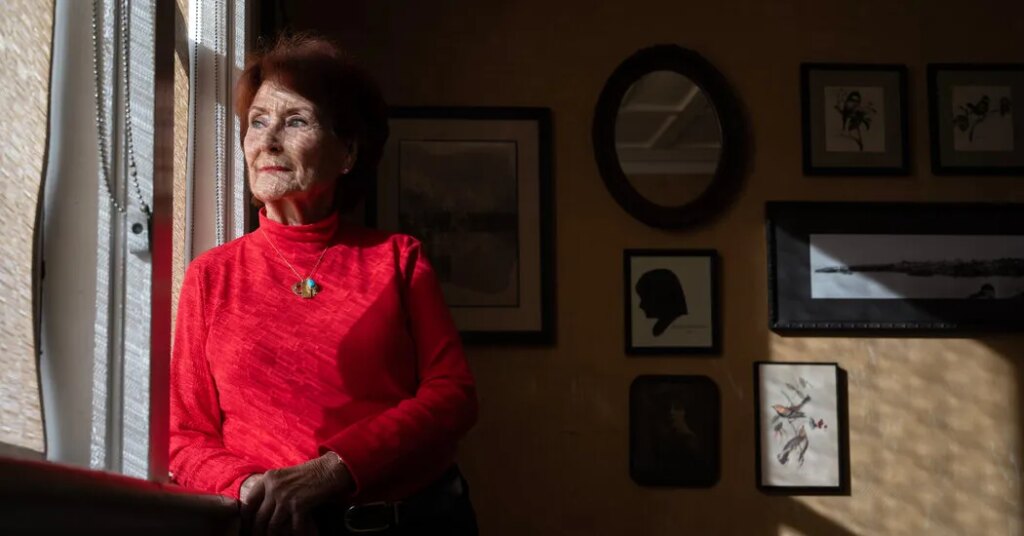
Now Larrian Gillespie, a 77-year-old retired urologic surgeon, has deployed the skills of a forensic medical investigator to challenge the conventional wisdom and clear Whitehead’s name.
“This isn’t just a story about Houdini’s death,” Gillespie writes in “Houdini: The Man Who Died Twice,” released in July. “It’s a story about how truth disappears — and why, sometimes, it takes science to bring it back.”
A New Theory Emerges
Gillespie fell into the topic of Houdini accidentally, while building a website for a friend’s class on the magician at the University of Nevada.
When she reviewed Houdini’s city death certificate, she thought it seemed off. Information was scratched out. Names were inaccurate. It was signed by a physician who had not been present when Houdini died.
“I knew immediately things were wrong, that this was not the way a death certificate is normally filled out,” she said in an interview. Gillespie was intrigued, even though she “had no interest in Houdini whatsoever,” she said, adding, “I’m not into magic.”
Gillespie, who lives in Los Angeles, has a long list of bona fides from her days as a urologist, but she is not your typical medical researcher. She grew up in a show business family (her sister Darlene was an original Mouseketeer). She appeared in TV series like the 1960 Christmas episode of “The Twilight Zone.” (“I am the elf that takes Art Carney off at the end,” she said.)
Trained at U.C.L.A., Gillespie practiced in Beverly Hills for 15 years and wrote peer-reviewed articles on topics like interstitial cystitis. She holds four pharmaceutical patents on the control of the growth or inhibition of blood vessels.
Gillespie has also written nine books on nutrition, including “The Goddess Diet” and “You’re Not Crazy It’s Your Hormones,” which has led to appearances on “Good Morning America” and other programs.
To research Houdini’s death, Gillespie consulted 1920s medical textbooks, affidavits, death certificates, letters and newspaper accounts. She interviewed experts, medical practitioners and a Houdini relative.
Gillespie said that, in addition to the Michigan death certificate, there had been two others, one filed in Detroit and another with Houdini’s insurance company. The city one was later proven to be invalid by the head of fraud at the Michigan State Vital Statistics Department, Gillespie said, because of several indications of tampering.
Gillespie said she found a paper trail of misstatements and actions by more than a dozen people close to Houdini, including relatives and employees. Among them, she asserts, several helped to cover up of the date he died, in part to make it appear to be Oct. 31 — “we remember Houdini because of the association with Halloween,” she said.
Guiding her through the research were Houdini specialists she described as her “Watsons,” including Patrick Culliton, the author of several books on the magician, and John Cox, who operates the Houdini website “Wild About Harry.”
“Nobody has ever approached this from the standpoint of a surgeon,” Culliton said in a telephone interview.
“There is pretty good evidence that she’s right,” he added. “She actually has completely exonerated Whitehead.”
Not Appendicitis at All?
The accepted account is that Houdini died when appendicitis, aggravated by the blow, led to Streptococcus pyogenes peritonitis, a form of infection.
Gillespie argues that the appendicitis was not the primary cause, and that the punch was not a critical factor. Rather, she argues, the culprit was a bowel obstruction, brought on by a fibrous mass of chop suey that Houdini ate on Oct. 28.
The obstruction led to emergency surgery on Oct. 29 in the late afternoon, Gillespie argues, an enterotomy to evacuate the bowel. But it was too late; according to the author, septic shock set in, Houdini’s fever spiked to 105 and his rapid breathing led to muscle spasms and unconsciousness.
“You don’t expect someone to survive 24 hours in this condition,” she said, “and so he doesn’t.”
But the bowel obstruction was never mentioned in any of the death records.
Houdini was operated on a second time on Oct. 30. Gillespie’s research into the death certificates indicates that the magician died that afternoon at 1:26 p.m., not on the following day at 1:30 p.m. But the documents were manipulated to change the date.
“Not identifying on the death certificate the second surgery is the critical tip-off,” she said. “That’s the smoking gun. Why was that not mentioned?”
She posits that the medical staff involved may have been concerned that the feeding and bowel obstruction might provide grounds for medical malpractice.
Gillespie argues that an autopsy was avoided to conceal that the death was accidental — from a bowel obstruction — rather than medical malpractice and that the finding enabled Houdini’s widow, Bess, to secure a double indemnity payment for accidental death from Houdini’s life insurance company.
Last July, Gillespie published her conclusions in the book, released by Cipher House Books, which she owns.
The book received a Kirkus star review and was a finalist for Kirkus’s Best Indie Book in Biography. “It all adds up to a quirky, irresistible search for hidden medical truth,” Kirkus wrote, calling it, “an absorbing, argument-starting account of what really happened to Harry Houdini.”
No autopsy was ever performed to confirm the cause of Houdini’s death, and he was buried in Queens on Nov. 4, 1926 at Machpelah Cemetery in the Ridgewood neighborhood of Queens. Each year — in a Halloween ritual as reliable as the carving of pumpkins — people show up there to see the gravestone, though the cemetery is closed at night.
Cox, in his review of the book, commended Gillespie for uncovering fresh information about Whitehead, “who comes off as the only blameless person in the book!”
“Ultimately, this is a well-told detective story with a lot of intriguing conjecture,” Cox concluded. “But in the end, the mystery remains.”
Houdini’s great-nephew, George Hardeen, said in an interview that he found Gillespie’s hypothesis “convincing and persuasive,” but acknowledged that the many Houdini historians, aficionados and magicians “are going to have a hard time letting go of what they believe.”
To be sure, Hardeen noted, a century after his great-uncle’s death, the magician continues to command widespread fascination. “I like to pose the question: Who was the president in 1926? What was the big news story in 1926?” Hardeen said. “But if you ask a fifth grader, ‘Who is the most important magician you ever heard of?’ Some of them will be able to tell you: Harry Houdini.”
Whitehead, on the other hand — though once infamous — died in obscurity. Though he was never charged with a crime, he paid a heavy price for Houdini’s death, becoming a recluse and a hermit to avoid the shame of being labeled the man who killed Houdini. He ultimately died of malnutrition in 1954 at 58 and was buried in an unmarked Montreal grave.
Gillespie, who became convinced of his innocence, has worked to address that. She recently — with a relative’s subsequent approval — ordered a granite headstone to be placed on his grave and flew there to see it installed.
The headstone reads, “WHITEHEAD, Joscelyn Gordon, Nov. 25, 1896, July 5, 1954. Falsely Accused No More.”
The post Houdini Died on Halloween 100 Years Ago. Some Still Question How. appeared first on New York Times.