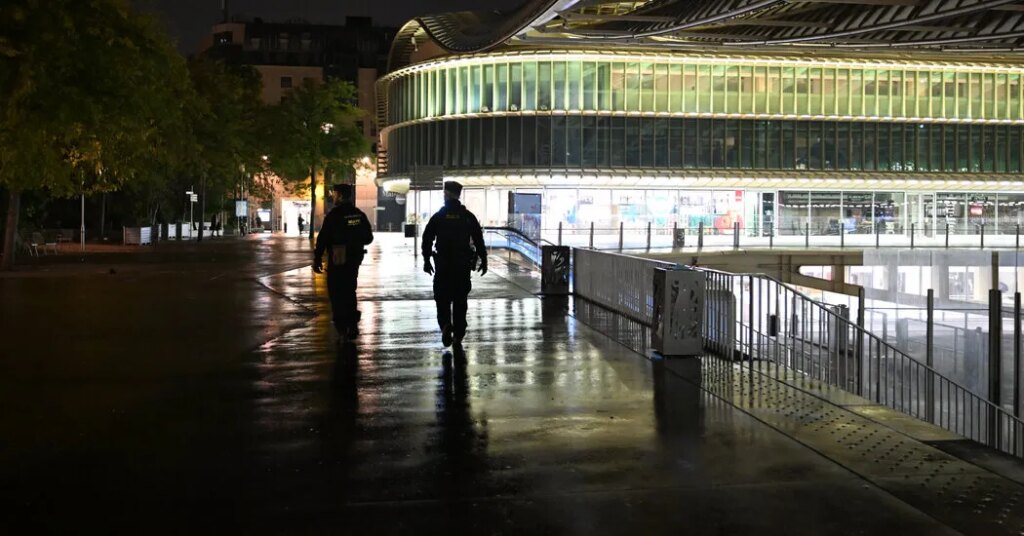
Several French cities extended curfews through Tuesday night after the measures helped quell days of riots and looting, as the government sought to reassure a rattled country ahead of fresh protests expected later in the week.
“These localized curfews are efficient,” Prime Minister Sébastien Lecornu told lawmakers on Tuesday, after cities like Paris, Marseille and Lille enacted restrictions on nighttime movements in some neighborhoods. “They helped to restore calm last night,” he added.
Mr. Lecornu also vowed that there would be a “massive” security deployment for further demonstrations planned for Saturday.
The French state is trying to reassert its authority after the country’s largest riots in years. Several government buildings were attacked and more than 3,000 shops were looted in unrest that started on Saturday, leading to the arrest of more than 2,500 people across France, officials said. About 1,000 police officers and gendarmes were injured over the weekend, according to Mr. Lecornu.
The attacks and looting spun off from massive, largely peaceful protests about school conditions and the rising cost of living.
In an attempt to address some of the cost-of-living concerns, the office of President Emmanuel Macron of France said on Tuesday that he had secured the delivery of an additional 200,000 tons of diesel per month from the United Arab Emirates and Bahrain while in the Gulf region.
That volume, added to 95,000 tons previously secured from Saudi Arabia, represents roughly 10 percent of France’s monthly consumption, Mr. Macron’s office said in a statement. The deliveries will “help lower energy prices for our fellow citizens,” the statement added.
The French government is also under intense pressure to deliver a firm and swift judicial response to the unrest.
Courts in Paris, Marseille and elsewhere are scrambling to process hundreds of cases tied to last week’s arrests, often by holding additional trials with expedited proceedings. Those typically involve prosecutors and court-appointed lawyers churning through straightforward cases in which the accused is caught in the act.
Gérald Darmanin, the justice minister, told reporters on Tuesday that about 150 people had already been incarcerated and that more than 800 people were expected to be tried in the coming days.
Mr. Darmanin said in a broadcast interview that those arrested included “people from immigrant backgrounds, people who are foreigners, but there are also people who are fully integrated and who are French.” He gave no further details about their nationalities, but added that 95 percent of those arrested were men and that 70 percent were adults.
“There are many convictions resulting in prison sentences with immediate incarceration,” Mr. Darmanin said. “In Limoges, 10 protesters attacked police officers. All 10 are in prison.”
A person accused of setting fire to the city hall of Limoges, a small city in central France, was arrested with the help of an elite police unit, prosecutors said on Tuesday. The devastating fire, in a quiet town known for porcelain, caused a national outcry.
Mr. Lecornu blamed the violence in Limoges and other cities on “insurrectionary” plots carried out by small “far-left and extreme-left” groups. But he acknowledged that the police deployment on Saturday had been “too static” and had failed to prevent loose bands of hard-line activists or looters from swarming through several cities.
The curfews, which were enacted to stop that unrest, vary from one city to another, with the government instructing local officials to take measures appropriate to the situation in their jurisdictions.
In Paris and in Lyon, a ban on demonstrations and a curfew limited to some neighborhoods were extended through Tuesday night. In Marseille, the authorities said a curfew would be imposed for minors from 10 p.m. to 5 a.m. in specific areas of the city until Friday.
The unrest came at a politically charged moment for France, where presidential elections are set for next spring. Mr. Macron, who is term-limited, will not be running.
French lawmakers said this week that they would investigate the violence of the past days and the government’s response, as politicians across the spectrum sparred with government ministers in the lower house of Parliament on Tuesday.
Addressing the prime minister, a top lawmaker for the far-left France Unbowed party, Manuel Bompard, called the riots a “real fiasco for which you alone are responsible.” The government has accused France Unbowed of stirring up the unrest for political gain, which the party denies.
Laure Lavalette, a lawmaker for the far-right National Rally party, asked whether the government would be able to “maintain the state’s legal authority and prevent widespread collapse while waiting for a new president to restore order in France.” The party is ahead in the polls and has presented itself as best placed to restore security.
Some protesters and student union leaders have called for more demonstrations this weekend, although France’s main labor unions are focusing instead on a day of protests and strikes scheduled for November 5.
Aurelien Breeden contributed reporting.
The post France Extends Curfews in Major Cities After a Night of Calm appeared first on New York Times.