Good morning. It’s Tuesday. Today we’ll find out about the newest weapon in the never-ending war on rats in New York City. We’ll also meet the new president of Pace University, coming from a position as a top official at Texas A&M.
Your first reaction to the latest weapon in New York City’s war on rats might be: Hasn’t somebody tried this before?
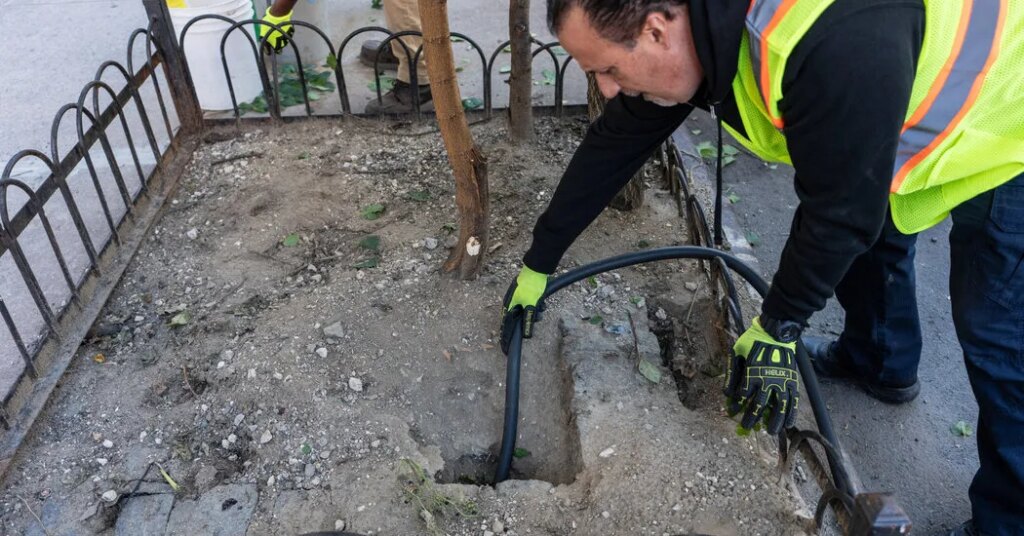
Somebody did — private exterminators, including one hired with $10,000 allocated by the City Council to clear rats from a block on the Upper East Side in 2023. Now the parks department is using the same weapon, a machine that shoots carbon monoxide into rats’ burrows in curbside tree beds.
“The rats get drowsy, and they fall asleep — permanently,” explained Danny Hernandez, an administrative parks and recreation manager.
He said that this poses less collateral risk than poison, which he said puts birds, pets and potentially children at risk. The machine that pumps in the carbon monoxide uses an oil to make the otherwise invisible gas visible. That lets people know where it is, and even so, there are restrictions. The device can only be used outdoors, and it can’t be used within 10 feet of a residential building.
Rats are a perennial problem in New York, something that standup comedians joke about. They’re funny until you see one yourself, in your very own neighborhood. Former Mayor Eric Adams — who fought tickets for rat infestations at a townhouse he owns in Brooklyn — called them “Public Enemy No. 1.” He also appointed a “rat czar” in 2023 who left the administration quietly in 2025.
Mayor Zohran Mamdani does not appear to share his predecessor’s preoccupation with rats.
What about the larger question: Who’s winning, the humans or the rats?
My colleague Dodai Stewart says that’s hard to figure out.
No one knows how many rats live in New York City. It’s not as if there’s a rat census every 10 years. She says that it’s easier to count the humans who have complained about rats.
Counting the human complainers
So far this year, New Yorkers have filed 25,025 rodent complaints with 311. That’s the fewest recorded for the same period in the seven years of data analyzed by The New York Times.
But the 311 data has its shortcomings. The app for rodent complaints wasn’t working for nine months between last year and this year. Some neighborhoods are more attuned to calling 311, while others seem to shrug. And the way information is channeled through city agencies has changed over time, complicating year-to-year comparisons.
Caroline Bragdon, the Health Department’s director of neighborhood interventions for pest control services, prefers building inspection data. As the pandemic waned, inspectors spotted a lot of rats out and about. Now the number of properties that fail inspection is “beginning to decline,” she said. “We think, long-term, we’re going to see success in continued declines.”
Changing the dynamic on the streets
The Sanitation Department has credited a change in “rat-human interactions” for some improvement. That mostly refers to rats’ interactions with humans’ garbage.
The dynamic has changed in the not quite two years since the city began requiring businesses and many buildings to put trash in sealed bins instead of loose bags. The rats were primed to scour sidewalks and curbs for four-star meals: They had developed longer noses and shorter upper teeth than their ancestors in northern China and Siberia, according to a 2024 paper in the journal Science.
Several city agencies are fighting the rat war. The Sanitation Department continues the effort to get bagged garbage in containers. The Health Department conducts inspections for rat activity, based on complaints, and posts a color-coded map in its department’s Rat Information Portal.
And the parks department has a team of six people to neutralize rats in what Hernandez, watching the crew with the carbon monoxide machine, estimated are 600,000 to 700,000 tree beds.
“It would take us 150 years to hit every tree bed in New York,” he said with a sigh.
Weather
Today will be sunny with a high near 69. The sky will be mostly clear tonight with a low near 48.
ALTERNATE-SIDE PARKING
In effect until Nov. 1 (All Saints’ Day).
QUOTE OF THE DAY
“A lot of us do point to his words.” — Gisella Castagna, a Barnard College student who attended a screening of the documentary “Edward Said: Between Worlds,” about the Palestinian American literary critic and activist who taught at Columbia University for decades.
The latest New York news
-
Expanding 2-K: Mayor Zohran Mamdani announced that the city would expand free child care for 2-year-olds to Staten Island and across the Bronx by adding 10,000 seats next school year. Wealthier neighborhoods in Manhattan and Brooklyn will not get any new 2-K seats.
-
Vintage bus: A restored version of Volkswagen’s Flower Power-era Microbus, by Kindred Motorworks, is newly fitted out with electric power. The vintage bus caused a lot of heads to swivel on a leisurely tour of Bergen County, N.J.
-
Subway shooting victim: Officials identified the man who was shot and killed inside the Seventh Avenue station at 53rd Street on Saturday as Darrel Rodriguez, 26, who grew up in the Bronx and worked as a security guard. No arrests have been made.
-
Life after a layoff: Two years ago, Janald DuFont was working as a creative project manager for Ebony magazine, earning about $100,000 a year, and living in a “semi-luxury” building in Bedford-Stuyvesant, Brooklyn. Now he’s back living in his childhood bedroom. Here’s how he’s living on $30,000 a year as a comedian and production assistant.
A new president for Pace
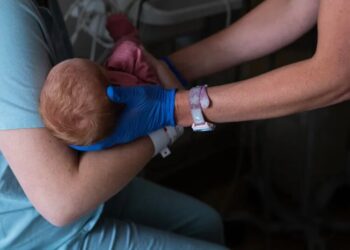
Pace University is hiring Robert Ahdieh, a top official from Texas A&M University, as its next president. He grew up in Jackson Heights, Queens, and says that Pace’s motto — “Opportunitas,” Latin for “opportunity” — has personal resonance.
His parents emigrated from Iran, his father in the late 1950s and his mother in the mid-1960s. “It’s not all universities that center opportunity in their motto and their mission,” he said.
Ahdieh, 55, will replace Marvin Krislov, the president since 2017, who said in February that he was not seeking another five-year term. Ahdieh will take office on Jan. 1.
He said that Pace could capitalize on its location, with most of its 13,000 students attending classes in Lower Manhattan. “The opportunities it creates for internships and externships, that drives outcomes and success,” he said. Pace is “not New York University, it’s New York’s university.” (Pace also has campuses in Pleasantville and White Plains, N.Y., in Westchester County.)
Ahedieh, who has a law degree from Yale, was a trial attorney in the civil rights division of the Justice Department and taught at Emory University for 18 years before he was named dean of the Texas A&M law school. Texas A&M later gave him two additional titles — vice president for professional schools and programs in 2022, and chief operating officer in 2023.
In April Texas A&M named a new president, Susan Ballabina, who had been the executive vice chancellor for the A&M system. When asked if he was in the running for the job, Ahedieh said, “Not as such,” adding that Ballabina was “a no-brainer for the role.”
Texas A&M is building a presence in Fort Worth, 170 miles from its main campus in College Station, Texas. The project was initially intended to provide a new home for the law school, which Ahdieh said had occupied a former telephone company switching facility. But he said the plans grew, with an eye toward providing A&M with “a significant urban platform” and Fort Worth — “the largest major city in the country that didn’t have a large Tier 1 university” — with an academic and industry hub for different disciplines.
Pace noted in a statement that enrollment at the law school had grown from 458 students to more than 2,000 during Ahdieh’s years there, and the percentage of students who passed the bar had climbed from 73 percent to nearly 100 percent.
METROPOLITAN diary
Pork chop scar
Dear Diary:
I was standing on a packed subway train on my way into Manhattan when I overheard two women having a lively conversation.
“I just don’t eat pork anymore” the louder of the two said. “See here? Pork chop scar!”
“What do you mean?” the other woman asked, turning to get a look at her friend’s face.
“Right here,” the first woman said. “My right brow bone. See? Look closely!”
I couldn’t resist trying to get a peek myself as her friend leaned in for a closer inspection.
“Like how?” the second woman said in amazement.
“One day, when I was a teenager, I came home from school absolutely starving,” the first woman said, “and I peered over my mother’s shoulder as she was in the midst of seasoning some T-bone chops for the grill.”
She then recounted the exchange that followed:
“‘What’s for dinner tonight, Mom?’
“‘Pork chops,’ she replied.
“‘Oh no, not pork chops again!’
“Thwack! Pork chop scar!”
— Jacqueline Rush Lee
Illustrated by Agnes Lee. Tell us your New York story here and read more Metropolitan Diary here.
Glad we could get together here. See you tomorrow. — J.B.
Davaughnia Wilson and Ed Shanahan contributed to New York Today. You can reach the team at [email protected].
Sign up here to get this newsletter in your inbox.
The post Can New York Win the War on Rats? appeared first on New York Times.